Barometer pavilion in Graz, Austria. When planning a stopover with students in the Austrian city of Gratz, I had made sure that our sightseeing intentions for the day were well laid out.
First, we were to seek out local artifacts by visiting the historic city center with its magnificent frescoes featured on many patrician house facades, the iconic clock tower hovering over the city, and the landmark Hofbäckerei Edegger-Tax (the city’s oldest operating bakery founded in 1569) whose carved wooden shop portal dates to 1896.
One of the surprises we had during our visit, was that the entire city was celebrating the yearly Styrian Autumn festival. The city was crowded and offered the best of the best in terms of social and colloquial cultural events, all along with delicious Austrian street food. Many citizens—both performers and observers—were wearing traditional Austrian garments: the dirndl for women, and lederhosen for men. Everything was a real treat!
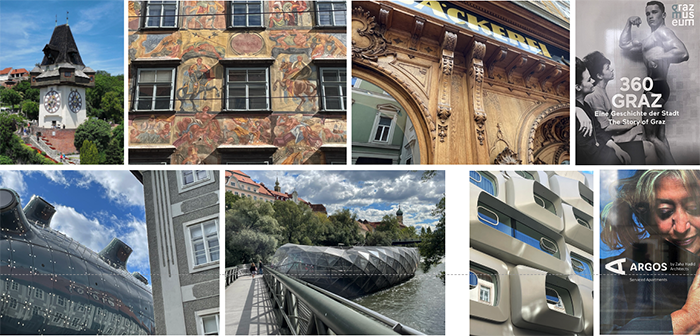
Also, as Graz has a long history as a seat of innovation and creativity that welcomes pioneers in many artistic fields, our afternoon schedule included visits to contemporary architectural interventions such as the 2020 Argos residence complex by Zaha Hadid (the name deriving “from the myth of the Greek giant Argos with its hundred eyes”); the 2003 Murinsel in the middle of the Mur river designed by artist and architect Vito Acconci; and the 2003 Kunstmuseum designed by Peter Cook and Colin Fournier (Image 1). The latter two projects were completed in celebration of Graz as that year’s European Capital of Culture. Additionally, along the way, I was delighted to discover an exhibition poster about Arnold Schwarzenegger’s deep ties to Graz. The city has such rich history!
Barometer pavilion
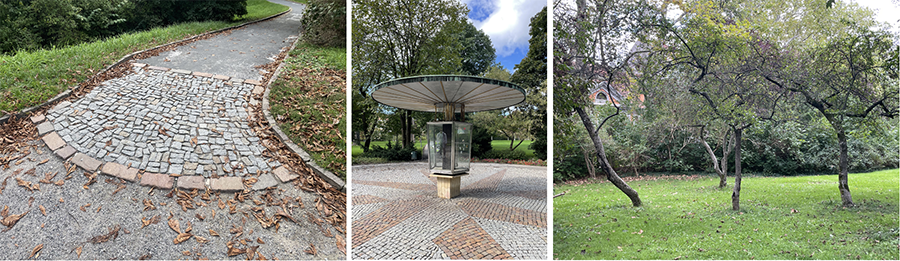
At the end of the day—after gaining a deep appreciation for a city I had not previously visited—I was walking through the city park to join our bus, which, because of the festivities downtown, had to pick up our group a little farther away from the city center. Admiring the grounds of the park that defined the inner limits of the former glacis—open spaces left after the fortification walls were removed—I noticed a small strange pavilion (Image 2).
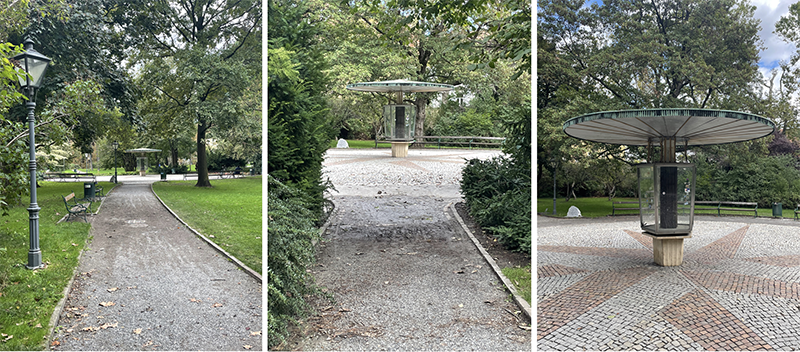
Located at the center of an elegantly designed radial plaza, the pavilion was partially surrounded by facing park benches. I immediately admired this discrete structure without knowing much about its purpose. The clarity of the architecture was what drew me to look at it closely.
It had an elegant yet not domineering presence formally defined by a tripartite division between base, shaft, and canopy. In a certain way, the pavilion was like a classical column that articulates each component with great clarity offering a seamless continuity between each of its parts. In particular, I admired the transitions between the base, the five-faced shaft, and the overscaled slim circular canopy. At a closer look, each of these components was structured by a central concrete column that was revealed with a sense of nakedness underneath the canopy (Images 3 and 5).
Three components of the pavilion
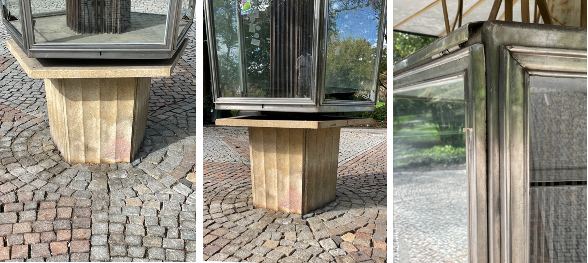
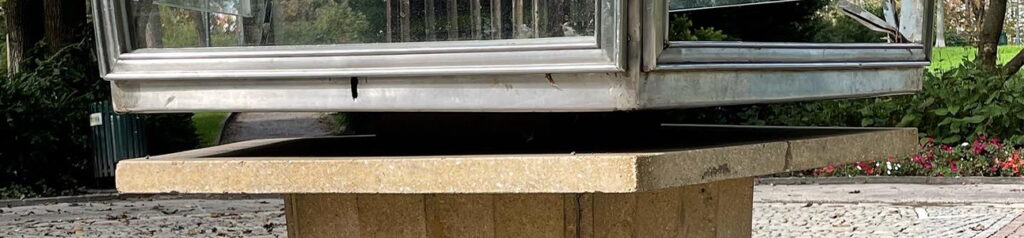
The base is made of five stone panels, each articulated by concave vertical grooves. This treatment counteracts the base’s stumpiness by offering vertical slenderness through an interplay of light and shadow, not dissimilar to the treatment of a classical column. A corbelled horizontal flat stone covers the base with a five-sided edge that introduces the five vertical glass vitrines. A gap above the stone, double the size of the corbel, gives the illusion that the display case is floating (Image 4).
The central shaft of the pavilion features five outward slanted vitrines (empty at the time of my visit) in a hexagonal shape. Fabricated similarly to windows with slim extruded frames, butt-jointed corners, and a silvery-gray finish, the construction is reminiscent of 1950s casement windows: modern, post-war, with a mid-century clean-lined aesthetic. Further research confirmed that indeed, the pavilion was erected in the 1950s replacing a previous one from 1878 destroyed during World War II. Walking around the pavilion, I discovered a keyhole and hinges on one of the vitrine panels that allowed it to be opened vertically. The inside column is ribbed, no other items were present to give me a sense of the pavilion’s purpose.
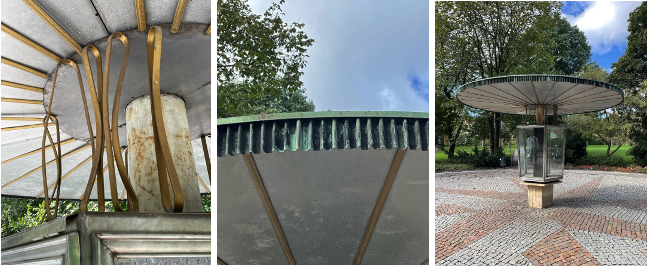
The mushroom-like circular canopy hovers over the vitrines and features a generous transitional element made out of what seemed to be brass due to its yellowish-gold color. At the time of my visit, some of the belt-like shaped ornaments linking the canopy to the top of the vitrines were missing, but originally, they seemed to have been placed underneath each of the ribbed structures which give rigidity to the canopy. The treatment of the edge of the canopy—reminiscent of the base’s treatment—is elegantly articulated by a copper frieze that has acquired an oxidized soft green patina that only time could have brought to life. As much as I continued to admire the pavilion, at this point in my visit, and contrary to the reader of this blog, I was still in the dark regarding its function.
Wetterhäuschen/weather station
Back at home, I conducted some research and discovered that the purpose of this pavilion—and many other freestanding pavilions in other cities—was a weather station. Furthermore, I learned that in German they were called Wetterhäuschen (little weather houses or in French borne météorologique) and were common in European city parks allowing everyone access to weather data. What an ingenious way to inform citizens who, at that time, did not have access to radio, TV weathermen, or contemporary digital apps on their cellphones.
Housed in the vitrines were meteorological gauges such as a barometer (air pressure); thermometer (temperature); and hygrometer (humidity). As city parks emerged during the 19th century as a gift to the citizens, what a great way to share daily weather data in an analogical manner, as part of a public service to make scientific knowledge visible and accessible. Progress in science was on display in the public realm, and this came along with the professionalization of meteorology that took place between 1870 and 1920. Scientific authority and a marker of modernity—both to a certain degree being a trust in objectivity—were at play with the function of this urban piece of furniture.
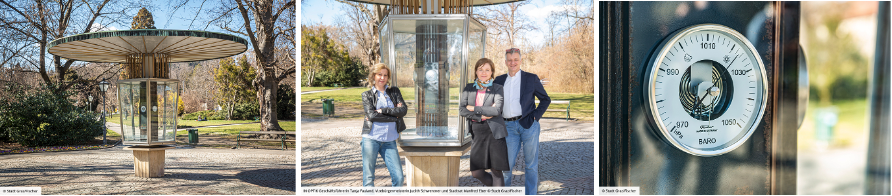
I am pleased to read that since my visit in 2022, the weather station pavilion erected in 1955—which is listed as a historical monument—has been renovated and can proudly stand for a new generation of users.
Conclusion
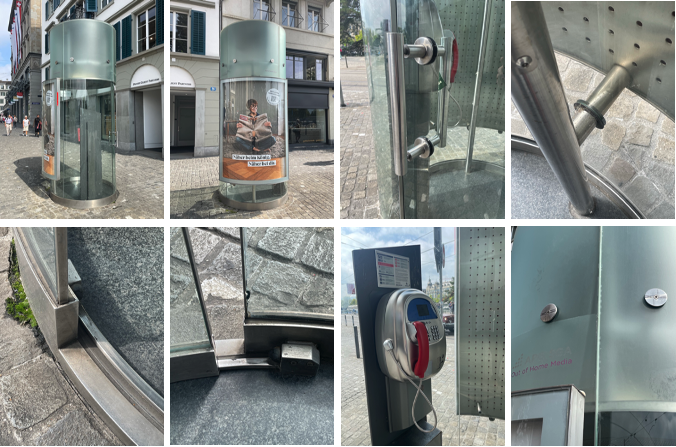
I will admit that I have always sought out urban artifacts that had a public purpose. Most of them, such as early ornate gas and electrical lamp posts; drinking fountains; public urinals and restrooms; telephone booths; bus shelters; advertising columns (called Morris columns); newspaper kiosks; public clocks, public benches and planters; mailboxes; litter bins; tree grates; bollards; bicycle racks; and to a certain extent metro entrances, have over decades given me much pleasure to document. Many of them, in particular in the city of Paris, are edicules or follies. My discovery of the weather station in Gratz has brought a new pavilion type into my repertoire of urban artifacts.
Happily, many of these urban furniture pieces have survived as design problems, and I am pleased to see that many of these artifacts have been reborn through the talent of some notable contemporary architects (Image 7, which will be the topic of a future blog).