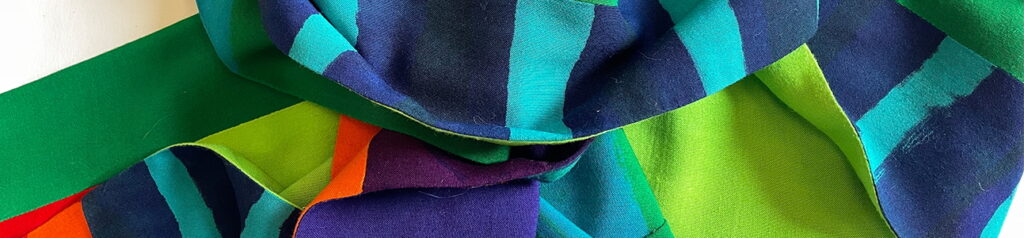
Collection of men’s scarves. Now that we are in the midst of snow and ice, it is again time to dress appropriately by wearing warm clothes when venturing in the below freezing cold. While we all have in mind what our favorite winter clothing is, I love wearing scarves. I own a collection that I wear on a daily basis—and may I say, also inside as I keep the temperature of my home rather low.
Let me state that contrary to most architects who favor curated black, white, and gray shades for their ubiquitous dress code, I have always enjoyed bold vibrant colors. However, not necessarily for pants (although I had a pair of deep saffron colored one’s that I loved), shirts, or jackets, but mostly for accent elements such as socks, ties, and scarves. They bring me joy as an important accessory and display something different from the architects’ stereotypical black outfit, accompanied, of course, by a Moleskin sketchbook and minimalist pen or pencil holder. By the way, also all in BLACK!
But let me not fool myself in my critique. In my own way, I am not defying the “all black” stereotype as my approach to style remains similar to a personal signature. I just favor more colorful accessories.
My first scarf
Years ago, while presenting progress on a renovation in NYC, I remember my client acknowledging that something was missing in my winter look and graciously offered me my first wearable piece of art. Practically drug uptown by Lynn, we marched up Seventh Avenue to Barney’s flagship store. I had heard about this iconic New York mecca of exclusive clothing, and here I was with my client, shopping there for the first time.
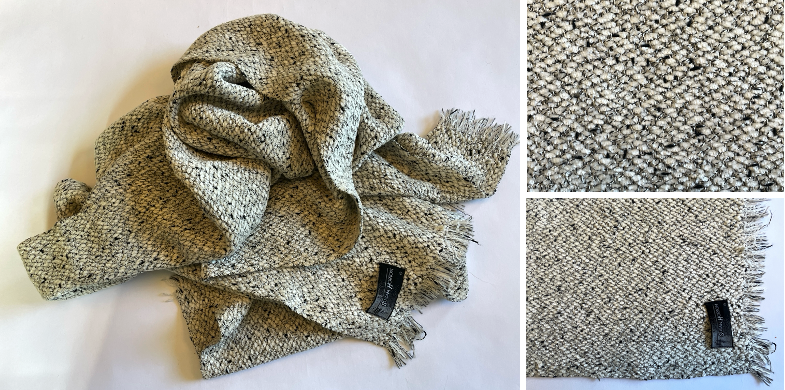
The errand was swift, and without a blink, I was now the proud owner of a Susan Horton scarf marked with her distinctive black label. I continue to cherish this scarf, which is part of her 1980s collection, and just shy of forty years, it is still as beautiful as the first day. Sentimentally, it reminds me of my first project for wonderful clients in New York City, and how I felt part of something very special.
The color of the scarf is a light grey to white with little black flecks (very architectural…). Made from chenille rayon—which has a soft and lustrous ‘caterpillar-like’ fuzzy texture—the weave is part of Horton’s unique identity featuring a knobby heavy texture with small silver threads that lend it a luxurious feel and drape.
Other ones followed
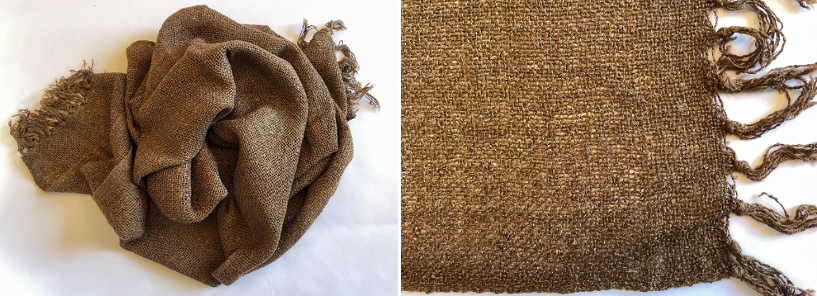
The second one, which was equally gifted to me, but this time from a friend in Switzerland, is a wonderful alpaca scarf. Alpaca is the name for a small relative of the camel found today mostly in the Andes of Southern Peru.
The softness of the fiber, and the warmth, and durability (after 30 years there is still no pilling) is unparallelled and often said to rival or exceed the qualities of cashmere. My friend Gisele has always lived a life close to nature, thus her interest in giving me a scarf made from alpaca, as it is hypoallergenic and eco-friendly. The scarf was not dyed and thus the fibers maintain their natural chocolate brown color, with the beautiful and extremely light weight textural quality of the weave.
Carmen Grier
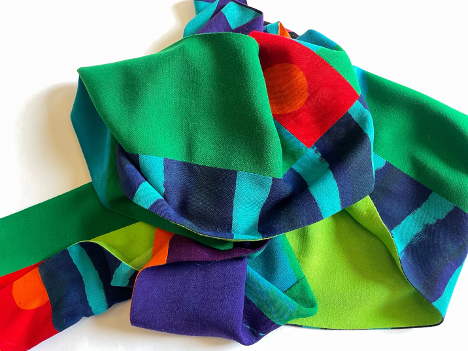
And now we get to the colorful scarves! Living in Lexington, Ky, I was fortunate to meet many artists who became life-long friends. Mike Goodlett, Arturo Sandoval, and Louis Zoeller Bickett II to name a few. Louis was well connected to the art scene, and we also knew him as our favorite waiter at the eclectic French restaurant A La Lucie. We collected his art, and he introduced me to his friend Carmen Grier, who at that time was creating fabulous scarves from cotton and chenille.
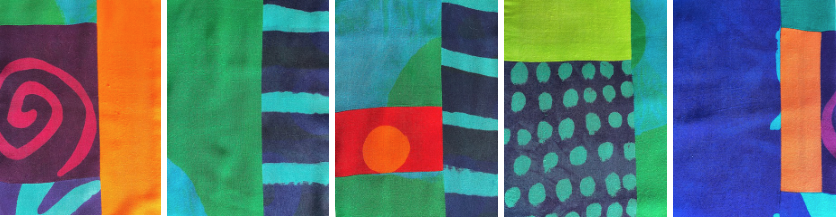
Three of the scarves that I have celebrate saturated high-contrasting colors with bold geometrical designs: lines, circles, spirals, and polka dots showcasing rich reds, oranges, greens, deep plum, and blues that are juxtaposed forming a striking and festive composition. At times, Grier uses solid fields of color that almost emit light (e.g. warm orange) to counterbalance the dynamic movements of her forms paired with the more structured intention.
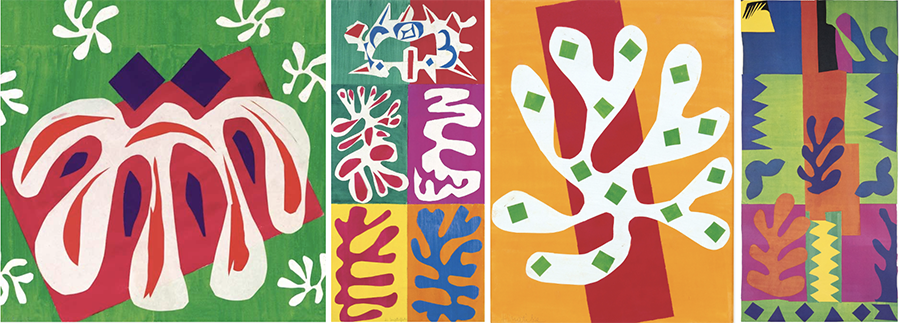
While Grier credits her inspiration in nature and to painter Paul Klee, I find her creative outbursts in these scarves to be similar to the work of Henri Matisse; many of the geometries are painterly in their form and seem at times like cut-outs set on abstract fields of color. The mood of her scarves is festive, musical, explosive, AND such a treat to wear.
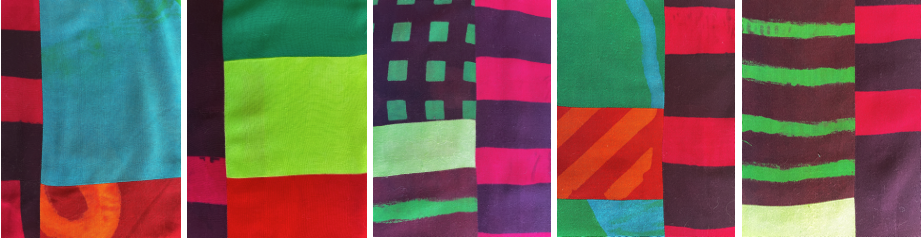
This artistic contrast of patterns is achieved through the stitching together of printed patches punctuated by long stretches of various sizes of fabric. As Grier humbly states: “The intricate piecing is meditative… I really look forward to it. All the different steps allow me to understand what I’m working on. If the process were fast and immediate, I don’t think I could get the same results. I need all that thinking time.”
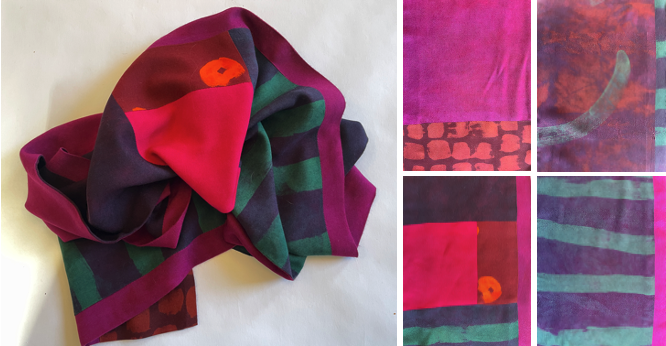
Grier’s intricate process is about dyeing most of her yarn, printing the fabric, assembling it by folding the carefully chosen pieces, then sewing and ironing them together with the seams open into a large composition so that they speak to each other. Each color panel complements and graphically challenges neighboring fields of color thereby creating a symphony where each player (pattern) has a key role in the overall composition. This technique is visible if you slip your hand between both sides of the scarf and look inside at how meticulously it is sewn together.
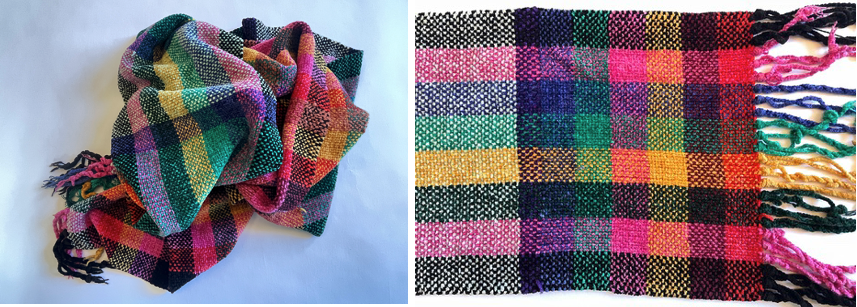
The last scarf I have of Grier’s is woven from a chenille yarn, and its colorful checkered pattern cannot be overlooked. It is very soft due to its fuzzy fabric which is made by twisting the yarn together. One sees this when looking at the tassels.
Indian scarves
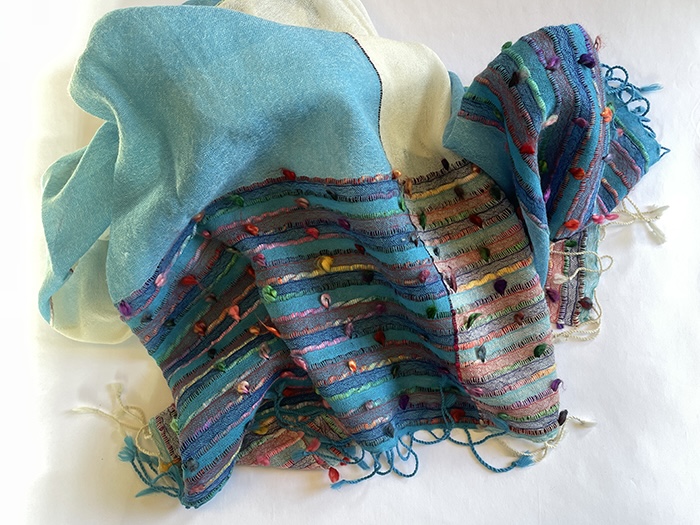
I also have a nice collection of cotton and silk scarves purchased at the famous Dilli Haat market in a southern neighborhood of New Delhi. The open-air craft bazaar comprises artisans mostly from Rajasthan and the northern disputed Kashmir region of India. The cornucopia of items found at the market has never disappointed me, and at each visit, I return to the hotel with traditional Indian folk-art mementos ranging from scarves, Indian stuffed animals, Kurta pajamas, saffron, and other gifts for friends.
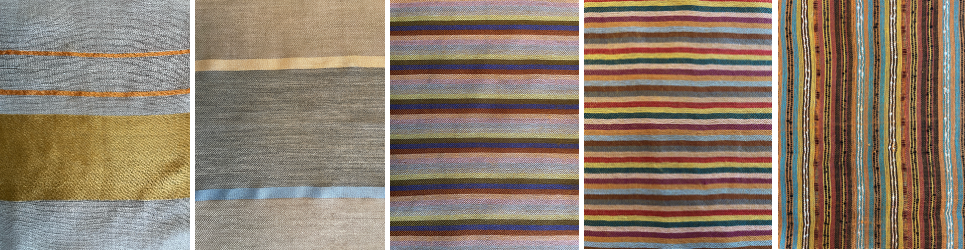
This particular market is known for selling items from the Indian Cottage Industry. These products are traditionally handcrafted, honoring skills passed down through generations of rural families, mostly women working at home or within their communities. I like to shop at Dilli Haat as I know that my money makes an impact on their communities, and this beyond that I love most items found at the market’s numerous stalls.
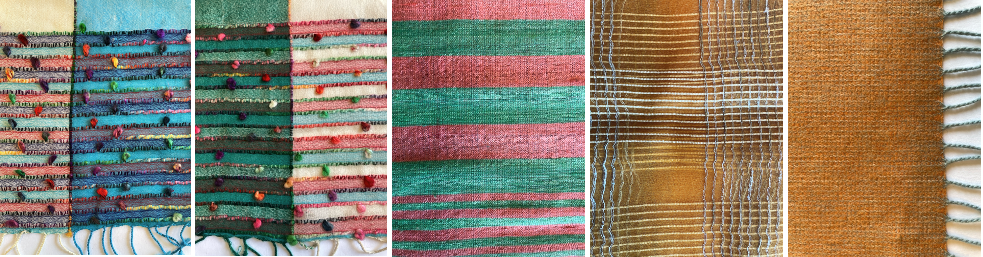
Some scarves that I have left after giving many to friends, have a playfulness in their texture and color combination. Others are more traditional in their horizontal striping but are nevertheless beautiful in their own right. I believe that not every scarf has to be like a Carmen Grier or Shaker crazy quilt.
I also own several scarves from India that are very large and used my men almost as shawls during the winter season. It gets cold and the need to have thin, yet very warm clothing has given these shawls an essential function beyond their modest beauty.
Bhutan scarves
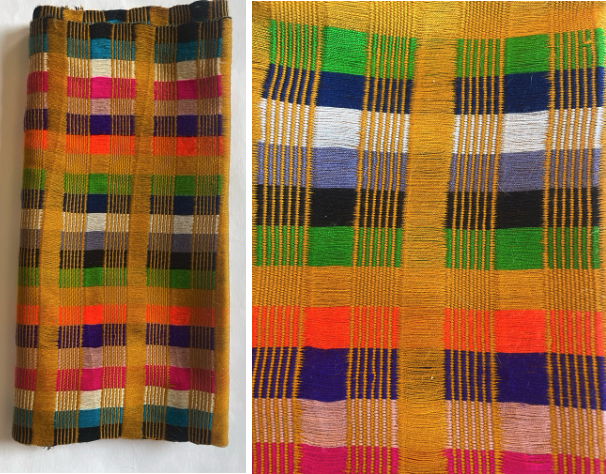
Recent scarves come from Bhutan via Hong Kong. Being an architect and fond of Billie Tsien and Tod Williams’ work, I paid a visit to the Asia Society Hong Kong Center (ASHK). At the store, I discovered a handmade scarf whose colors where like sunshine (Image 3). The scarf is a typical Bhutanese handwoven textile, with a bold mustard-yellow background weave. Within this color scheme emerges a checkerboard design showcasing small square pattern blocks of green, indigo, white, lavender, black, coral, and magenta. Each square is made of bands of colored cotton framed by both large and narrow yellow striping. Certainly, a contemporary interpretation of traditional Royal striping patterns.
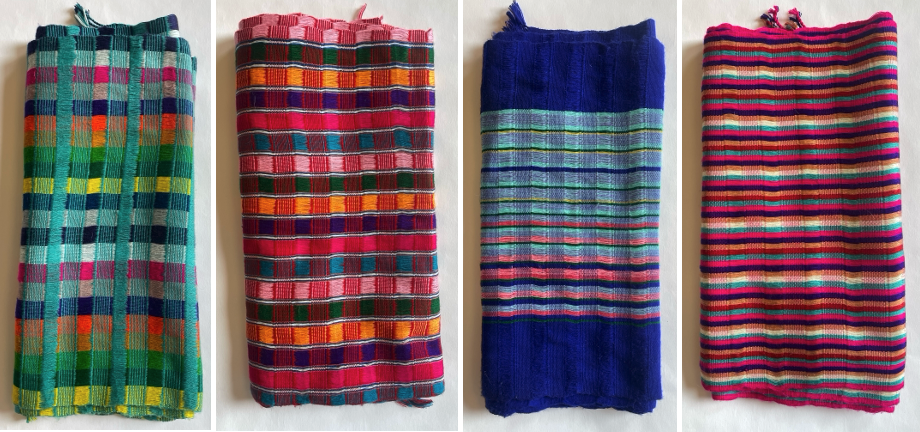
I fell in love with the intricate patterns and richly decorative colors, and during subsequent visits to Hong Kong, I started collecting other Bhutanese scarves found at the museum store. Two are similar to the sunshine motif but with green and red highlights, while the third and fourth scarves rely more on a combination of thin and large horizontal stripes of different colors. All scarves end with tassels on each end and a very specific loose undulation in the weft giving a beautiful texture (Image 3 and 4). But beware of pulling on them, especially men who wear a 5 o’clock shadow.
Lithuanian scarf
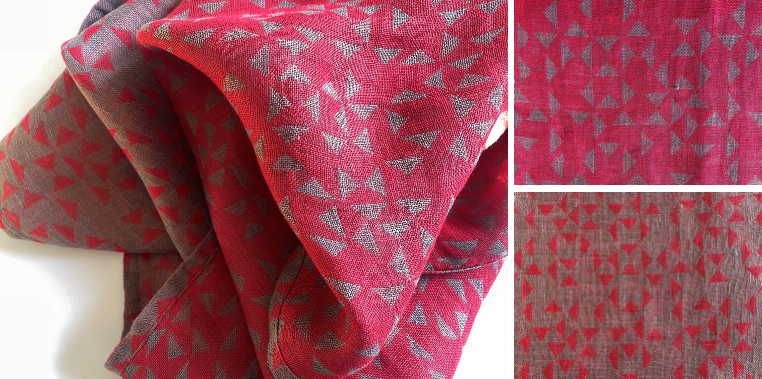
My last purchase comes from Lithuania. Visiting the city of Kaunas with an eye toward its unique modern architecture, I discovered a store featuring local products. I loved the texture, and the triangular pattern which give both sides a distinctive look.