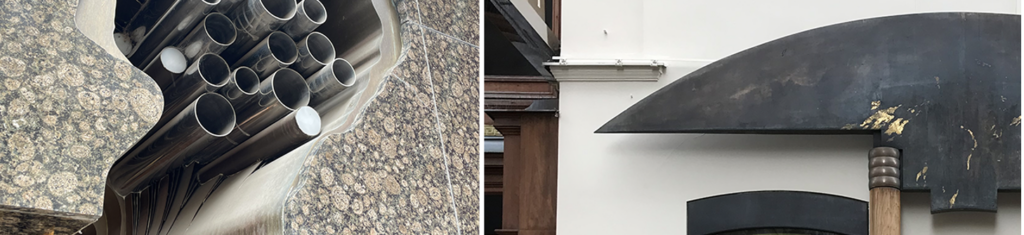
Revisiting Hans Hollein Schullin 1. During a recent trip to Vienna, Austria, I rekindled my connection with two iconic retail projects by Austrian architect Hans Hollein (1934-2014; 1985 Pritzker Prize laureate). I have always admired Hollein’s talent and deeply Viennese approach to the design of these early stores; projects which rapidly became signature interventions in the city center of Vienna in the mid 1970s and gave him the international notoriety that would carry throughout his entire life.
I am referring here to the two jewelry stores Schullin 1 (1975) and Schullin 2 (1982), omitting deliberately in this blog the Retti candle shop completed in 1966 (Reynolds Memorial Award that year) and the Christa Metek Clothing Boutique (1967). The latter two commercial retail spaces (Image 1 and 12) are equally important but are part of an earlier language that will resurface later in his more mature work (e.g., Hass House opposite the Stephansdom).
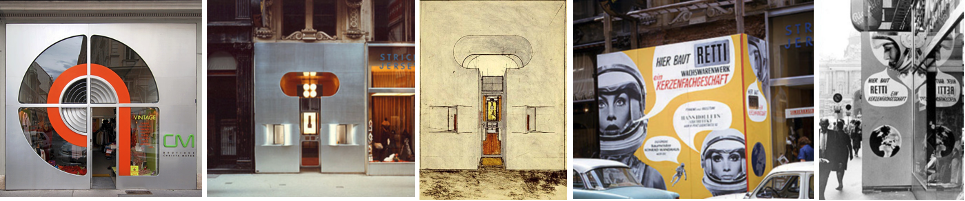
Schullin 1 and Schullin 2
The Schullin stores have not changed much since I first visited them in the early 1980s while a student in architecture at the EPFL. In fact, and retrospectively more than ever, they remain for me vibrant, contemporary, and elegant. They are quintessential examples of Hollein’s unique, and contextually rich designs (in a cultural and historical sense). The stores emanate from a highly theatrical design philosophy, which made him a pioneer of postmodern architecture. Also, key to the success of Schullin 1 and 2, is how he achieves a timeless quality through a powerful conceptual and symbolic approach rather than adhering strictly to trends.
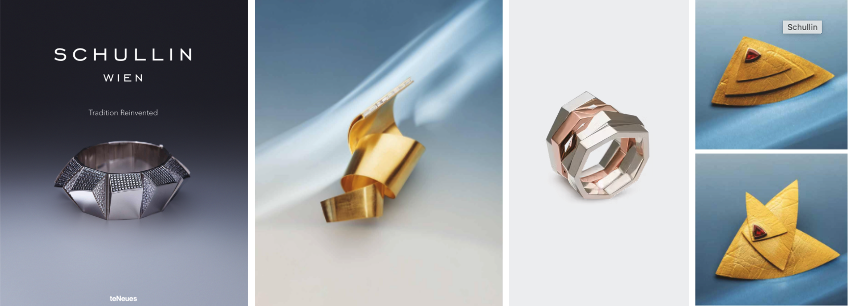
Both stores were commissioned by Dr. Herbert Schullin, the third generation of the family-owned Viennese jeweler, known for his progressive architectural and sculptural designs, a high-caliber craft often coined as “wearable art.” Call it reinvented jewelry, Schullin’s family business has been at the avant-garde of luxury jewelry in Europe since 1902. They were famous for their creation of memorable geometric pieces of great clarity, brilliant form, material, and color for some of the world’s aristocratic and contemporary elite.
In this context—which arises from a Viennese tradition of patronage by the upper middle class and which is often intellectually driven, not dismissing other patrons throughout Europe and the world over centuries—it seems particularly fitting for Hollein to have designed both stores for Schullin. His overall approach was clear: to challenge the aesthetic narrative of modernism (International Style) as neutral, mass-produced artifacts relying on functional approaches with a quasi-obsessive faith in standardized technology.
Here, on the contrary, Hollein favored a more Viennese historical exuberance imbuing each store with defining gestures of great meaning and symbolic value. In fact, this was much like the Schullin jewelry collection throughout the century, particularly those art pieces produced from the early 1970s onward (Image 1).
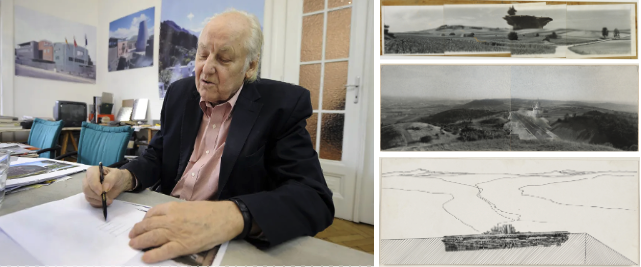
Hans Hollein
Hollein’s early built work is heir to what we call speaking architecture—i.e., “…buildings that visually communicate their purpose or meaning through their form, details, and decoration…”, or, as defined in a more contemporary manner, buildings that encapsulate architecture as mediatic interventions (e.g., Rem Koolhaas)—anticipating (in Schullin 1), and representing (in Schullin 2), the values of a postmodern attitude of quotation. In both jewelry stores, Hollein deliberately reframes the past, and embraces a mixture of different and often complex and contradictory styles by returning to another marker of taste; one of renewed refinement and historical connoisseurship which favors projects at a small human scale. A notion of pluralist forms espoused by postmodern architects.
The belief that everything needs to be new without reference to the past seems absent in Hollein’s built work. However, prior to his built work, Hollein gained fame early on by teasing the establishment by proposing conceptual drawing, collages, and polemical manifestos (e.g., in 1967 Hollein declares “Everything is Architecture”) that questioned the nature of form and function (Image 2). But it is within the built work that we comprehend the fascinating arc of his development and synthesis, as he matured to become a Pritzker Prize laureate.
Viennese exuberance
I mention Viennese exuberance, as Hollein is heir to key architects and artistic movements such as the Wiener Werkstätte, Secessionist movement, and pictorial symbolism that were associated with the turn of the century in Vienna. In these movements, each in their own way, architects such as Max Fabiani, Josef Frank, Adolf Loos, Koloman Moser, Joseph Plecnik, Joseph Hoffman, and Otto Wagner to name a few, blended historical styles with the use of modern materials in often unexpected aesthetic and constructive ways.
Each of these architects promoted the fundamental modern ideas of a Gesamtkunstwerk—a fascinating historic time where works of artistic synthesis brought aesthetic and social ideals into one unified vision that often were translated into elaborate interiors, built-in furniture with fold-out desks, reverence for detailing, attention to the proportion of windows, and more domestic items such as umbrella stands and clothing.
In this movement, artists, designers, and architects worked with artisans, weavers, printers, and metal craftsmen to envision a new language. Most of their work was brought to bear on the creation of buildings, art, furniture, household goods, posters, films sets, clothing, fabrics, ceramics, wallpaper, and books that transcended the mere functionalism favored by pure modernists.
Hollein is the recipient of this rich tradition of pioneering Viennese architecture at the turn of the century as perceptual, haptic, and sensual. The two above mentioned stores, in particular the treatment of the facades which are the topic of this blog and the following one on Hollein’s second store for Schullin, are key to understanding Hollein’s reverence: in particular to Adolf Loos, Joseph Hoffman, and Joseph Plecnik.
Schullin 1
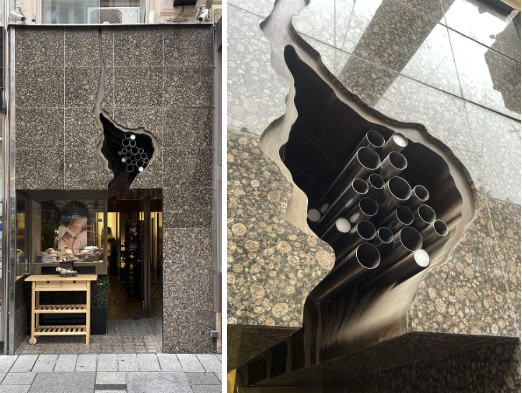
Located on the Graben in central Vienna—an historic and prestigious commercial pedestrian streets—one is immediately drawn to the most prominent feature of the store’s façade. Namely a striking incision within the upper part of the façade that is almost like a bronze sculptural sign above the entrance that develops into the door’s design. This continues through to the interior ceiling of the store. This carved out landscape blurs the lines between art, architecture, and commerce, metaphorically suggesting the layering of geological stratifications from which Schullin’s architectural jewels are similarly carved out of precious stones and metals.
This sculptural sign accompanies the entrance to the inner store. In fact, the store acts almost as an elongated mass of black granite from which the exterior and interior have been excavated. I previously mentioned Adolf Loos as it seems noteworthy that catty-corner to Schullin1 is the famous Knize store by Loos, and a little further up the Kohlmarkt is the bookstore Manz, also designed by Loos, and off of the nearby Kärtnerstrasse is the American Bar, nicknamed the Loos bar. Of course, there is the Loos Haus, perhaps the most mature among these projects. I allude to these interventions by Loos as Hollein seems to draw clues from the nature of the Knize façade.
Both Knize and Schullin 1 stand on a limited urban lot size, and the way the entrances are treated build on a spatial void where curiosity brings the customer halfway ‘within’ the store. In Loos’s intervention, symmetrically positioned large display windows inflect towards the entrance. This is reinterpreted in Schullin 1 with a more opaque and domineering façade. Looking at the three facades (Manz, Knize, and Schullin 1), one can almost see a natural progression where the vitrines in Loos’s projects brought the edges (Manz) to frame the entrance (Knize), ending up asymmetrically within the depth of the entrance by Hollein (Schullin 1).
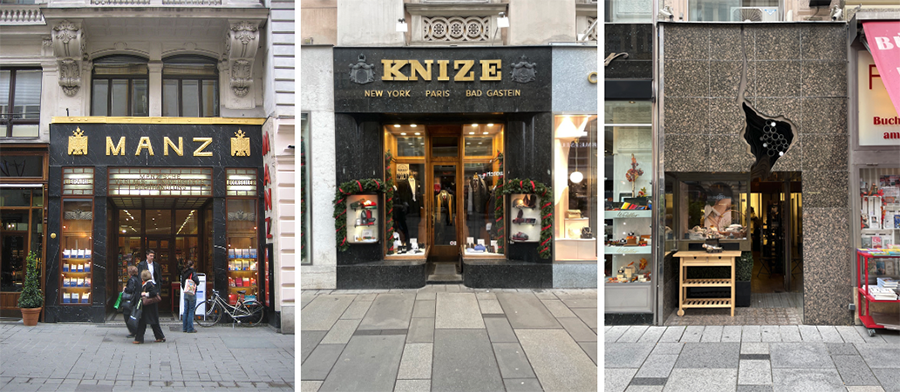
Also, in Loos’s Manz and Knize interventions, a stark black marble façade gives gravitas through an abstract spatial reading of the exteriors compared to the more exuberant and rich material development found within each of the interior spaces. This strategy refers not only to Loos’s above mentioned commercial stores, but to his domestic interventions such as the Steiner House (1910), the Scheu House (1912-13), and the Strasser House (1918-1919), all three located in the Hietzing neighborhood of Vienna. Each house exhibits a stark plain exterior while developing an inherent interior aesthetic richness based on high-quality materials.
Here in Hollein’s work in Schullin 1, contrary to Loos the interior exuberance registers on the façade to tease the flaneur’s curiosity to approach the store, admire the jewelry presented in the cantilevered window case, and ultimately entice them to enter the store and select the piece they no longer can live without.
The interior built-in cabinets in the store remain similar to the original design. This is true as well at Schullin II as I understand that they are protected by landmark status. Once again, like Loos and other Viennese architects of that period, Hollein favors elaborate built-in-furniture to maximize space that promotes an integration of furniture and storage. However, sadly, the ‘movable’ furniture such as tables, desk, chairs do not match the original design intentions.
Back to the façade
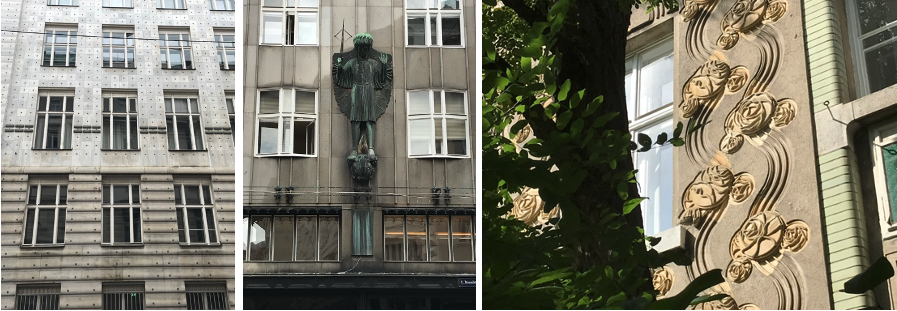
The strong frontality of the façade is a stereometric play on a solid volume that is built from horizontal rectangles set flush with the neighboring stores. While I previously mentioned that the black marble cladding is reminiscent of the nearby Knize store by Adolf Loss, here, Hollein reference two other juggernauts of Viennese architecture, namely Wagner and Plecnik. Contrary to the nearby Postsparkasse by Wagner and the Zacherl House by Plecnik where rivets expressed the construction technique of fastening the skin to the building, at Schullin 1, the marble is simply mounted on a frame with no expression of construction (Image 7 and 8).
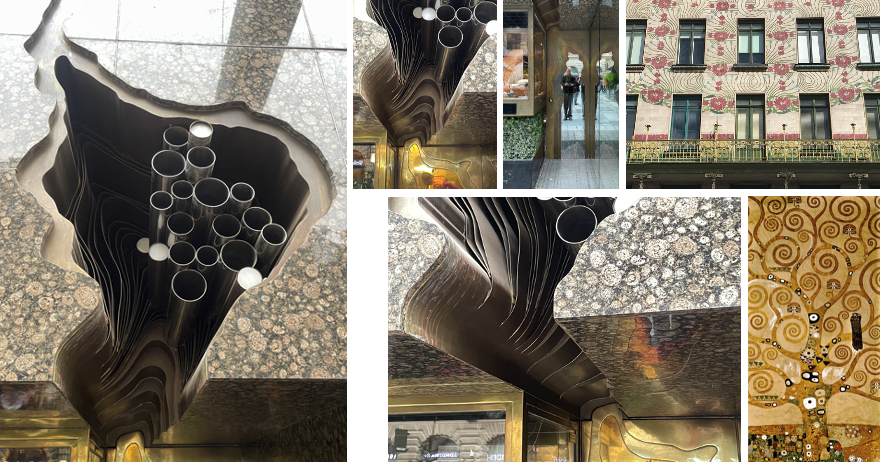
I remain mesmerized by the subtle choice of the marble that presents such a beautiful and delicate pattern, almost like a field of flowers. In fact, conjecturally, I see in Hollein’s meticulous choice of materials, a clin d’oeil to the delicacy of Gustav Klimt’s symbolic painting titled Tree Of Life or the facade of the Majolikahaus by Otto Wagner (Image 7 for right)
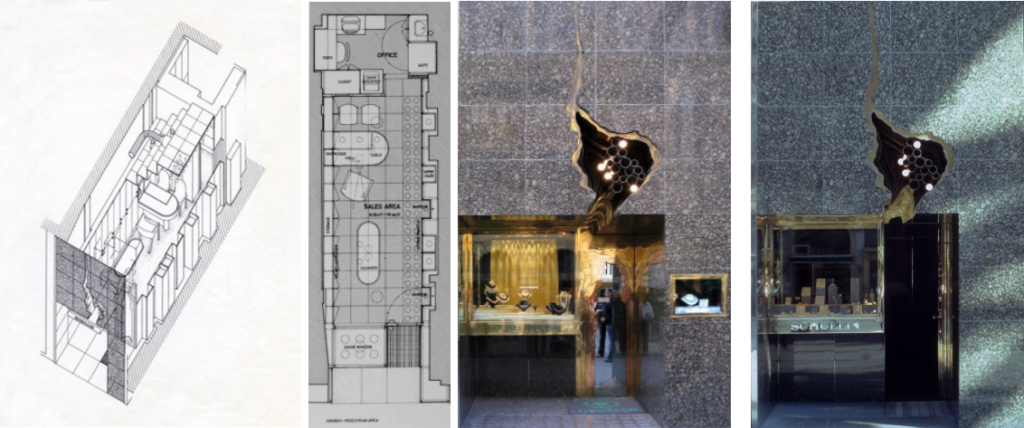
Researching the history of the store, I found an early photograph depicting a small display window framed in brass to the right of the entrance (complementing the entrance and larger display window to its left) (Image 2, center right). This shadow box which acts almost as a little theatrical stage for the presentation of jewelry, was present in the original 1974 building owned by its first client Dr. Herbert Schullin. However, already during my first visit in 1981, the small presentation show window had been removed (Image 5). Today, one sees that three original panels to the right of the entrance have been replaced (Image 6 right).
It is interesting to note that the above axonometric and plan (Image 5) depict the store after the removal of the presentation window. I have been unable to locate any original drawings that include the missing showcase.
Entrance door
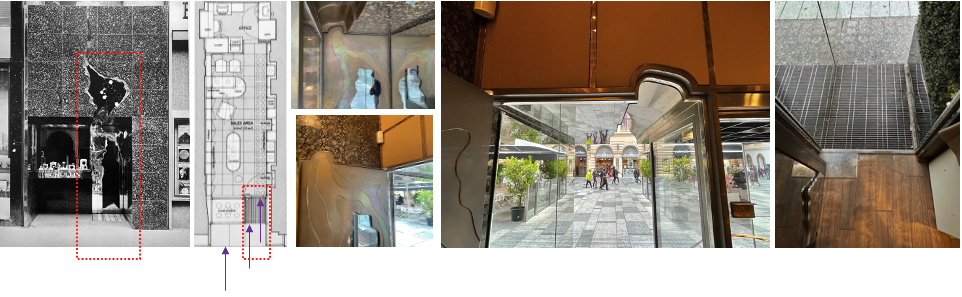
While the magic of the sculptural element defines the façade, its symbolic nature also has a functional and tectonic purpose. Namely its development towards the entrance door (Image 8 with arrows), which resonates with the spatial narrative of the actual physical door, echoing the sculptural sign on the façade. This creates a spatial continuity throughout the interior. The threshold becomes spatial lending the impression that you are part of, and integral to, the symbolic element of a geological stratification.
Conclusion
In conclusion, my findings expanded to Hollein’s next store and Schullin 1 cannot be understood without Schullin 2, which I will explore in the next blog.