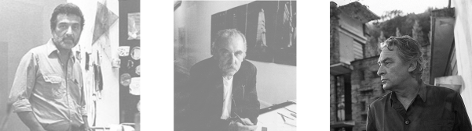
Leonardo Ricci. This blog concludes my thoughts on mentors, the three who have made me who I am as an architect and educator. Following blogs on two of my professors, Robert Slutzky at the EPFL and Raimund Abraham during my year at The Cooper Union (Cooper), I want conclude with Leonardo Ricci who I met as a colleague at the University of Kentucky.
While unable to fully describe my feelings towards my profession, I was always committed to becoming an architect. But what did this truly mean for me is something I still cannot fully explain. I mention this because often during casual discussions with my students and prospective students, the obvious question arises: When did I have my first inkling about being an architect? My answers are rightfully ambiguous as I continue to have difficulty to pinpoint the origins of my decision. I cannot answer this question rationally or authentically. I just knew that architecture was my calling. It came naturally to me without much bravado, or because of parents being coercive, or emulating my admiration towards famous architects. Architecture always seemed what I wanted.
He [Ricci] was a man who knew how to go through the ages, the philosophies, and the nations, and from these he drew the fundamentals to build a personal vision of the world and the practice of architecture
From Leonardo Ricci 100, Writing, paintings, and architecture,
100 side notes on anonymous (20th century)
Preamble
My schooling at the EPF-Lausanne (EPFL), Switzerland prepared me well to practice architecture. This was what one had trained us for, particularly since at the end of our six-year studies, we gained licensure upon graduation. After the completion of my studies, I attended Cooper in New York City for an additional year, with the full intention of returning home to form a practice in Switzerland. Yet, the notion of home as a place to return to, became uncertain as I had at that time serious doubts about where home was truly located. This was because I felt like a nomad and a traveler, and not a tourist. I had always enjoyed moving from place to place with occasional destinations in mind that kept me grounded.
Coincidences in life taught me how small and interconnected the world of architecture is. While working in a Manhattan office, I received a phone call from Dean Anthony Eardley (Tony) who encouraged me to come teach at the School of Architecture at the University of Kentucky.
Fast forward. Tony’s invitation ended up with me being just shy of twenty years there; a period where I grew from a visiting lecturer to the rank of associate professor, and accumulated fond memories of students, many who became life-long friends. While learning a great deal from my colleagues about how teaching could unfold, I at the beginning of my tenure was able to balance teaching with an emerging practice, although upon receiving tenure I was sadly obliged to distance myself from the professional world. Academia was not what I had experienced during my studies in Switzerland, as faculty in Lausanne were excellent teachers all the while owning or working in an office. Here in the United States, at that time publish or perish— a common saying in academia—became a reality that tainted my ideal of being a teacher.
It was during those early years in Kentucky (1987-1995) that I met two Italian architects: Maria Grazia Dallerba Ricci (Pucci) and her husband Leonardo Ricci (Leo). This blog is dedicated to Leo, despite that that his later work is indissociably linked to Pucci who deserves a blog in her own right. With my two other mentors (Slutzky and Abraham) I can complete the trilogy of mentors that ushered me into a lifelong journey, setting in place my fundamental stand about the relationship of life and architecture.
Leonardo Ricci (1918-1994)
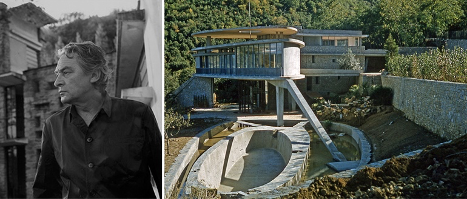
While my previous two mentors were instrumental during my formative years as a student, Leo had a remarkable influence on the early part of my academic and professional career. As a young teacher, I was thrown into my new academic setting where sadly mentorship was quasi absent. Fortunately, Leo offered invaluable guidance, giving me support, advice, and encouragement during pivotal moments of self-doubt. As we were both European, I had confidence in Leo’s ability to help me navigate the larger question of where my career was to unfold, in Switzerland or in the United States. This in particular as I assumed that Leo had similar questions when he had his first teaching responsibility in the States.
I want to share what I learned from him, and how he allowed me to come full circle in my search for an architecture that I could humbly claim as mine. Years have passed, in fact almost four decades since first meeting Leo; an interval that seems today an eternity but remains as vibrant as if it was yesterday. I can still hear the tone of his voice that was deep and warm, always adjusting the intonations of English words to his Italian heritage. His pronunciation, rhythm and word choice contributed to an unwavering admiration and respect from the audience; we all felt like we were his sons and daughters.
University of Kentucky
For me, as well as for my colleagues and students at Kentucky, Leo was truly a master architect. He had trained during World War II under teacher and mentor Giovanni Michelucci at the Faculty of Architecture in Florence, where he met his future professional partner, Leonardo Savioli.
As with many architecture programs in America, Kentucky seemed at that time far away from the intellectual East Coast Ivy League institutions, and on the West Coast the emerging experimental formalism espoused by Sci Arc. But, for all its remoteness and prejudices, the commonwealth of Kentucky may have conjured, Leo had elected—after years teaching in Gainesville, Florida—(with stints at other institutions in the US) to unfold his teaching skills and Italian perspective in Lexington. The school may have seemed provincial to many neophytes, but under founding Dean Charles Graves followed by Dean Anthony Eardley, the architecture program at Kentucky was recognized nationally as of one of utmost excellence—and this prior to the now defunct Design Intelligence, the often-dubious annual survey program and rankings catalogue.
The University of Kentucky’s architecture program could legitimately brag that it had plucked emerging and talented faculty from programs such as Cornell, Cooper Union, Princeton, and as far away as the Architectural Association (AA) in London. All to train their students to think architecturally. Faculty who joined the program came to quickly appreciate the growing outstanding architecture program set in the middle of an idyllic Kentucky landscape.
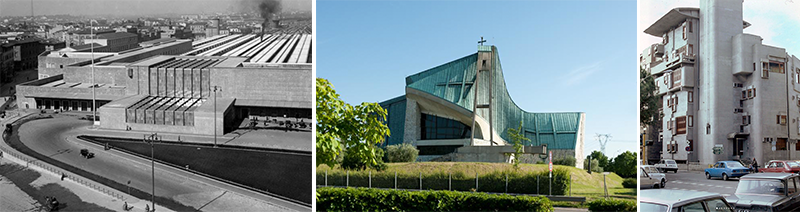
I was somewhat aware of Ricci’s name prior to arriving in the Bluegrass region, and this was because of my familiarity with the rational terminal train station in Florence (Stazione Santa Maria Novella completed in 1935), and the expressionistic Chiesa Dell’Austostrada del Sole (1963), both designed by Giovanni Michelucci. I was also aware of the Florentine brutalist apartment complex on Via Piagentina (1964), and the modern Giovanni da Verrazzano bridge (1970) over the Arno river by Leonardo Savioli and Ricci.
Although each architect carried different formal languages (read grammar) throughout their work, they collectively drew my attention and admiration as a young architect, particularly in regards to their architecture as urban place makers, which made them leaders of the Tuscan school movement in architecture (also called the Florentine School). After meeting Leo, to my delight I was able to bring Michelucci, Savioli, and Ricci together in my mind; three key protagonists who were initially disparate but now constituted an Italian family in my understanding of post war architecture.
A trilogy in architecture
I was fascinated by Leo’s interconnected and synthetic approach to architecture, urban planning (always associated with strong expressions of structure as a spatial component), visual arts, and writing. All three disciplines were key to my understanding of his work and were intricately linked to his pedagogy as I developed my own teaching agenda. Already for me, and in particular with Leo, each discipline was not seen as an isolated endeavor. His knowledge of each allowed his teaching and professional work to be seamlessly integrated, which had a profound impact on the quality of life and the way people (primarily the users of his buildings) interacted with their environment.
As a seasoned pedagogue, he used his humanism to engage students as a community of learners, talking about the relationship between life and its meaning, and most importantly, about existence (let us not forget that he was an existentialist). What was so fascinating for me, is that students were intricately linked to his professional preoccupations. Unfortunately, I believe that this essential relationship between academia and the profession, is quasi absent in today’s university context, and makes—to my perspective—the education of an architect so much poorer. Leo generously shared that design was to enhance social connections and the well-being of the user, while never denying a disciplinary approach to the art of architecture. Students were the recipients of his intellect and were encouraged to think critically about the impact of their work (praxis versus practice) by considering the deeper purpose of their endeavors as future architects.
In this context, I remember during Leo’s reviews, that the critique of students included debates within a larger humanist framework. To encourage their designs to be successful, they needed to create a place for the inhabitant’s happiness to unfold. This was so essential for Leo, while simultaneously not denying the development of a project in plan and space. This brought forth Leo’s design process based on the trilogy of:
- Creating a model of life;
- The responsibility to give it structure;
- Which lead to finally giving the project and the spaces of inhabitation their form.
My first encounter with Leo’s built work
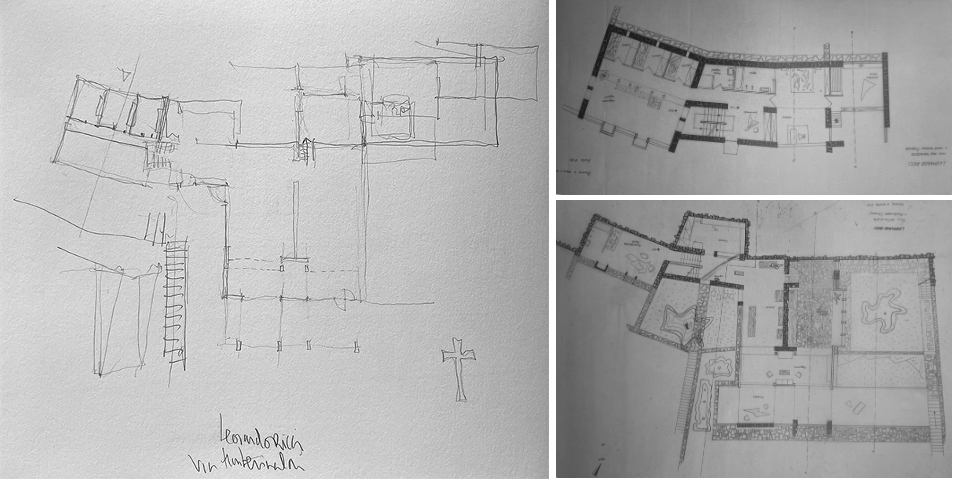
Before concluding on Leo’s design philosophy, at least how I interpreted it then and now, I would like to mention three projects that marked me profoundly. The first was his house and village-housing settlement in Monterinaldi north of Florence, Italy. I was invited for a visit and the above sketches, done by memory, gave me my first understanding of what Leo was trying to do regarding form. It was only later that I read an essay by Leo mentioning the impetus of how he thought about the birth of his house and how form should be found and not conceived as a-priori:
We chose a place which, although it was without gentleness and humanity, permitted us to experiment with a new way of living [model of life], in regard to the relationship between a man and his own house. The variety of a house and the process to the final form of a building can come about in a thousand ways.
I shall describe mine. My wife [Leo’s first wife] and I did not reason this way, for example: that we needed so many bedrooms, a living room, a kitchen, two baths, etc. We started from something different. We asked ourselves what it meant to awaken. How we would wish to open ourselves to the world each morning, to the life of a day. We asked ourselves what it meant to go to sleep, that is, to close our day. What it meant to eat, to be among ourselves or with friends. How to give the children their own private place to develop their own natures, and also a collective place so that they would learn to be with other, even if for now only among themselves.
Leonardo Ricci
Village of Monterinaldi, Florence
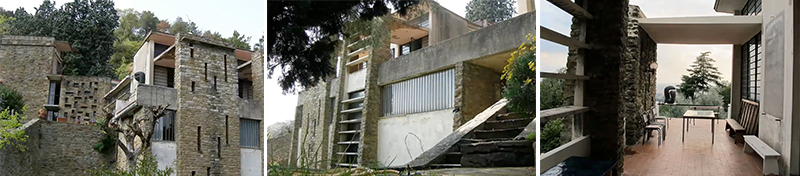
Without knowledge of the above excerpt, my visit to Leo’s house (Casa Studio Ricci) gave me an inkling of how his architecture engaged form as the generator of the project only after thinking of a model of life for its inhabitants. I later came to understand that Monterinaldi signified a vision that was influenced—as many of the architects of the Florentine School—by the material syntax of Frank Lloyd Wright; one where “the logic of construction impeaches gratuitous freedom of form.” Of note, this brings me full circle to my first semester as a student where we were introduced to architecture through vernacular structures, which is described in a previous blog.
The primary ingredient of Monterinaldi was the principle of settlement. Located on a steep slope, a village was created from a restrained set of building materials such as stone and reinforced concrete—a 20th century material par excellence that was favored by Leo in his latter work—and a profound understanding, and perhaps more appropriately stated, a poetic interpretation of the inhabitant’s required functions (human accommodations and needs) within a new program (model of life).
Jesi Cemetery, near Ancona
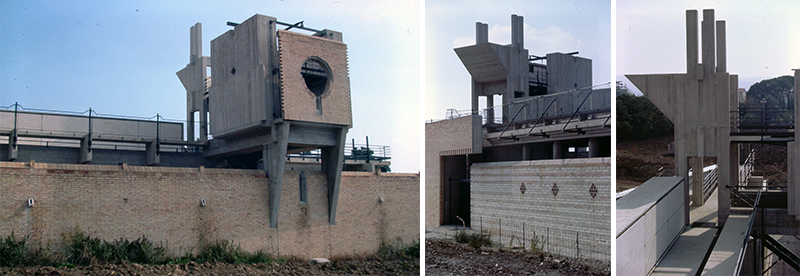
My second encounter was the experience of the Jesi cemetery, near Ancona. For me, it was and remains an icon among the many cemeteries that I have visited (Rossi, Scarpa
, and Miralles/Pinós). At Jesi, I was moved by the expressionist and figurative forms that came from Leo’s work as a painter. Platonic volumes that intersected, overlapping and teasing adjacent spaces and functions. Both of my visits took place during the construction of the first phase of the addition to the adjacent existing cemetery. I could see how each part became whole within the overall organization of the cemetery.

While I have not visited the completed cemetery at Jesi, and have only seen images, I admit that I maintain a fondness for the structuralist expression of form of the early stage of the project. Perhaps this is because I recognized the nascent and more exuberant expression of form—as defined as geometry with meaning—as it became a translation within a deeply rooted pictorial space of a model of life. The quasi obsessive affinity for figuration clearly emanates from Leo’s abstraction of the human body in many of the visuals in the cemetery, which are found primarily as elements of permanence in his paintings.
The lowest level of the cemetery is defined by a wall that that reaches below ground and acts as a metaphor of ancestral burial ritual. The structural system is one of compression, reflecting the first act of building which sets stone over stone to create a boundary. There, similar to a crypt, the dead were protected as if returning to Mother Earth (Image 3).
In opposition to this principle of compression, one finds at the top of the building the place of repose for infants, a dedicated environment using a structural principle of suspension suggesting the fragility of life for infants buried between earth and sky (Image 4 far right).
My second encounter with Leo’s unbuilt projects
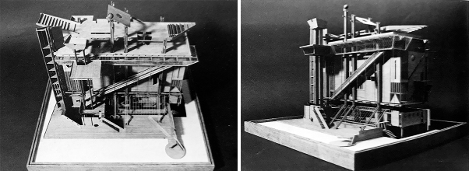
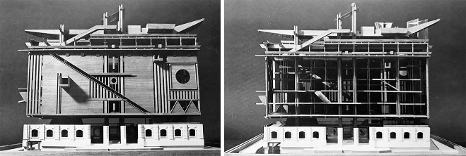
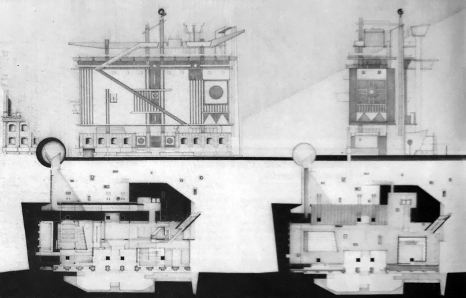
The two Venice Biennale projects, the Academia Bridge and the Peggy Guggenheim Museum addition (Image 4 and 5), stand out as Leo’s virtuosity par excellence. It was during my studies at Cooper that I came across these projects. However, I will confess that while I was overjoyed that my studio professor Raimund Abraham had won two prestigious awards at that year’s Biennale competition (ironically the Peggy Guggenheim and the Academia Bridge), there was something unique in Leo’s proposals that one could not avoid noticing. This was expressed through the strong figurative aspects of the façade, lending the pictorial effect of a Paul Klee or Wassily Kandinsky with their strong geometrical abstract forms, along with structural principles of compression, tensile, and cantilevers developed throughout the building.
Conclusion
It was only by being around Leo and his students and the privilege of teaching in Venice during two different semesters while he lived there, that I finally understood the larger picture of how Leo influenced me so profoundly. For him a model of life was always at the onset of any project. Beginnings were about examining the needs of contemporary living (habitat), public or private, and were looked at through the lens of unconventional ways of living. For him, this was never for the sake of being exceptional or different, but simply the desire to seek an ontological rethinking of the “deadening pull of habits;” habits that were merely accepted functional attributes rather than what was truly necessary for a contemporary way of living.
For Leo, an existential model of life was not an existentialist stand. Rather, it was to be “recognize[d] as ‘fundamental’ and only as an act that arises from the existential truths of man and not where form is a futile motive of taste.” A model of life was about an act of civil conscience as it relates to politics and place making, a key principle reflected in the previously mentioned Tuscan School. Similar to Le Corbusier, Leo’s belief was that the artist-architect has a social role, a responsibility that is made manifest in a new environment appropriate to modern society, and should be at the center of the condition of life which architects create. This undeniability of the role of the architect was the only way for Leo’s architecture to unfold in the real world.
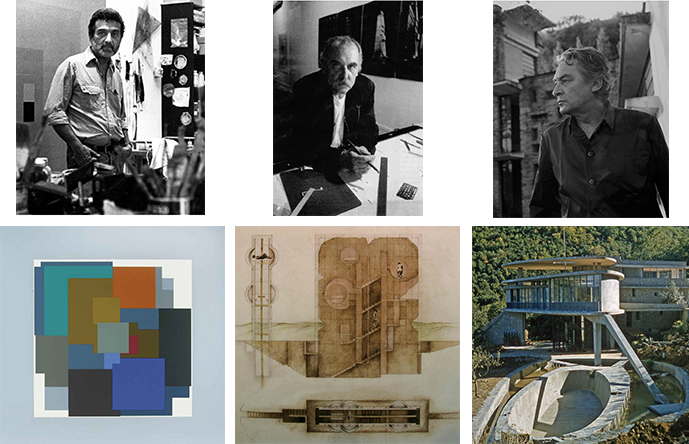
Image 5: Robert Slutzky, Raimund Abraham, and Leonardo Ricci
Additional blog on Leonardo Ricci
Leonardo Ricci: how to project in architecture
PROGRAM, function, and value of usage, Part 2
I worked on the academia bridge competition doing some of the competition drawings including the entire “fantasy ” drawing. Also did the Venice studio semester in spring of 1984. I believe it was the first one.
WOW, that must have been incredible. I love the bridge and its social agenda which was always part of Leo’s commitment in making architecture. I, of course, admire Raimund Abraham’s Academia bridge for being so Venetian. Yet my favorite is Leo’s proposal for the extension of the Guggenheim museum. Question. Do you happen to have some photographs of the process or anything pertaining to the project. I would love to include them in the blog and of course give full credit. Also, may I assume that you studied at UK. I taught there between 1987 and 2006.
Meanwhile, wishing you a belated Happy New Year.
I graduated from UK in 1986. Got my last 9 hours to graduate on a 6 week trip in India with Jerzy and Tony.
I have nothing on the museum but have some images for the bridge design.
Also on my way back home from India I stopped by Venice and helped him with the drawings for a competition for the bank in the city of Jesi.
I can’t find any documentation for that projects but I think it’s one of his best designs! I have some personal drawings from it and some pictures of a small mass model he built. (I drew the site plan for the competition but as I said can’t find any documented drawings. Please write to my email and i will share. Ciao