Swisscom telephone booth in Zürich. Following up on a recent blog describing a barometer pavilion in Gratz, Austria, I concluded by mentioning that “Happily, much urban furniture has survived as design problems, and I am pleased to see that many of those artifacts have been reborn through the talent of some of the most notable contemporary architects.” I included photographs of one of my favorite public telephone booths in Zürich, Switzerland, thus this blog to describe more in depth about this particular artifact.
It was during my three-year stint as a professor at the ETH-Zürich that I was made aware of Swisscom’s newly designed (1993-1996) cylindrical phone booths called Telecab 200’0. Distinctively modern in shape, materials, and overall Swiss minimalist design, I welcomed their presence within the city’s streetscape. Along with public benches, tree grates, recycling bins, tram/bus stop signals and ticket dispensers, the new phone booths were a pedestrian-appreciated addition to the visual urban landscape.
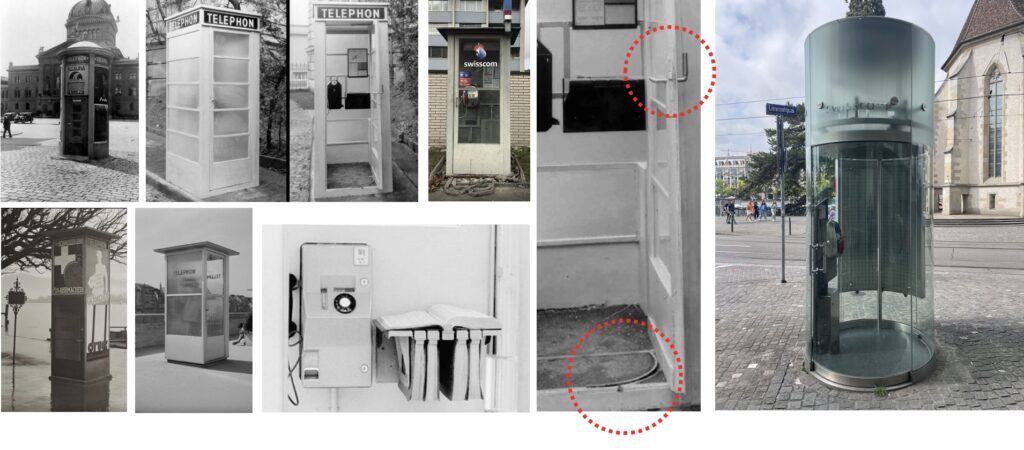
In the early 1990s, mobile phones had not yet become ubiquitous, thus the importance of this piece of urban furniture. Like many countries, Switzerland relied on phone booths as a public utility. I remember not having access to a phone during my university studies in Lausanne and remember having to walk up the street to a phone booth next to the bus station so I could call friends and parents. On that note, I also remember that telephone books were provided within the booths; often secured between a metal L shelf allowing the books to swivel forward and unfold (Image 1).
Not unlike the British red phone booths that remain memorable because of their high visibility as a cultural object beyond their primary function, the traditional Swiss telephone booths were equality iconic with their rectangular form. They were a part of a robust and extensive network of public phone booths throughout the country. They formed a visual landscape on many streets, and in high-traffic areas at train stations and airports.
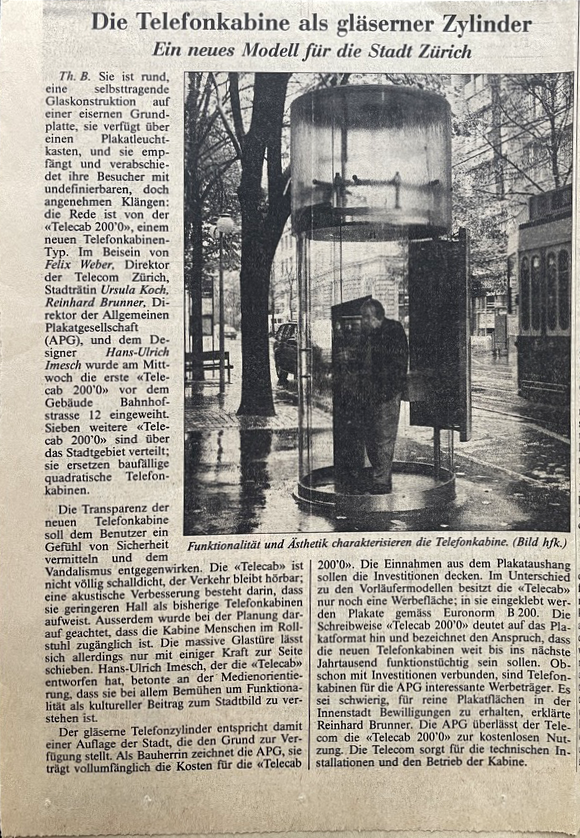
The new Telecab 200’0 was designed by architect and psychologist Hans Ulrich Imesch in partnership with two Swiss companies APG/SGA (an outdoor advertising agency), and Swisscom (previously the Swiss Postal, Telephone, and Telegraph, PTT), and the Institut für ganzheitliche Gestaltung (Institute for Integrated Design) in Berlin, Germany. The new phone booth remained faithful to the core qualities of Swiss design. Traits and values that are about an economy of means, and visual silence. They do their job without asking much attention. As a newly designed object, or better said, serving as an indispensable urban equipment, the new cylindrical phone booth was not only aesthetically pleasing, but provided ergonomic characteristics that made it extremely user friendly.
The nomenclature of the phone booth
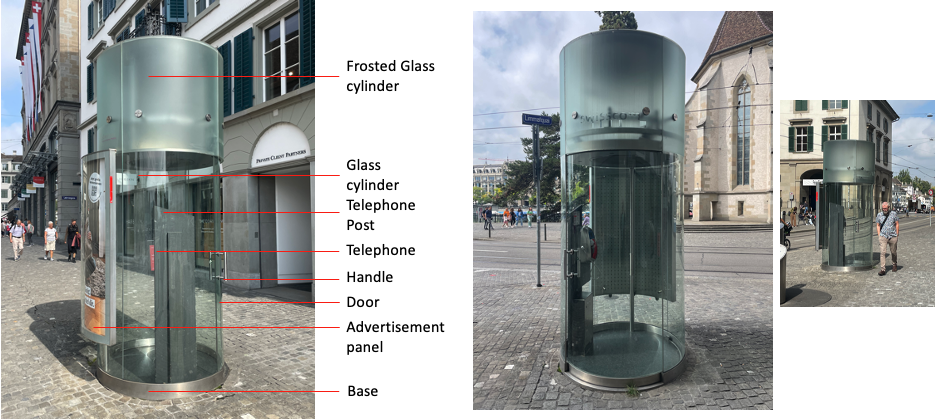
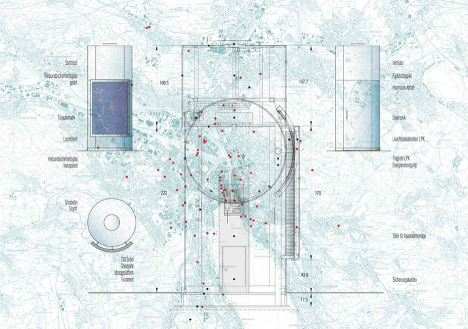
Let us look at the main components of the phone booth. The first and most obvious observation, especially for any Swiss citizen which I am, is that compared to the previous phone booths in operation (called Publifon), the shape is cylindrical and similar to a column divided in a tripartite way. The treatment of the base gives stability by firmly anchoring the glass panels and door to the ground, a shaft that is created from four curved glass panels—of which one is a sliding door— and a cap treatment that give structural stability and houses additional features such as ventilation system, lighting, and loudspeakers.
The circular shape offers several advantages. It eliminates corners, which are less ergonomic and often unusable, especially with the need to optimize internal space in order for the user to move around. Also, the form of the phone booth offers a quasi-interrupted panoramic 360 degree view with the exception of an outside publicity panel that provides visual privacy when communicating on the phone. While the space remains tight, the overall feeling is not claustrophobic. And last, as an urban furniture, the cylinder become a versatile object with a noticeable and elegant presence—a ‘private’ room within the open public realm. Often, during my strolls in the old city of Zürich, I found pairs of phone booths which acted like partners.
After using the new booth and photographically documenting the Telecab 200’0 for posterity, I can confidently say that it is the product of a perfectly engineered thinking process and is therefore heavy-duty, weather-resistant, and to extent possible, vandal-proof. Yet, its final design also expresses transparency—both inside and within the urban context.
Base:
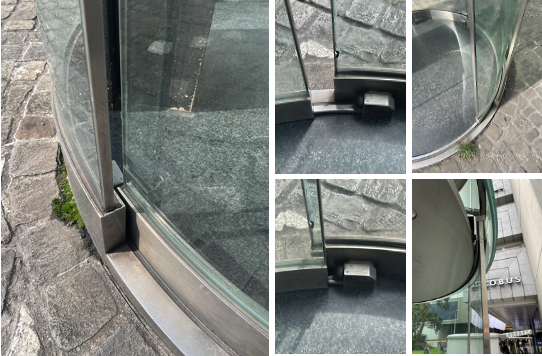
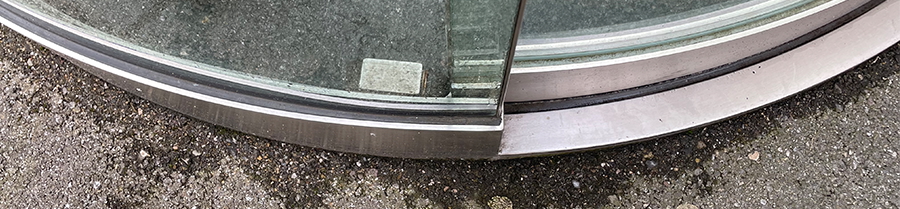
The base of the booth is made from a brushed stainless steel ring with a U profile, which anchors the glass enclosure to the ground while allowing the sliding door to move easily inside the cabin space. The above images illustrate the simple and almost effortless design strategy used to slide the door, provide a door stop on either side (open and closed) while overlapping the door with the fixed panel to provide the closure without compromising the mechanism between fixed and movable parts (Image 3).
Of note, as shown in the above far right image, while leaving ample space to enter, the sliding door does not fully open to the frame. This is to provide space to accommodate the door handle affixed to the glass, which ergonomically eases the movement. The inside flooring is typically natural polished stone, often Swiss granite similar to the material used for Peter Zumthor’s baths in Vals, Switzerland. A slight ledge negotiates the transition between the outside and the inside of the booth—in this case cobblestones that are often found in historic city centers.
Shaft and coronation:
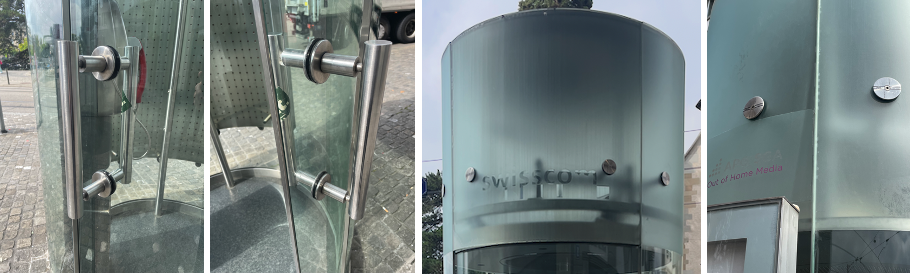
The booth’s enclosure is made out of three large laminated curved tempered glass panels that extend the entire height of the booth, with the top portion being frosted to conceal the anchoring system, screen the hinges that hang the door, provide a lighting system that combines the primary colors, and shields the ventilation mechanism and loudspeakers for sound (Image 4).
Note that there is no framing between the glass panels, just gray sealant, indicating that the glass panels are self-structured. On the note of sound, I was reminded that a musical theme played upon entering and exiting the phone booth. The designer Imesch of the phone booth had worked with Indian composer Sri Ganapathy Sachchidananda Swamiji—a revered spiritual leader and proponent of music therapy—to provide sound in addition to the auditive qualities when talking on the phone.
In keeping with previous phone booth design, the contemporary detailing of the sliding door does not impede on the sidewalk when opened. Also, when looking at door handles of past phone booths in Switzerland, they were cleverly designed to reflect the different forces used when entering and exiting. The exterior handle was positioned vertically so that users could easily push the door in, allowing it to swivel to the right. When exiting the booth, the handle was horizontal so the user can push the door open (Image 1 with red dot). Because the Telecab 2000 is a sliding door, the handle is the same on both sides.
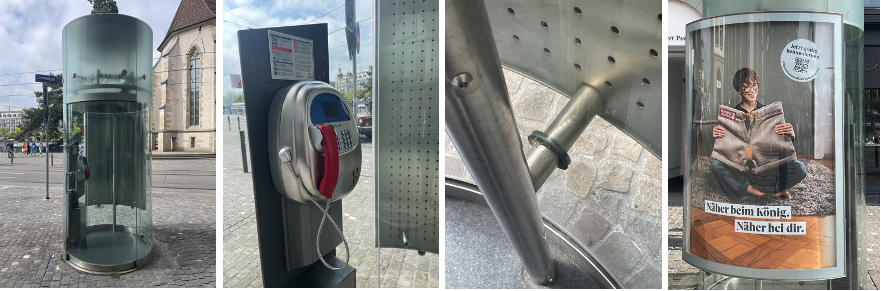
As to the phone itself, it is not new. Fastened on a vertical metal rectangle, the phone for the Telecab 2000 was developed for earlier phone booths. Its curved form—contrary to the iconic American payphones which I have mounted in my kitchen for use and nostalgia—is a product of a thoughtful design. Minimizing sharp edges, the backpack-like form reduced damage upon impact and made the surfaces easy to clean.
The overall organization of the actual payphone clearly articulates several important components; the prominence of the handset color with a nod to older PTT models that reflect the national flag; the touch buttons to the right; a digital display screen above, and a slot below for electronic payments. On a side note, when I worked in Swiss architectural offices, I remember Swisscom employees would come on a monthly basis to clean all desk phones. I am not sure if this was included in the monthly phone fee or was an extra expense that office administrators requested and enjoyed. Nevertheless, what a service that predates Covid-19!
Conclusion
Further research on the architect of the Telecab 200’0 revealed that the cylindrical phone booth had an ingenious purpose beyond the purely physically functional. It used the sonorous spatial concept. This concept “refers to the integration of sound and space to create a three-dimensional, immersive experience where auditory perception defines, transforms, or creates architectural and environmental spaces.”
What a holistic idea for a new phone booth, one that synthetically complements sound, communication, technicality, the circle as a symbolic form, size and proportion appropriate to an urban scale, and the aesthetic qualities of a three-dimensional transparent and see-through (read safety and protection) urban object. There is here set in place a brilliance that elevates the pragmatic to psychological levels, which is an immense credit to the architect’s training in both architecture and psychology!
Because of their excellence in many design aspects, this phone booth received the prestigious DuPont Benedictus Award (USA) in 1998, The German Prize for Communication Design (1988) and, and the Design Prize Switzerland in 1999.
Postscript 1
After decommissioning most phone booths throughout Switzerland, in the spirit of sustainability the approximately 150 cabins that remain (mostly in the German speaking urban regions of Switzerland) provide either free calls to Swiss landlines and mobile networks or, in a spirit of reinvention, have been repurposed as smoking areas, books exchange stands, defibrillators, or mini-libraries or bars. Some sadly serve solely as advertising kiosks. The rapid transition from land line telecommunication to mobile cell phones have made dinosaurs of these beautiful objects.
I miss those days when such technological artifacts were first and foremost about cultural and democratic practices, which sadly have morphed into status symbols through the ownership of the latest most successful Handy (Swiss German name for portable phones while the French speaking use the word Natel). The miniaturization of the hand-held mobile phone is most welcome, but its presence insists on individuality rather than a place where community takes pleasure in being together. Just look at bus stops, metro cars, or students on break between critiques. Few speak or interact—the rush to one’s mobile phone means a lot about our sad future.
Postscript 2
Postscript 3