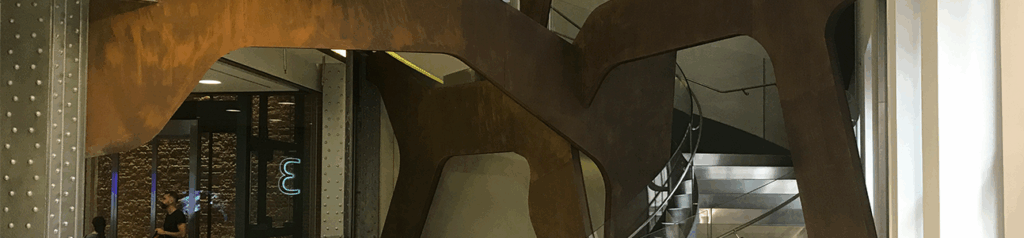
Staircase at the National Telephone Company of Spain in Madrid. I have written many blogs on staircases and have always found delight in showcasing their identity. This blog is not dissimilar and will highlight a staircase that I stumbled on years ago while visiting an exhibition on the work of British architect Richard Rogers.
The staircase is located in the Edificio de la Companía Telefóñica (the National Telephone Company of Spain (NTC)) at the corner of Gran Via and Calle de Hortaleza in Madrid. It is an iconic building and was considered the tallest building in Madrid until 1953. It was also the first skyscraper in Europe.
Completed between 1926 and 1930 by architect Ignacio de Cárdenas Pastor, the NTC is an homage to US tall buildings which showcased technological steel framing advances. Noteworthy, in the skyline is the prominent upper pyramidal coronation of NTC, a stylistic nod to Madrid’s Baroque architecture. While currently in operation by NTC, the building houses the telephone foundation, and a museum on three floors covering the history of Spanish communication with rotating thematic exhibitions.
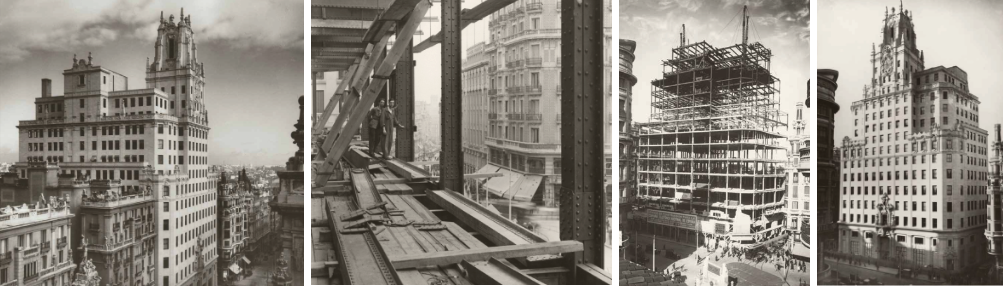
The main entrance to the building is on Via Gran and will give you a glimpse of the beautifully renovated foyer that includes a contemporary staircase. However, to access the museum’s gallery spaces, and staircase which is the topic of this blog, you will need to enter on Calle de Hortaleza, just to the right around the corner. As you reach the entrance, you get a glimpse of the staircase from the sidewalk through a very large window, but it is only upon arrival in the foyer that you can admire the staircase in its full majesty.
It is important to mention that anyone can visit the staircase and peruse the upper galleries during opening hours without a charge. If you have backpacks or large items, do not feel intimidated by the guard who will ask you to store your belonging in nearby lockers located toward the back of the foyer, this is also free.
Armani staircase in New York
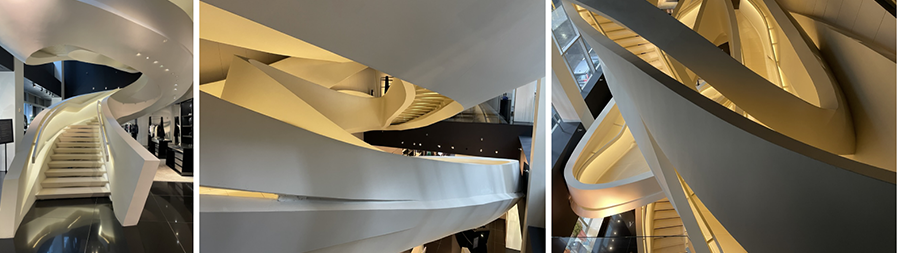
When speaking of sculptural stairs—and I mean SCULPTURAL in the stunning three-dimensional way that they occupy space—I have only experienced one other contemporary staircase that competes with the one in Madrid. That on is located on Fifth Avenue in New York City, and was designed for the Giorgio Armani flagship store. At first glance, the New York staircase is reminiscent of Zaha Hadid’s style, but the formal clin d’oeil is unfair as it takes away from the prowess of the real designers of the interior of the store; the architects Massimiliano Fuksas and Doriana Fuksas.
To my delight, the intervention in NYC balances architecture and interior design in “a single, fluid, intercommunicating space held together by the impact of the staircase, the heart of the building.” Coated in white plastic over a rolled calendar steel structure, the staircase curves centrally along the simplicity of each floor’s showroom, which reinforces that the staircase is nothing less than an object of conversation. The views towards, and the spatial experience walking on the staircase, are nothing less than Piranesian.
Of note during your visit, there is no need to pretend to purchase an expensive Armani suit—although it is a must if you love Armani’s choice of fabric, tailoring, and flawless execution that defines Italian perfection. While the staff is trained how to spot an architect’s appetite for quality architecture, they will obligingly tease your credit card while admiring the superb staircase!
Staircase in Madrid
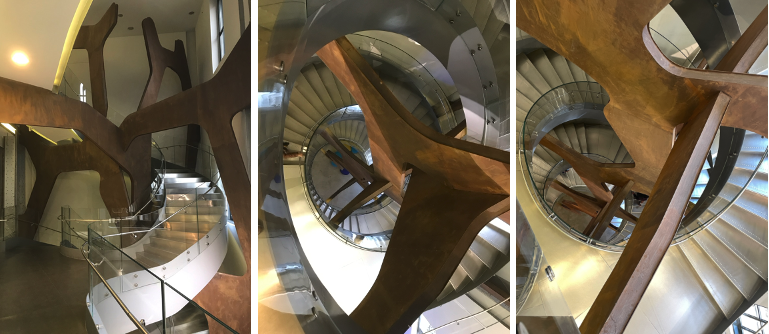
Back to Madrid. I was awe struck when viewing the NTC staircase for the first time, and my immediate instinct was to understand how it could hold up in such an elegant and almost effortless way. Photographing it beneath each angle did not do it justice (although I did that during my visit), thus I embarked on the staircase to experience the sensuous flow of curves that accompanied my ascension to the top floor and distribution to various galleries on the way.
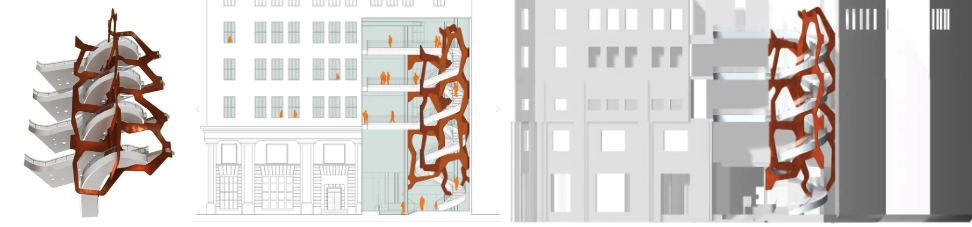
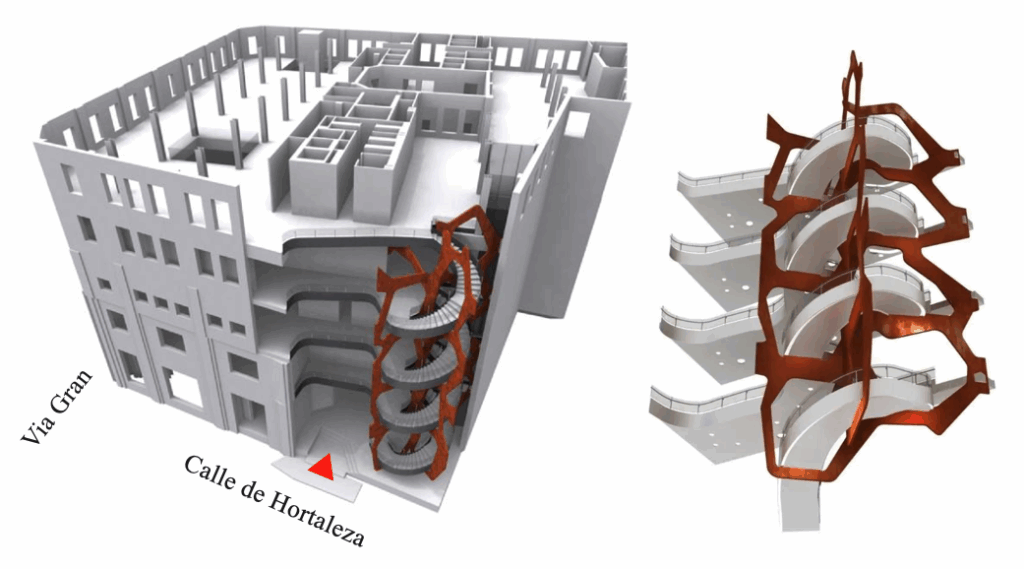
To accommodate new galleries for the museum over the four stories of the historic NTC section, the architects Moneo Brock Studio + Quanto Arquitectura, cut out sections of the existing floor slabs to create a generous vertical atrium. Sculptural in its organic and fluid shape, the new staircase was inserted in the northern corner of the space with new floor plates that bridge the various gallery floors. The remodel included an auditorium and larger rooms on the third and four floors to accommodate a permanent exhibition on the history of Spanish telecommunications, temporary exhibitions associated with cultural activities, as well as an overscaled glass elevator. These spaces form what is called the Espacio Fundación Telefónica.
The tectonics of the staircase
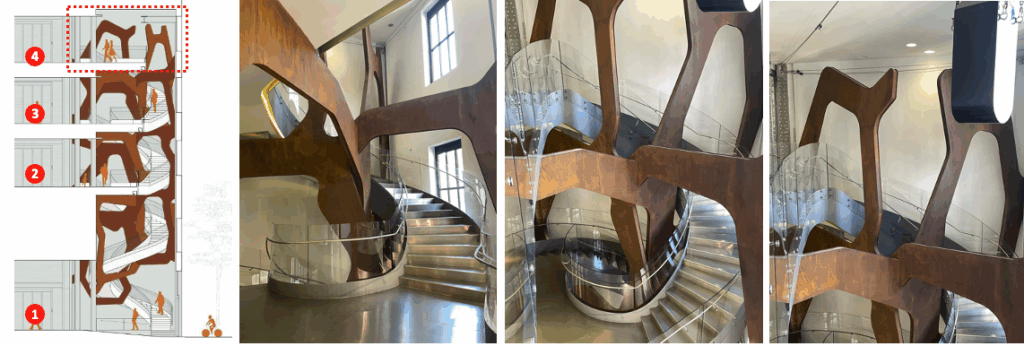
The following four images document in section and through photographs the complexity of the staircase from the first to the fourth floor. Perhaps someone will venture to make an analog model as the visual complexity still remains when looking at these images.
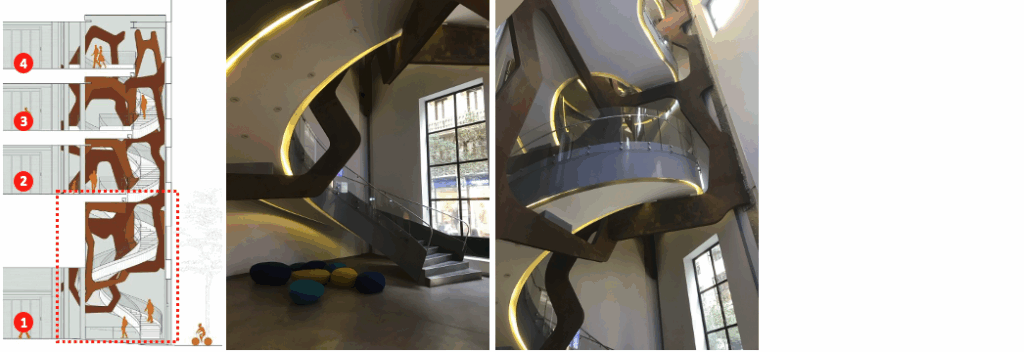
The staircase is formally complex but can be reduced to a helicoidal form which is supported by a Corten steel structure that reminds me of a spiderweb. The Piranesian view towards or from the staircase are challenging when trying to understand the underlying structure. However, when examined closer with an engineering mind—as with any great architecture—one discern a simple yet complex (versus simplistic and complicated) structural principle that extends and anchors the adjacent two walls and floors.
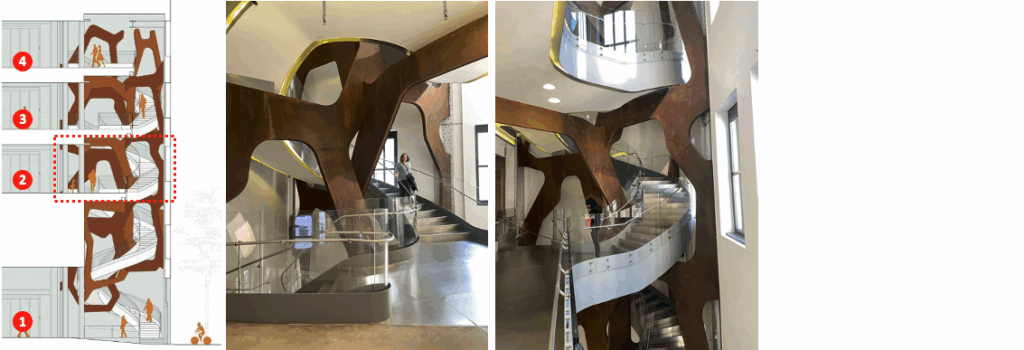
The staircase is held by two intersecting Calder-like sculptural frames weaving into each other as the steps ascend. The structural strategy of the lateral cross-bracing of both frames gives stability to the circular staircase, as well as securing the entire assembly to the original steel structural pillars of the building, and this after the removal of floor slabs that originally were anchored to the façade on Calle de Hortaleza.
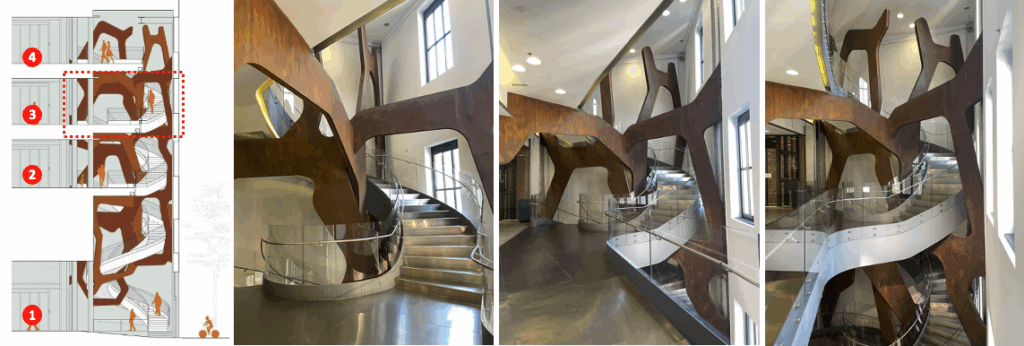
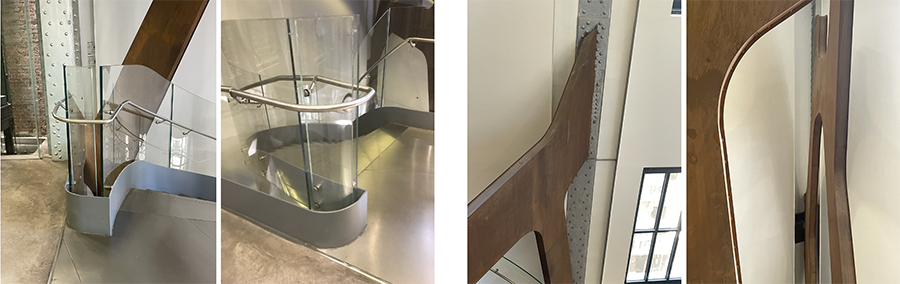
Like many architectural projects, designing a memorable staircase is a great feat in itself, but here the designers faced additional technical challenges in order to balance architectural aesthetics with preservation requirements. Other key challenges included removing existing floor sections while shoring up those for exhibition spaces, exhibiting mechanicals in the ceiling, and using existing load bearing riveted-steel columns, which in the new design were exposed to highlight the skyscraper’s industrial nature.
Thus, the need to coat the columns with fire-resistant paint. All this effort enabled the staircase to remain open and visually accessible while adhering to complex regulations governing fire safety. The Staircase at the National Telephone Company of Spain in Madrid is nothing less than remarkable.
Additional blogs pertaining to stairs
Latvian National Museum of Art (ProcessOffice), Part 1
Latvian national Museum of Art, Part 2
The Whitney Museum: stair by Marcel Breuer
Vittorio Gasteiz: a lessons in stairs (Francisco Mangado)
Hong Kong: a lesson in stairs (Bille Tsien and Tod Williams)
Porto: a lesson in stairs (Alvaro Siza)
Firminy: a lesson in stairs (Le Corbusier)
Lexington: a lesson in stairs (Jose Oubrerie)
Vienna: a lesson in stairs (Jože Plečnik), Part 1
Vienna: a lesson in stairs (Jože Plečnik), Part 2
Geneva: a lesson in stairs (Le Corbusier)
How to design a stair