Herzog et de Meuron: Between Coffee at Tai Kwun, Hong Kong. Over the last decades, museums have evolved with the realization that patrons demand more than renovated galleries with endless rooms where they can admire provocative and renowned art.
Art, to be fully appreciated, demands that visitors be engaged and open minded, and they need a place which allows reflection and deep appreciation of a museum’s collection. To support contemporary curiosity in understanding art, new curatorial strategies have moved the presentation of collections from passive to active engagement. For me, they have accomplished this by setting themed paintings next to one another, or, even more courageously, juxtaposing a contemporary with a classical piece of art (e.g., David Hockney and Giovanni Bellini).
What comes with such intense moments of appreciation of the art, is that the stamina of museum goers cannot be sustained without a well-deserved moment of repose. Let me be frank, there is never an abundance of seating in museums, and if any are vacant, they are uncomfortable to say the least as they have no backrests. Also, you become self-conscious and feel that you are monopolizing a seat when another patron would benefit by observing larger art from a seated position. I am thinking here of the famous Brueghels at the Kunsthistorishes museum in Vienna, Austria where distance is key to appreciate these monumental pieces.
Museum Cafés
In the past, if you could find a cafeterias, they were small and dingy, and usually relegated to basements with few dining options beyond generic breakfast staples, sandwiches, salads and desserts. Of course, there were welcome exceptions that have always offered sit down dining experiences that often did not match the visitors need to have a casual moment away from the art.
Finally, museums have got it right. To remain relevant and respond to a demanding and discriminating public, they often now provide visitors with a place to replenish their senses while enjoying snacks and beverages. On the other end of the spectrum, some museums have upped the ante by offering destinations restaurants as delectable epicurean places that are designed as an integral part of the museum experience. Often, these spaces offer overpriced gastronomic treats, without the sophisticated and luxurious designs such as the defunct high design of the Four Seasons in the Seagram building. For me, visiting a museum requires a mental respite from the intellectual engagement of viewing art; especially as I tend to stay hours in art meccas of metropolitan cities.
Between Coffee at Tai Kwun, Hong Kong
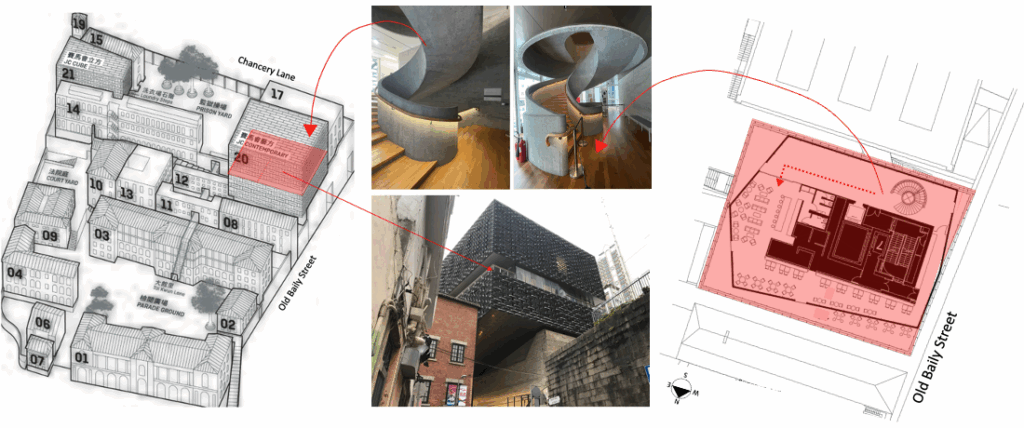
Such a space to relax between experiences may be found at Between Coffee created as part of the 2018 renovation of the Tai Kwun Heritage of Visual Culture Museum in Central Hong Kong, designed by Swiss firm Herzog et de Meuron. I heard about the café because it is accessed by a superb circular stair that I have thoroughly documented and will be the topic of a next blog (Image 2). However, after patronizing the café, I discovered a number of other outstanding design moves that deserved to be highlighted.
Inside spaces -café, and dining area
The Between Coffee which I visited (previously called Old Baily, and now Tozzo, all owned by trendsetter JIA Group), is located on the second floor of the JC Contemporary building—“between” galleries both above and below—and is accessible by elevator or by the superb spiral staircase designed in an archetypical Herzog et de Meuron fashion (another is located across Victoria Harbor at the M+ museum in Kowloon).
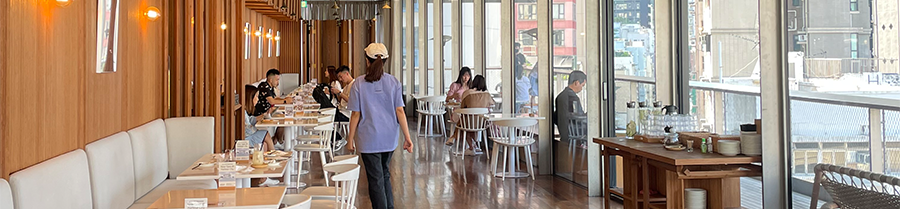
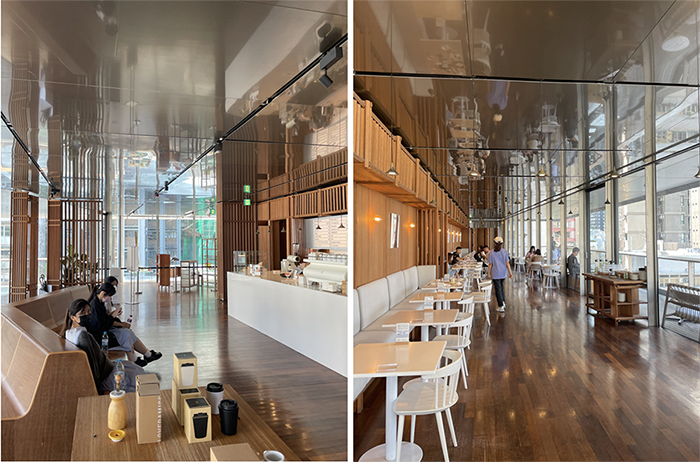
The interior of Between Coffee has an open plan that provides a contemporary and minimalist atmosphere. This is primarily accomplished through the choice of materials, textural treatment, design of casework, and choice of furniture. As the space has an L-shape configuration and is rather narrow given the overall footprint of the second floor, to create a sense of spaciousness both floor and ceiling use highly reflective surfaces (high glossed hardwood floors—probably teak given its warm golden-brown hue and appreciation by retailers in Hong Kong due to its durability and resistance to water and insects—and uniform aluminum panels for the dropped ceiling) (Image 1).
The benefit of these materials is that they allow an increase in the sense of verticality to the entire room, while providing views through floor to ceiling windows. Patrons can overlook other Tai Kwun structures that surround the two main courtyards (Parade Ground and Prison Yard), and the dense neighborhood vistas of Central, SOHO, and the Mid Levels. Through this strategy, the entire café has an abundance of light and offers both interior and exterior spaces that capture unexpected views of Hong Kong in a 270 degree panorama. Upon reflection after visiting the café, I find the design intent in terms of materials to be spot on, accentuating the outside sense of verticality within the interior spaces.
Lounge bar and dining area
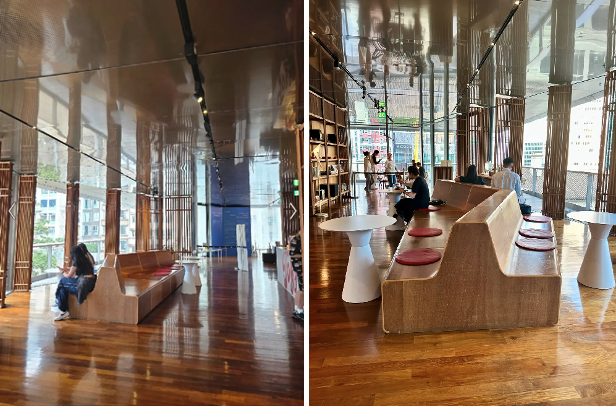
Considered a Japanese-style café, Between Coffee was the first of a series of model cafés in Hong Kong owned by the local JIA Group. The space is designed to accommodate two distinct areas. At the front, an elongated bar, completely in white, greets you. There, order your food and beverages, and a famous barista will prepare some of the most delectable coffees from around the world for you. Opposite the bar, the local architecture studio Eskyiu created a sculptural boomerang shaped seat, which accommodates communal seating while waiting for one’s order or a place to simply chat in an informal manner compared to the rest of the café’s more formal dining area. Noteworthy about this seating area, is that it also faces the city views that extent beyond the terrace.
In the main dining area, a white banquette lines the entire wall. Above it, is veneered wood paneling that seems to be made of bamboo. Neat small white tables are arranged along the banquette, paired with equally white chairs. The relationship between bar and banquette cannot be missed and is a nice interior design touch to bring together the two spaces. A minimalist lifestyle is found in the furniture treatment, material choices, and dishware (Image 1).
As a background, the design uses wood paneling in which a lattice is incorporated near the ceiling to hide the HVAC ducts.
Outside spaces – terraces
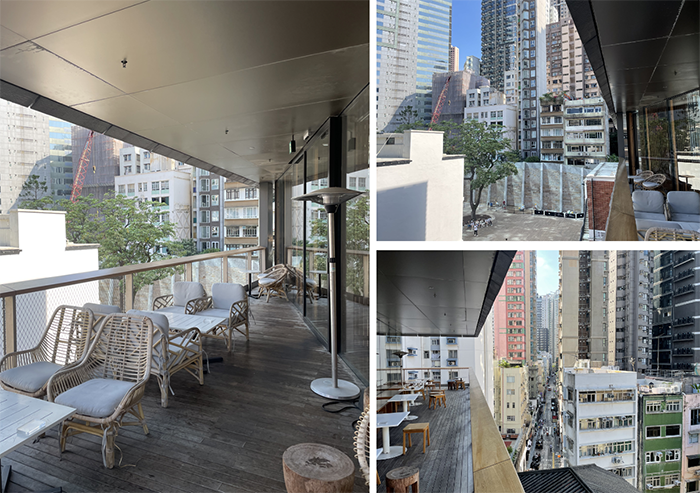
The city views from both terraces are amazing as it is the one of those rare open ‘courtyards’ left in Hong Kong where you do not see the city from above but have a panoramic view from within. The only other café that I know that offers a similar experience on a more modest scale is The Blue Bottle Café located in the Wai Chai neighborhood of Hong Kong. I spent several hours at Between Coffee sipping a coffee with delectable desserts, while enamored of the privilege of seeing Hong Kong is a very different way.
Conclusion
Architecture for me is revealed at multiple scales, and the spaces of Between Coffee is an example of a seamless continuity between an architectural and urbanist vision for the Tai Kwun renovation, all the while paying close attention to the interior design qualities. What writing this blog revealed to me once again, is how much I enjoy attention to interiors, and how in my teaching, it is imperative that architecture students early on be sensitized to detailing, texture, colors, furniture, and interior programming. Big gestures have become the status quo of design pedagogies and often reveal little about the final architecture or the talent of students when they need to pay attention to a model of life for a particular place.
Postscript 1
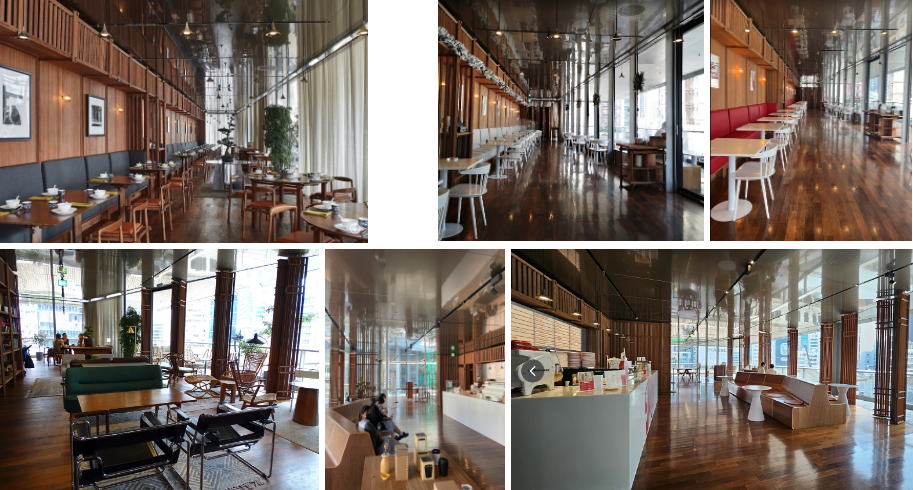
These images show the café over time as subtle change were made to the interiors the with handover to a new name.
Postscript 2
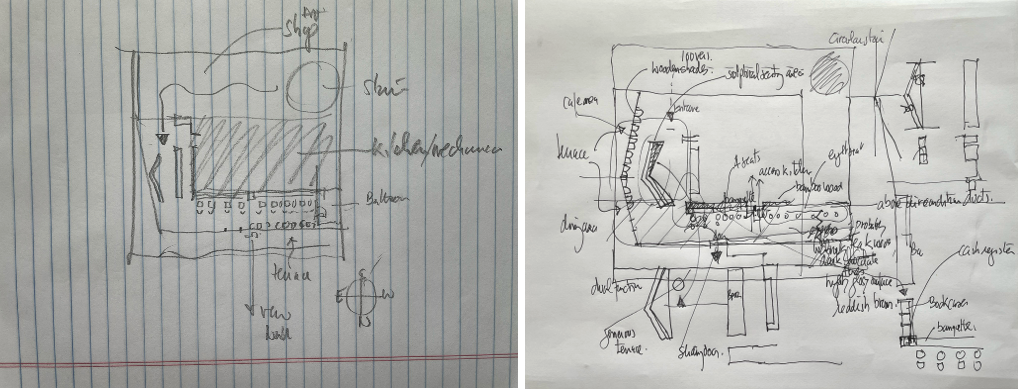
I enjoyed the Between Coffee experience so much that I didn’t think to make a drawing of the layout. Years later I remembered the experience and jotted down my recollections (Image 6 left). Finding my photographs I made modifications in a second sketch (Image 6, right). Memory isn’t perfect, but it is a first step. I learned a great deal by working through these steps, rather than immediately searching for the plans online.
Postscript 3
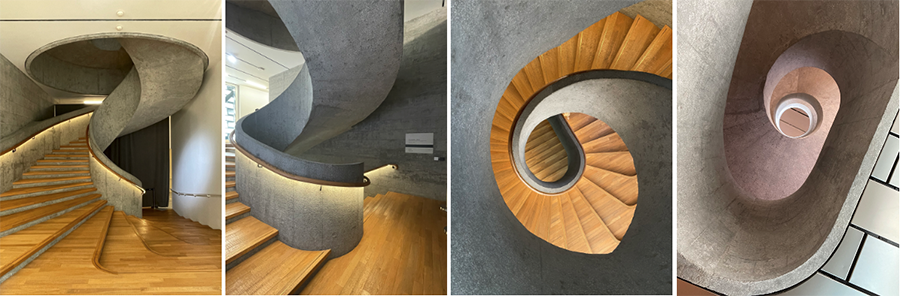
The iconic stair leading to Between Coffee was a treat in itself. Its elegance was defined by the flow of the circular movement that gave the brutalist concrete material a sense of plasticity in the minimalist idiom of Franco-Swiss architect Le Corbusier. Wooden treads and the hand railing that incorporated lighting were welcome touches that offered a contrast to the commanding concrete. Certainly a blog in preparation!
Additional blogs pertaining to Hong Kong
Blue Bottle Coffee: Hong Kong
Murals at Hong Kong Central Station
Hong Kong trams, a way to travel
Hong Kong Shopping Mall
Hong Kong: Bauhaus style Central Market
Hong Kong: a lesson in stairs (Central Market)
Hong Kong: the history of Central Market
Bathroom at the Novotel in Hong Kong
Hong Kong: a lesson in stairs (Billie Tsien and Tod Williams)