Category Archives: Art & Design

Latvian National Museum of Art (Processoffice), Part 1

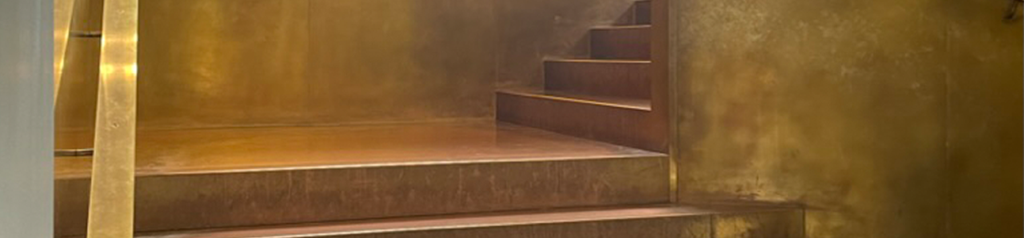
Detail of golden stair

Latvian National Museum of Art (Processoffice), Part 1. Hands down, the stair that I am about to share with you is conceptually one of the most subtle tectonic statements that I have seen in recent years. Not simply because it is both simple and utterly sophisticated in its execution, but it takes its place so eloquently and effortless within the entrance foyer of an existing building, namely the Latvian National Museum of Art in Riga, Latvia (LNMM). 

Continue reading Latvian National Museum of Art (Processoffice), Part 1
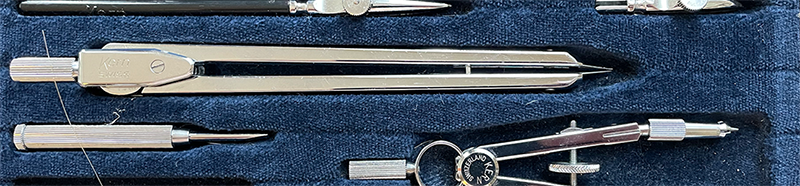
A compass set

detail of Kern compass set

A compass set. For an architecture student in the early 1980s, owning a compass was not a luxury, it was a necessity. This, along with other required mechanical tools (drafting instruments) including a triangular metric scale (which in Europe serves both architects and engineers), various triangles, ruler, T-square (parallel bars were rare and expensive and were seen as an American luxury for a European student), protractor (measured angles), templates known as French curves (to draw complex geometry), eraser shield, and the ubiquitous item that was expensive but lifesaving – Rotring’s famous rapidograph ink pens.

Continue reading A compass set

Hong Kong: Bauhaus style Central Market

Hong Kong: Bauhaus style Central Market. Previous research on the Central Market in Hong Kong, resulted in a blog describing the genesis of the market through 1850. After 1858, the building—originally called Canton Bazaar, thereafter Middle Bazaar—was rebuilt, and from there on was officially named Central Market. The 1903 map (Image 2, below) suggests the market was a rather large structure. 

Continue reading Hong Kong: Bauhaus style Central Market

National Museum in Singapore, Part 2

National Museum in Singapore, Part 2. Following my thoughts on the nature of the growth of museums, during a recent trip to Singapore, and, in particular, the National Museum of Singapore (NMS)—a place that I remembered for both its extensive galleries showcasing the history of Singapore and the temporary exhibitions on topics relevant to a more in-depth analysis of specific cultural dimensions—I was interested in the development of museum additions using this museum as an example. 

Continue reading National Museum in Singapore, Part 2

Hong Kong: a lesson in stairs (Central Market)

Hong Kong: a lesson in stairs (Central Market). In a recent blog, I described the origins of Central Market. I’d like to add that more detail of its history can be found at Timeline; at the Central Market website under Our Heritage Conservation; and in the comprehensive documentation Study on Historical and Architectural Context of Central Market

Continue reading Hong Kong: a lesson in stairs (Central Market)

Hong Kong: the history of Central Market

Hong Kong: the history of Central Market. Photograph of produce at the Boqueria in Barcelona

Hong Kong: the history of Central Market. Since ancient times, public markets—coined mercatus in Latin, which means trading, dealing or buying, as well as the physical place where those activities occur—have served as the identity and social lifeline for countless cities and towns. Food markets in particular have played a significant role as community-gathering places.

Continue reading Hong Kong: the history of Central Market

Tri-fold mirror

The history of mirrors goes back to the first human gaze in a pond of still water, which in around 6000 BCE evolved to become the ubiquitous object that we call a mirror. To create mirrors, man started with polished stone (or volcanic glass when available), later fabricating them from various metals, finally ending with rough polished man-made glass backed by mercury. This technique was invented in Venice, which during the Renaissance held the monopoly for the production of mirrors. 

Continue reading Tri-fold mirror