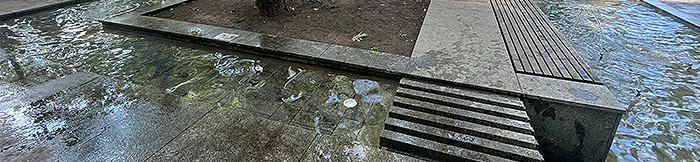
Public fountain in Kaunas Lithuania. The identity of cities is profoundly shaped by the interplay of enclosures, both public and private. These various degrees of interaction contribute significantly to a city’s unique character and the way its inhabitants and visitors experience it.
Here are three exemplary identities: the expansive public space of Central Park in New York City, with its surrounding towering buildings and grided urbanism, is quintessential to Manhattan; while the 19th century Grand Boulevards renewal project of Baron Haussmann, which carved a new urbanism from the medieval fabric of Paris, formed today’s quintessential morphology of that city; and Venice, a city created by a network of hundreds of islands, canals, and bridges, sets the pedestrian center stage by offering quaint neighborhood campos in which to socialize, along with the most recognizable urban plaza in the world, Piazza San Marco.
Place making and place marker
Since antiquity and the birth of the notion of civitas, urban furniture as place making and place marker—alongside the creation of public spaces—have held essential roles in defining the character of neighborhoods. Noteworthy, are spring and stepwells. Those in India called Baolis served as social hubs and are nothing less than exquisite architectural wonders. More common are public fountains, often a key to the life of a city. While fountains served as a convenient water delivery, they also played a role as a gathering point for daily life. Unfortunately, today, many of the urban sources of water have been diminished as celebratory events due to the loss of their primary function.
This change has occurred mainly because of the widespread availability of water, which has been domesticated and is no longer part of an open-air public urban infrastructure. Thus, many existing fountains have been relegated to visual interest and beauty—especially for tourists—which, I will admit, cannot be underestimated in the appreciation and attractiveness of their aesthetic qualities.
Fortunately, in recent decades, some municipalities have shown an interest in urban renewal projects that are vested in the quality of public spaces. The creation of fountains seems to return with a preoccupation that accompanies a sense of place making. Case in point, I discovered a fountain of great interest in the city of Kaunas, the second largest city in Lithuania. It is the topic of this blog.
Kaunas and the Soviet Union

Driving from Riga, Latvia, to Vilnius, Lithuania, a short detour introduced me to Kaunas, a city known for its impressive collection of modernist architecture from the interwar period (Image 2). I was fascinated by this architectural history and pleasantly surprised to see how many well-preserved structures still stand as the country was under Soviet occupation (USSR) between 1944 and 1990.
Prior to Lithuania gaining independence in 1990—a year after the fall of the Berlin wall—Soviet-era policies neglected much of the local heritage within its annexed satellite states (e.g., East Germany as described in a past blog). In the case of the Baltic States (Estonia, Latvia, and Lithuania), they were republics that involuntarily became part of the Eastern Bloc, known as the Iron Curtain after Winston Churchill popularized the term.
Before my visit I was unaware that Kaunas had previously served as Lithuania’s provisional capital from 1919 to 1939 (because Vilnius, the actual capital of Lithuania, fell under Polish control during that period). The city showed evidence that progressive architecture and urban development—along with a vibrant cultural revival—had taken place in Kaunas in that interwar period. This was a time of great optimism where the town aspired to become a modern European city. Thus, the name of the city’s architectural style: Kaunas Modernism or Architecture of Optimism.
Because of the architectural and functional qualities of the interwar building stock in Kaunas, many of these modernist buildings seem to have resisted neglect or intentional destruction. A clear advantage that the Soviet Union put to practical usage after they annexed the country post World War II, thus the buildings physical survival and cultural preservation held against a Stalinist style favored by the USSR.
Modernist architecture in Kaunas
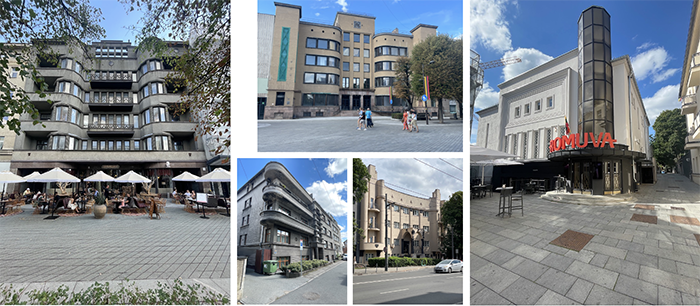
Many of the modern buildings that I visited were designed by Lithuanian architects trained in Western Europe, interpreting modernist design trends such as Amsterdam School, Art Deco, Bauhaus, and Functionalism, appropriately merging new structures with the country’s own identity, and the local traditions and building culture of Kaunas. These buildings were public (offices, museums, cinema, churches) as well as residential (houses and apartment buildings).
A common language among them features strong symmetry, fluid forms in the facades, ribbon windows, streamlined balconies, corner treatments, and an evident lack of neoclassical ornamentation. Most importantly, all buildings incorporated flat roofs that, together with the design language, offered striking designs reminiscent of the International Style promoted in the West.
What struck me the most was that many of the interwar interventions worked within the city’s historical context by subtly integrating new modernist idioms even as they sought a degree of continuity with the original historic fabric. Today, many buildings have been restored, and the city’s modernist architecture was recognized as a UNESCO World Heritage site in 2023.
Fountain in the musical theatre garden in Kaunas, Lithuania
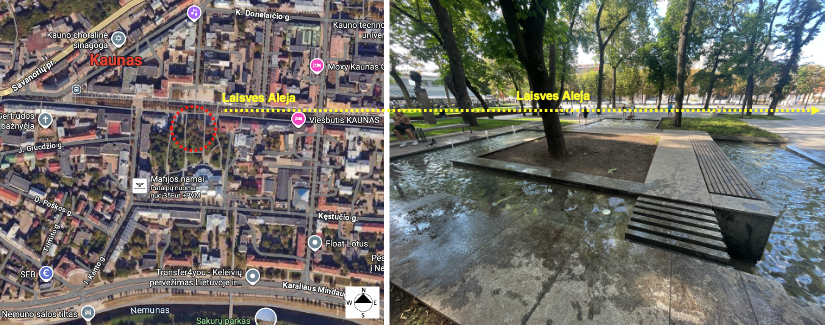
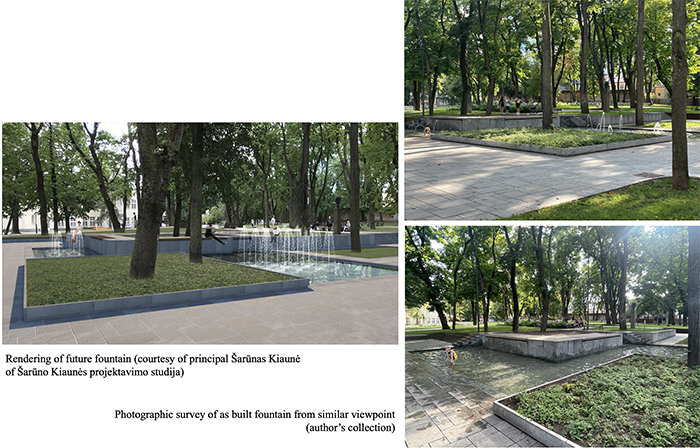
Along my peregrinations through modern architecture and the café culture (I highly recommend the contemporary Habits Coffee House across from the Russian Orthodox church –Kaunas Sobor), I discovered the City Gardens facing the Kaunas State Musical Theatre, and in them a wonderfully designed fountain. Perhaps not a fountain in the traditional sense as an isolated object in space, this fountain is more like a landscape, with water featured at two levels, incorporated seating areas, trees, lawn and planters, and generous pavement for circulating around and on the fountain.
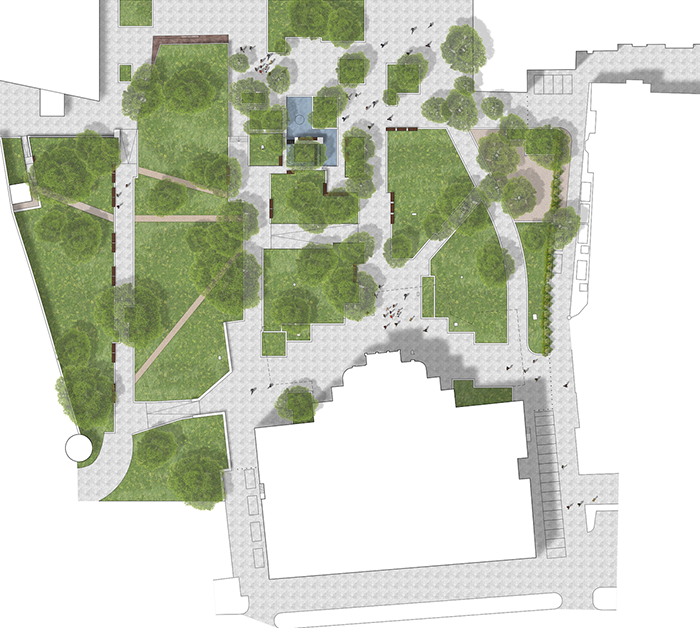
Fronting Laisvės alėja (Freedom Avenue), a beautiful 19th century pedestrian boulevard—famous for its linden trees as well as being the longest pedestrian-only street in Eastern Europe, and diagonally opposite the Central Post Office (Image 1)—the fountain of the City Gardens negotiates the change in elevation between Laisvės alėja and Kaunas State Musical Theater.
I would argue that the fountain expresses a subtle landscaped pedestal to the Theater with a central island that can be both admired and used as an aesthetically pleasing place of relaxation: a place for lunch, congregation, or simply as a playful splash pad for young children. In fact, the day of my visit, number of children had fun interacting with the various water levels and water sprays making the fountain a vibrant space to enjoy—of course under parental gaze.
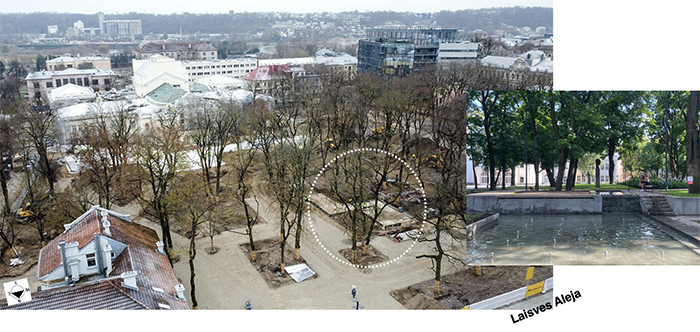
Research revealed that the fountain had been designed in 1976 by V. Paleckienė. However, for unknown reasons, it was slowly abandoned until the 2020-2022 restoration of the entire City Garden that included the repair and renovation of the existing fountain. The project was authored by design company UAB Šarūno Kiaunės projektavimo studija, in collaboration with Kauno Planas—following their winning competition for the vision of Laisvės alėja.
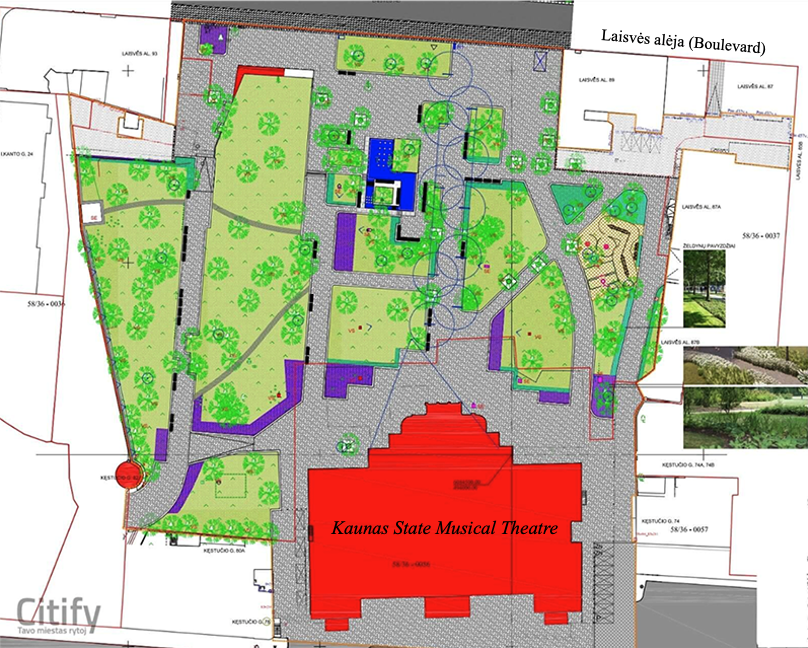
The project was under the auspices of the European Regional Development Fund that invests in enhancing cities, and, in particular, the creation of fountains in Lithuania. The preservation project was considered a heritage project and was conducted through careful archeological surveys associated with multiple cultural layers as the site of the entire territory of the historic City Garden was previously occupied by a cemetery in the 19th century.
Design features of the fountain
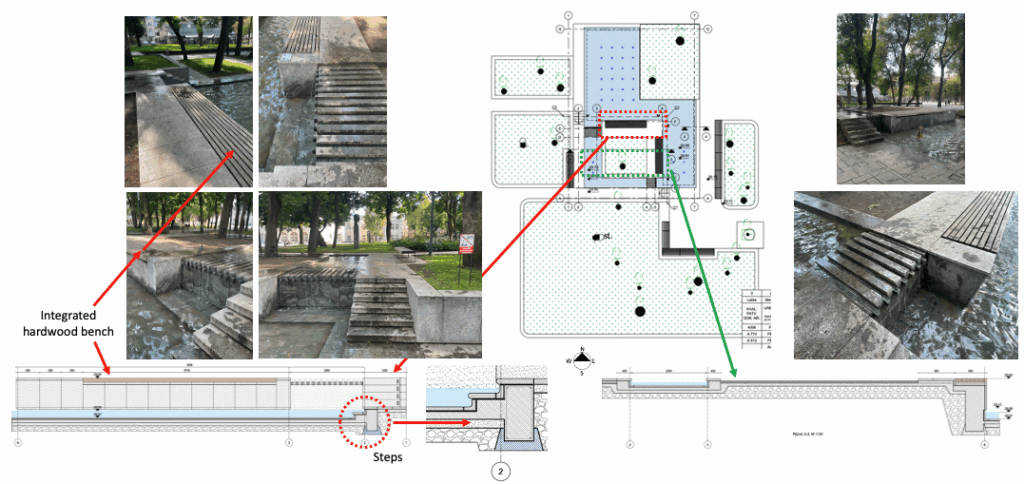
The fountain sits within a larger rectangle oriented towards Laisvės alėja. The northeast corner of the rectangle is given to a slightly raised planted green space with two trees, off setting any symmetry with the second important feature, namely a raised island. On the island, two elongated strips of water end as waterfalls into the larger north and east basins. The center of the island is given to an embedded lawn where visitors can enjoy a picnic or a well-deserved siesta.
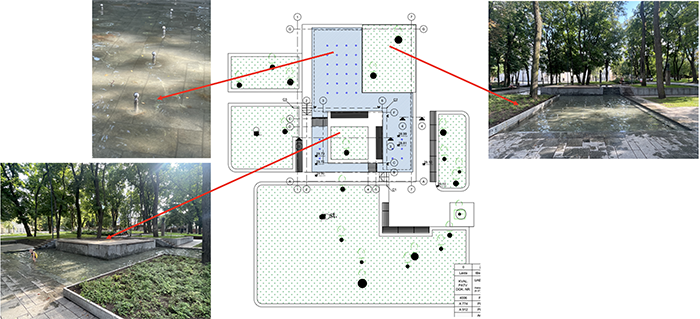
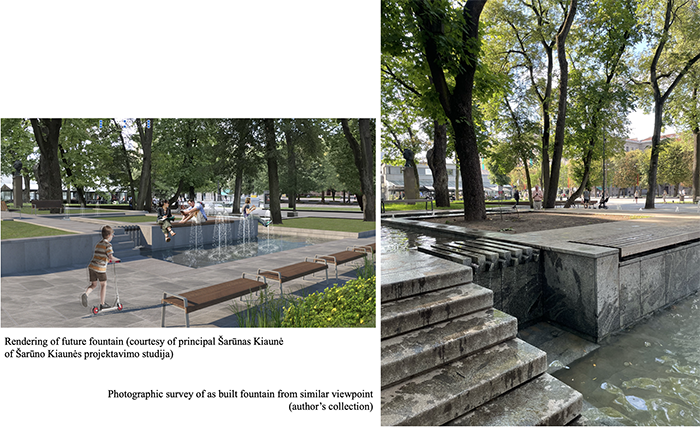
The periphery of the island has two areas that subtly integrate hardwood slats that act as benches within the fountain. They do not provide backrests and allow the visitor to sit almost over the larger water basin (Images 6). The overall fountain and its details are made of dark grey burnt granite modular panels.
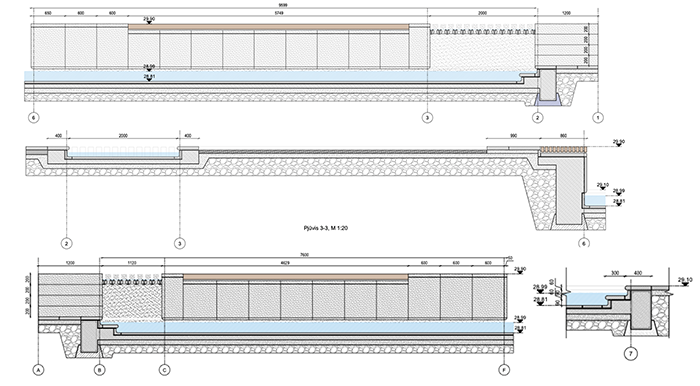
I particularly enjoyed the treatment of the various horizontal surfaces that brought several areas together: the island path at the top of the steps; the crossing of the water strip with a comb-like detail allowing water to flow through the space of the elongated narrow teeth, ending in a gentle waterfall into the lower basins; and, the built-in seating areas that allows one to enjoy the water from a balcony position. The seating is made from hardwood, potentially oak as it is readily available in the region. All three components are flush (to the exception of the lawn) and distinguished from one another by texture and material choices. This design strategy is exhibited in the sections (Image 7).
Conclusion
Beyond the overall tectonics, detailing, and material choices of the fountain and its landscaping, none of the water surfaces are still. One can hear the sound of the moving water and the gentle waterfalls (Image 7 far right detail).
Postscript 1
The history and renovation of the City Garden and its fountains would not be complete without mentioning the tragedy of Romas Kalanta. A high school student in Kaunas, Romas killed himself May 14, 1972, in the garden near the fountain by “self-immolation in an act of protest against the Soviet Regime in Lithuania.” The aftermath of this tragedy was almost self-evident in which the Soviet government made every effort to disguise the event, but without much success (Image 1, center). Memory carries many meanings . . . .
Additional images of the fountain
Additional blogs on the Baltic States
Vilhelms Kuze cafe in Riga
Pharmacy in Riga (Office: Substance)
Latvian National Museum of Art (Processoffice), Part 1
Latvian National Museum of Art (Processoffice), Part 2
Dubulti train station at Jurmala, Latvia, Part 1
Dubulti train station at Jurmala, Latvia, Part 2