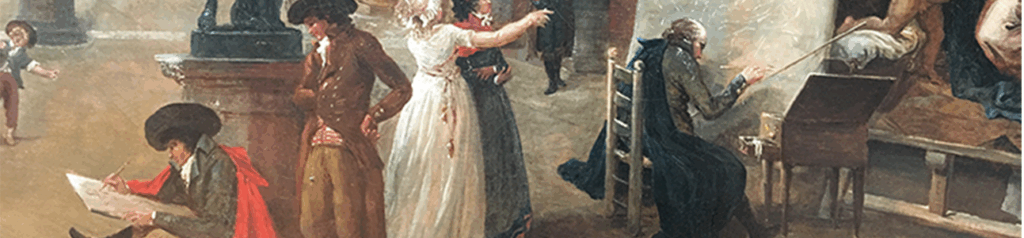
Hubert Robert copying paintings at the Louvre. I remember the day when I was a student of architecture, and was asked to deliberately copy a drawing (e.g. plan and section). At first, the faculty’s request took me off guard as I thought the act of creating came solely from an inner calling—my genius, my intuition, and my talent!
My arrogance was uncovered as, at that time, I had none of these attributes as a young designer. The lesson I learned on my path to becoming a seasoned designer was that I needed to understand precedence, which invited me to move beyond passive “seeing” and into active “observing.” This fundamentally shifted my approach to how to design.
Copying for the purpose of learning allowed me to acquire skills from past solutions, to understand particular design contexts, and to build on existing knowledge. This experience stimulated innovation, rather than as I had initially thought, stifling my creativity, or worse, being considered plagiarism. Since this epiphany—one should always have and remember these moments in life—I have continued to learn by observing and copying precedence in order to become a better designer.
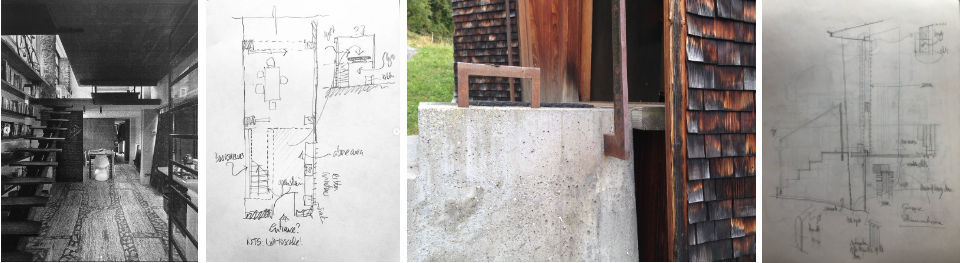
Copying in this manner is not replicating a project in lieu of relying solely on creativity.
Pride can often be stubborn. As a young designer I believed that I could make a mark through my own work. And yet, truly looking, observing, analyzing, and comparing and contrasting ideas is not about borrowing solutions by literally copying, but it is a way to understand how past masters handled the translation of ideas into space. To my joy, this also led to my fondness for anonymous architects.
Copying, as a method of “decoding greatness” is not only about skill building, but is fundamentally a way to break down a design, while rebuilding it to offer insight into the designer’s process (e.g. “reverse engineering”). I delight in acknowledging this skill-building two centuries after, as an updated version of the tried and true Beaux-Arts master and apprentice model!
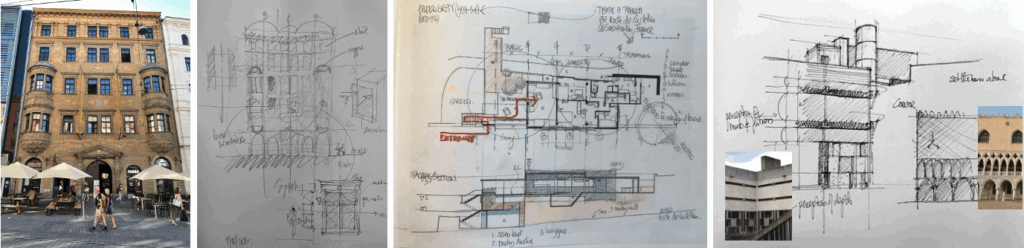
The Ecole des Beaux-Arts and Polytechnic education
While the teaching of fine arts and subsequently the instruction of architecture dates back to the middle of the 17th century in France, my education at the EPFL in Switzerland in the early 1980s, had understandably evolved since that time, especially since a polytechnic education had become a staple for the training of architects. And yet, while almost two centuries had passed since instruction was explored within an academic setting, certain traditional and foundational aspects remained relevant in the education of both disciplines.
One of these aspects was understanding the legacy of the discipline of architecture through careful observation and, in the case of my education, copying and understanding existing projects. I remember setting pencil to paper in order to understand a seminal buildings: the Villa Capra (commonly known as the Villa Rotonda (1567-1590s)) by Italian Renaissance architect Andrea Palladio.
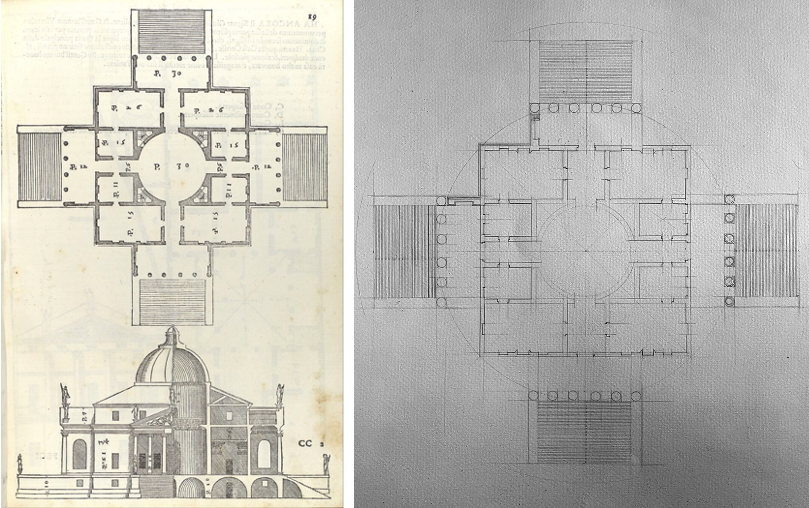
My drawing (Image 3)—which I have kept over four decades and begs to be completed—was an attempt to understand the underlying principles of composition that contributed such beautiful harmony, proportion, balance, unity, scale, and contrast in one of the most subtle double symmetries that a student could study. These foundational principles would give credibility to my drawing, as I would recognize the complex and cultural organizational ideas behind Palladio’s project. And this, while avoiding the project’s visual appeal that could easily bring a superficial and immediate satisfaction to the viewer.
These thoughts about learning from the past remind me of three paintings by one of my favorite artists of the 17th century, French painter Hubert Robert. A neophyte looking at these paintings, will easily see that they are depicting identical subject matter, namely one of the most iconic museum spaces in Europe: the Grande Gallerie at the Louvre in Paris, France (Image 4).
Hubert Robert
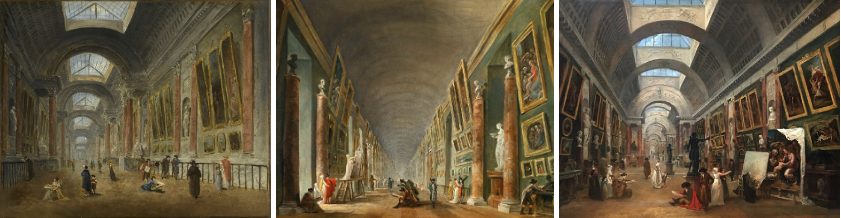
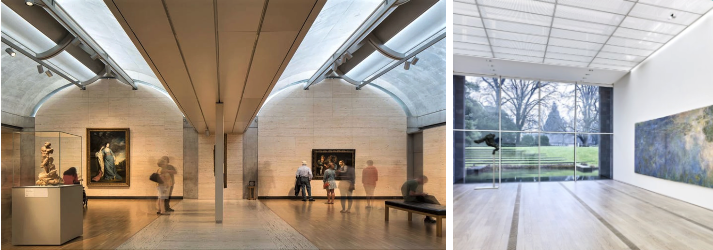
Painted between 1796 and 1805, the three spaces are all encompassing with an endless perspective defined by a long vaulted corridor-like space. In two of the three paintings, the vaulted ceiling is subdivided and treated as an enfilade (Image 4, left and right), all the while bringing generous sources of light to the gallery through skylights. This architectural strategy of lighting will be questioned in contemporary museums, as direct lighting provides glare and a misreading of original colors; all aspects soon to be understood as detrimental to the conservation of art.
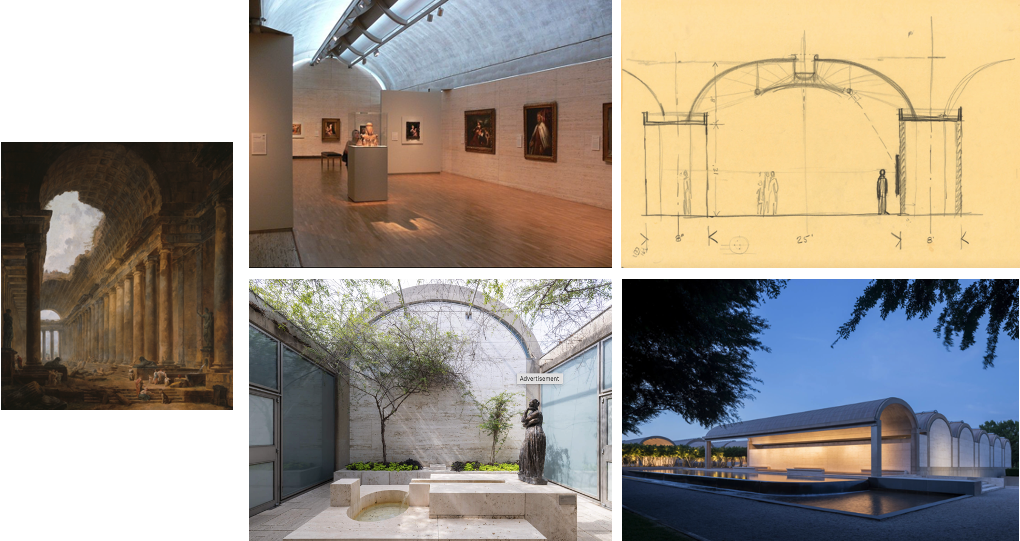
Of note regarding color, I would like to mention that as early as 1841 portable and stable colors were available in collapsible paint tubes, allowing artists to paint en plein air (outdoors). This caused both the Barbizon School in England, and the French Impressionist artists to abandon their studios and paint directly from nature with colors that were pre-mixed and newly vibrant. Paintings now needed to be appreciated in an environment where light control remained faithful to the artist’s color combination devised when painting outdoors, thus a more scientific approach to gallery lighting was in order (Image 5).
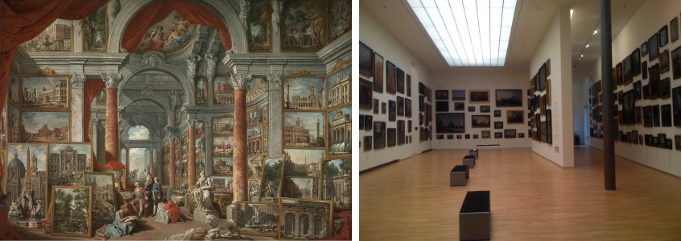
Beyond the skylights in Robert’s paintings, the density of art that takes place on both walls within the Grande Gallerie is noteworthy. Nineteen century galleries and domestic homes alike presented paintings in a salon-style manner. Masterpieces, often with elaborate gilded frames, were hung tightly together and often stacked from floor to ceiling (Image 4 and 6).
This hanging strategy, often referred to as accrochage à la française (hanging à la française) lacked a regard for the intimacy that viewing art may command at specific moments (e.g. the modern curatorial museographic strategy popularized by the MoMA in the 20th century). In a country such as France that revolutionized knowledge in the 18th century, creating what we know as the modern Encyclopedia, classifying, organizing, systematizing, comparing, and contrasting, they also found a way to define how paintings should be hung. Of course, this crowded method of hanging was also the result of the need to accommodate far too many paintings at the annual exhibitions of the French Royal Academy of Art, which evolved into the Ecole des Beaux Arts.
Large format canvases of acknowledged subject matter (e.g., biblical, mythological, allegorical and famous battles) were hung at a higher level, while those considered as lesser genres (e.g., landscapes, portraits and still lives), were displayed at a mid or lower level. Case in point, you compare the middle painting of Hubert Robert’s in Image 7 with the same gallery at the Louvre today.
The erudition of learning
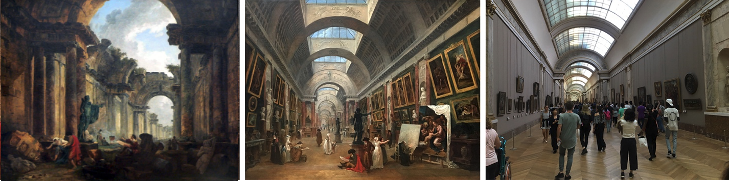
What is perhaps most fascinating for me and brings us back full circle to the idea of copying, is that within the context of these three painting (and many others featured in the postscript), is that Hubert Robert sets a number of protagonists center stage who are not only admiring art, but in fact, are copying art within the gallery. After the French Revolution of 1789, the Louvre was not only a public museum but also played an educational role by serving as an academy of painting, assisting in the display of art from the newly born Ecole des Beaux-Arts—the institution that is located catty-corner across the Seine on the Rive Gauche in the famous bohemian Quartier Latin.
Project for the Grande Galerie of the Louvre
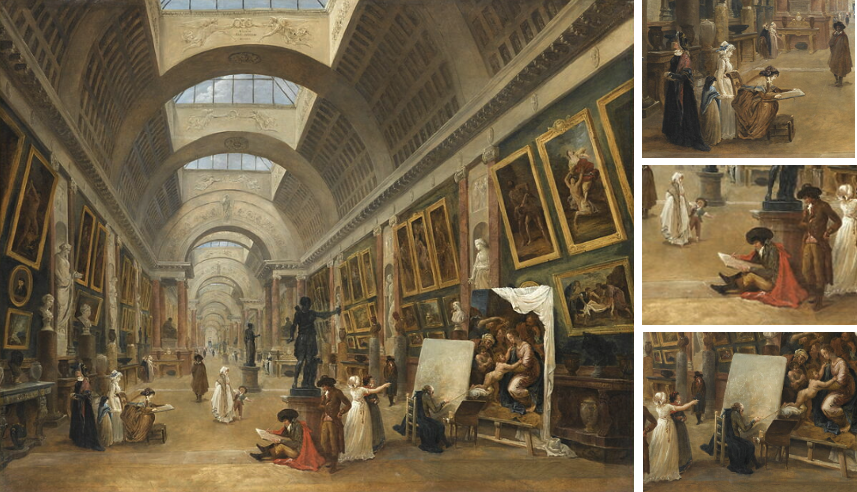
Of the three paintings in image 4 and 7, I choose the 1796 version to illustrate the concept of copying. Here, in the foreground of the painting, which is considered the finest in his series on the Grande Gallerie, are three internal scenes where Hubert Robert identifies copyists surrounded by curious bystanders (Image 10). To the far right of the tableau, an elderly gentlemen is seated in front of a large canvas set on an easel surrounded by his paint box (in fact, this depicts Hubert Robert himself). A larger master canvas is set on a tripod in front of him near the ground for closer observation. Hubert Robert was 63 when he painted this.
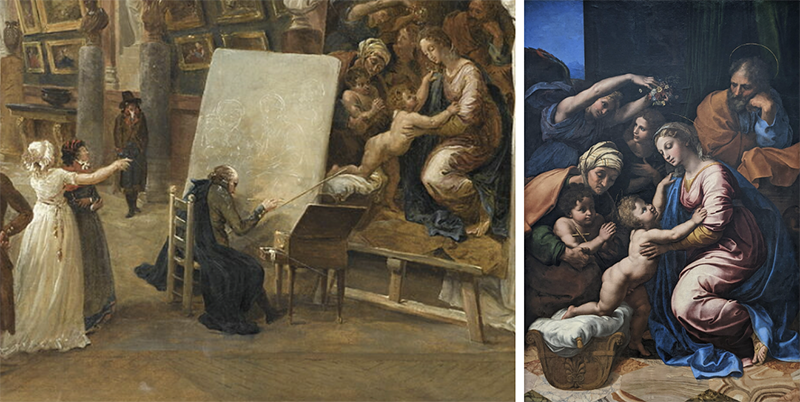
The painting by the copyist is in its infancy, but at a closer look one sees a careful composition of the original painting. Of note, the master’s painting in front of the copyist is The Holy Family of Francis I by Rafael dated 1518 and has been a possession of the Louvre’s since 1530 (Image 11, right). It is the only painting that seems to have been removed from a nearby wall for the artist to copy, thus the suggestion that the painter is question must have some renown, which Hubert Robert certainly had due to his responsibilities at the Louvre.
With a maulstick in one hand and a paintbrush in the other, the painter proceeds to now give meaning to the organization of the painting that has been outlined on the canvas through contours, shapes, and forms. At close distance behind the seated painter, are a couple of fashionably dressed ladies who seem enthralled by what they see (Image 11). The lady in a lightweight cream dress reaches out her hand suggesting lively engagement or instruction with her companion who seems more reserved and attentive, suggested by her gaze and the crossing of her hands.
The others in the background are treated similarly as Hubert Robert suggests a new public audience for art, a consequence of the transformation of the Louvre from a royal private collection into a public museum after the revolution. Art no longer belongs to a courtly elite. It has been democratized, and women seem to play an active role within the Grande Gallerie, this new cultural place for learning, leisure, and the spectacle of seeing and capitalized by the rising bourgeoisie.
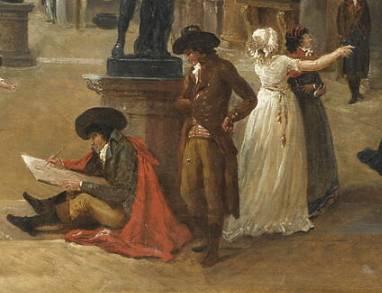
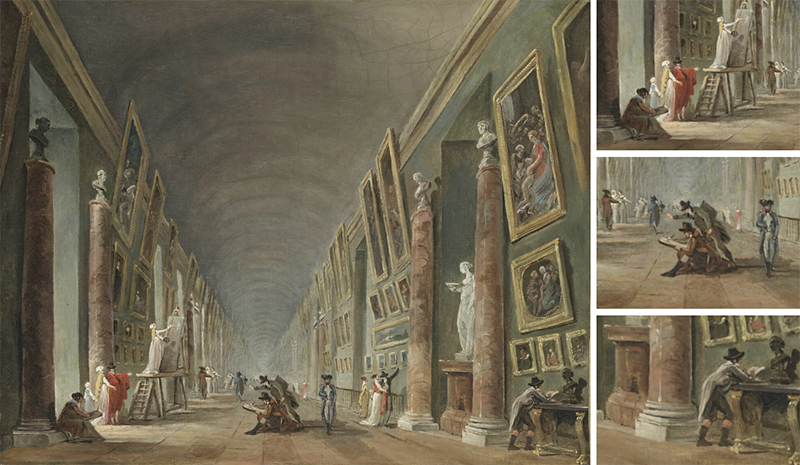
In the second scene of the painting, two young men take center stage in the composition. The one to the left is seated on the floor absorbed in sketching a painting or sculpture in front of him. Contrary to the other copyist (e.g. Hubert Robert himself), the young man has few attributes that give him recognition as an established painter. However, his clothing, boots, bright red cloak, and broad rimmed black hat, as well as the bystanding viewer, suggest that they all live a life of a certain elegance. Both men seem cultivated given their dress code. This is especially true for the bystander who has his left hand resting on his hip and the other one tucked in his jacket. A posture that suggests he must be a confident observer, self-awareness in his knowledge of art. Perhaps the men are acquainted and form a camaraderie similarly to the two ladies previously described, and to the right in this detail (Image 12).
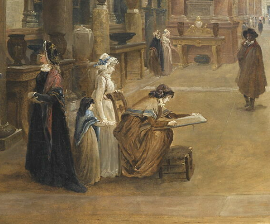
The last scene in the painting depicts women engaged with art. The key protagonist is a younger women bent over her drawing board, seated on a chair with a low stool in front of her. Similar to my previous observation, the women are positioned center stage in their participation of the study of art with postures suggesting concentration, much like the group of male counterparts in the same painting.
Behind the copyist are two women, one holding the arm of a young child perhaps meaning the study of art is now multi-generational, especially if one includes the elderly gentlemen to the far right of the larger canvas (the Hubert Robert character). The other lady dressed in black, observes art on the wall as if she had moved away from the young man on the floor perhaps to scrutinize the art depicted on his drawing board. Maybe a subtle suggestion of movement that takes place in front of our eyes.
Conclusion
Hubert Robert gives a realistic depiction of the gentleness of each character, suggesting the ideals of the age of Enlightenment. Like a cultural tableau, the copyists, bystanders, and museum visitors enjoy the individual liberty of appreciating art. For me, the idea of transmission of knowledge through precedence is as key in this painting as for me as an architect. Thus, in each of these scenes, the copyists are surrounded by viewers; perhaps a suggestion by Hubert Robert that they serve as intermediaries between the artist and us; the real viewers witnessing the activities between art, artists, and the democratization of society that are shown within the cultural mecca of the Grande Gallerie of the Louvre.
Postscript 1
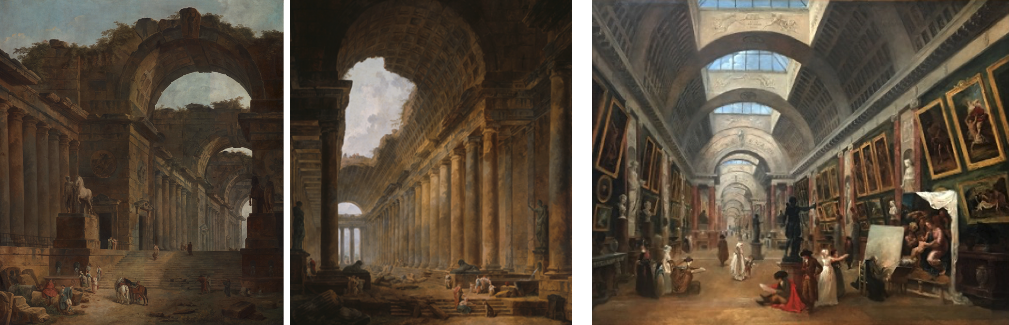
This blog would not be complete if I omitted additional paintings that inspired Hubert Robert in defining the tectonics of the Grande Gallerie. In particular, two paintings that were commissioned for the Château de Méréville by a wealthy financier: the Interior of the Temple of Diana at Nimes, and Le Vieux Temple, both painted between 1787-1788 by Hubert Robert. These paintings depict in the manner of Neoclassical capricci, scenes of fantastical dreamlike interior landscapes similar to the work of Giovanni Battista Piranesi.
In both, a Roman basilica made of antique ruins, monumental stone arches, endless colonnades, and coffered barrel vaults, partly collapsed and overtaken by vegetation, are teased out as the pretext for the transformation of the future Louvre. Robert’s curiosity in depicting the transformation of key monuments of the capital of France, was explored in a past blog. With Robert copying and invention become one.
It is the latter aspect that is particularly revealing for the current space of the Grande Gallerie, Let us not forget that in 1795 Hubert Robert was appointed curator and collector for the Louvre after the French Revolution. In his role—and while living at the Louvre just shy of twenty five years between 1778 and 1802—he created imaginative depictions of the museum, emphasizing the Grande Gallerie with suggestive power based on Classical Roman ruins in different states of disrepair. The architects who were later responsible for the lighting and redecoration of the Grande Galerie seem to have been inspired or they were merely executing the original ideas of Hubert Robert.
In many of his paintings of the Grande Gallerie, Robert envisioned a future Louvre—one that would open in 1793—where one could experience the famous art in a space covered by a vaulted barrel ceiling that later would become a key architectural feature of many museums.
Postscript 2
During my research, I discovered additional paintings by Hubert Robert depicting the Grande Gallerie at the Louvre. I am including them below. Some images have details to the right, showcasing similar topics of copying!
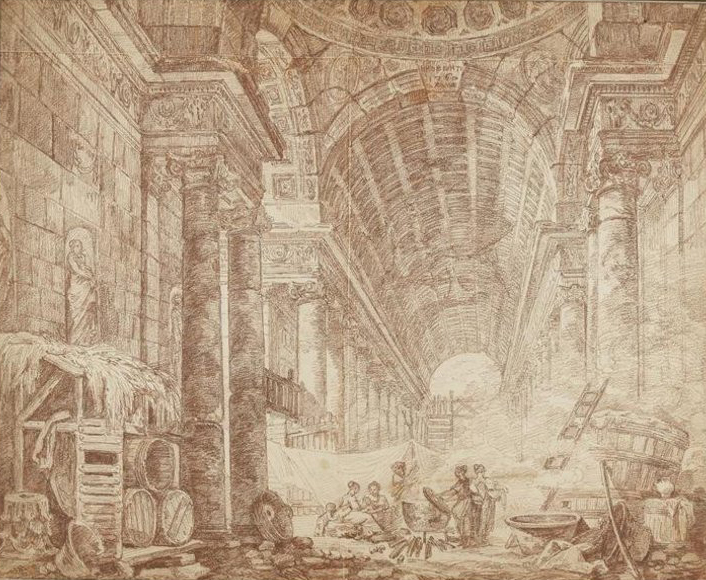
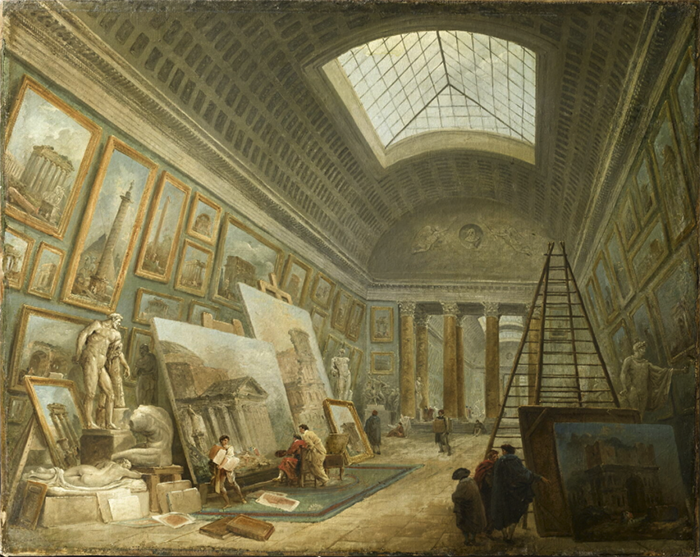
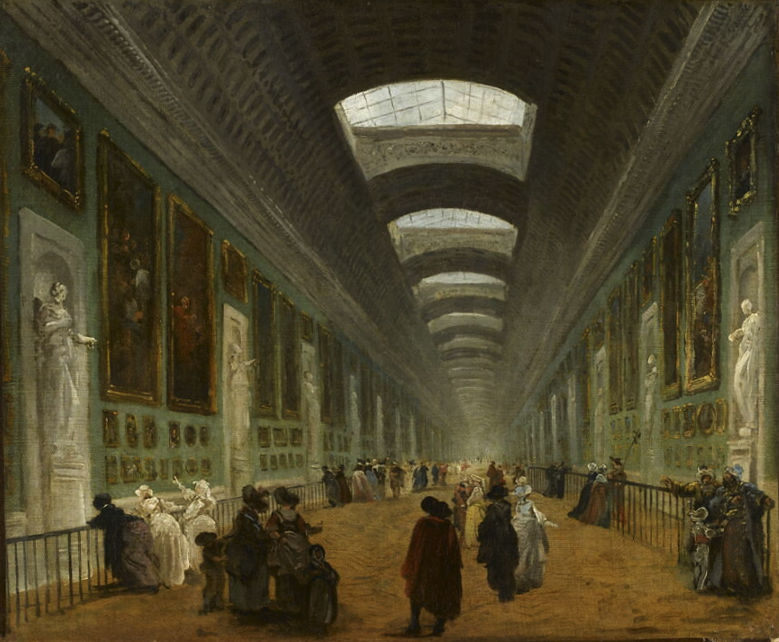
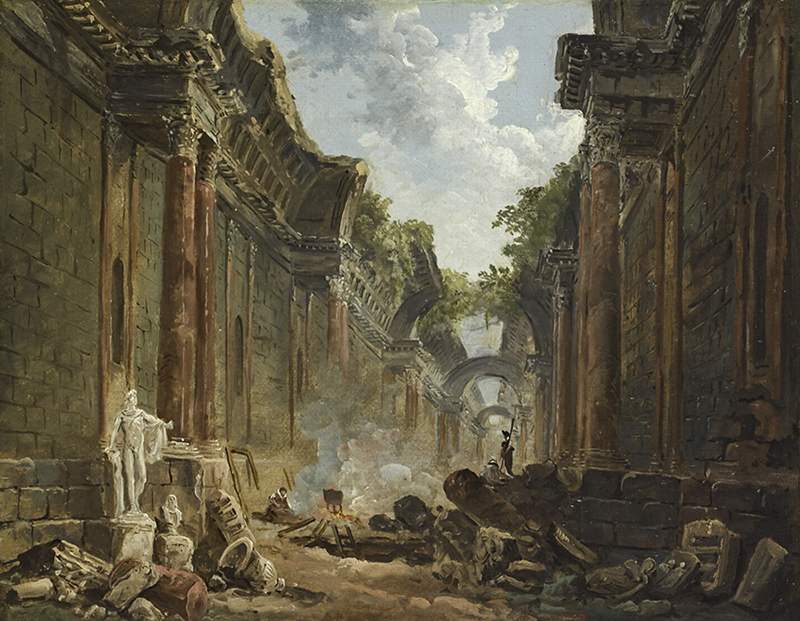
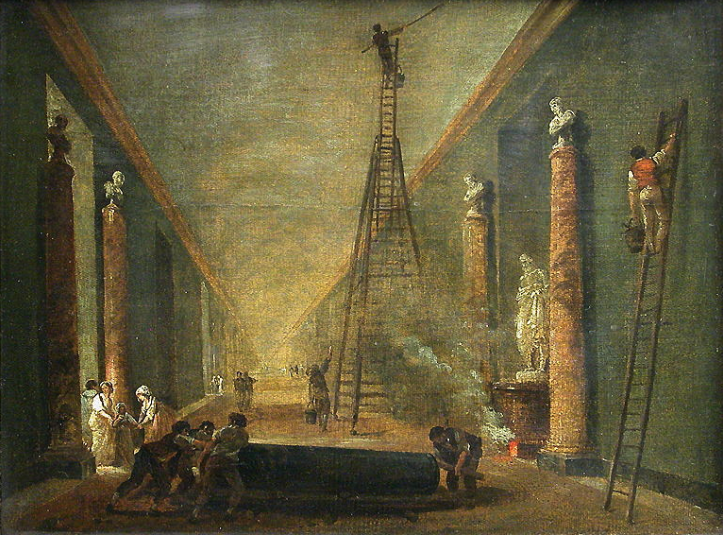
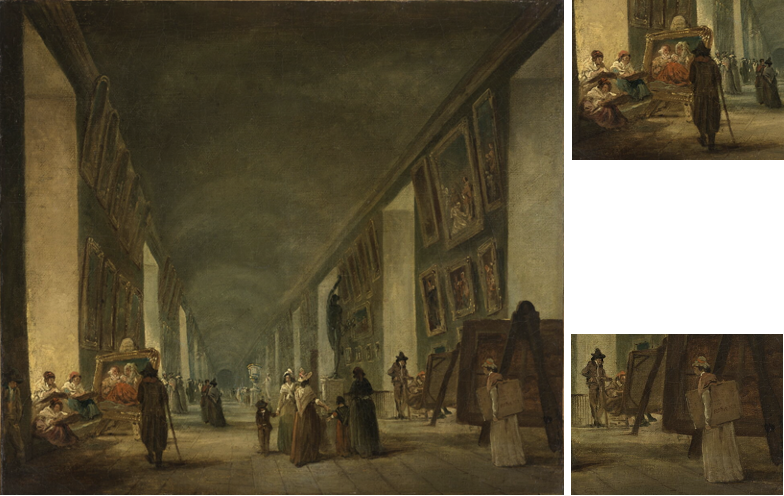
Image 21: Google Images -painting by Hubert Robert titled Project for the Grande Galerie of the Louvre (1796). Note the far left women characters is similar to the 1795 painting, to the exception that the bystanders are not present. This is equally true for the center copyist (see details).
Postscript 3
Other blogs of interest on painting
Architectural Education: valuing your mentors -Robert Slutzky. Part 2
Still lives by Ben Nicholson
Simone Martini: three principles of settlement
Le Baron Tavernier: a cafe terrace in the middle of the Lavaux vineyards, Switzerland
Edward Hopper
Art by Mike Goodlett
Robert Slutzky
Netton Bosson, Gruyeres, Switzerland