
Student critiques in architecture. Reflecting on my life as an educator, I perceive three important phases in the evolution of my teaching methods, and how, retrospectively, they have mirrored significant shifts in how students learn. As an introduction, let’s delve into the three phases.
First phase
- My first phase was as a young faculty member. My teaching methods were influenced by my own education, and highlighted the relationships between a structured approach offered by the EPFL in Lausanne (a Swiss polytechnic education), and a more urban, and artistic pedagogy experienced during my stints at the I.A.U.S, and Cooper Union, both located in New York City. Thus, this early phase reflected the need to balance various tensions: foundational skills that are both technical and creative explorations, with strategies to impart core competencies to my students. Finding a fine balance remains at the center of my current teaching, which emphasizes the acquisition of professional skills within a solid disciplinary context in architecture.
Second phase

- The second transformation was a direct and immediate response to Covid-19. The long-held belief for me, and my colleagues, was that a design studio environment could not be effectively replicated online. It was an understandable challenge—although ultimately I embraced the change with ease and aspirational confidence. When forced from the classroom because of social distancing, I quickly transitioned to the digital Zoom Workplace, which required finding new ways to not only deliver content, but, more importantly, for my students to design within a remote and hybrid learning environment.
Although they are part of the digital revolution, most students had never been introduced to Zoom. As a result, my teaching shifted from the traditional individual in-studio desk crit to daily on-line collaborative sessions. The result was that students learned to interact among each other, collaborate, and critique their colleague’s work in public (our on-line forum), although certainly to their dismay, missing the essential face to face interaction with their peers.
Third phase
- The last approach, which I have not yet explored, is the spiral into an unknown as we respond to the rise of AI tools. I will leave the promise or anguish of this unprecedented revolution for another blog, but at this moment, I see that with AI students arriving at college are on the path of a prepackaged tour of their life. Choices may already be predetermined for them in high school based on algorithms leaving little room for personalized learning and independent thinking.
My approach to AI at this time in my career might appear somewhat prejudicial, as I do not fully understand the exciting and dynamic possibilities of how this tool will enhance student learning especially in a design field. Can we continue as humans to rely on intuition and promote critical thinking and ethical judgement towards user inclusiveness—attributes that are indispensable as students self-discover the pleasure of the art of making space in architecture?
Of note, teaching on Zoom seems to have already been part of a third transformation: if one considers the introduction in the 1980s of computer aided software as a second revolution in the student design process and ability to communicate their ideas.
A traditional approach to critique

Prior to the pandemic, which spanned late 2019 to 2021, much of my teaching was done through desk crits and final reviews; an atelier system initiated by the French education model named after the Ecole des Beaux-Arts. Desk crits were a personalized and important moment of introspection between author (student) and critic (faculty) and remained the primary mode of teaching design throughout architecture schools. Students receive a personalized one-on-one moment of learning—a balanced approach based at its best on Rousseau’s Romantic idea of Culture versus Nature—where they showcase their progress, receive feedback, and most importantly, witness their faculty sketching out what they had verbalized but often not conceptualized in drawing.
The latter has played an important role in my teaching technique as I always sketch during student discussions with no fear that concepts and the illustration of potential solutions may hamper students in their own design ambitions. I believe that showing students how a faculty approaches problem solving through iterative sketching is essential and makes learning a dynamic and enjoyable process. The hands-on feedback through drawing is never linear and allow students to participate in my thought process as part of a constant discussion.
Sketching is never required to provide a solution, nor does it imply that students lack the freedom to investigate their design as they see fit. On the contrary, it is a visual translation of verbal comments that show, from my point of view, discernible indecisions and hesitation; spontaneous discoveries; seeking to unfold the meaning below the surface of their drawnings, and more often than not, eventually provides students with tangential design solutions that bring forth questions for their exploration. The value of such desk crits are immense and emphasize sketching as an important communication skill.
The obvious draw back with this approach is that students may believe that the sketches reflect what is required to advance their project. As a quick reminder, I state that ‘our sketches’ are not ‘my sketches’, thus resolving the question of authorship and possible fear or enticement to copy! Showing is sharing, and allows students to understand that design critique is about looking for options and refining ideas.
A new space for critique
So, what is different in my teaching from pre to post Covid? One answer is that in the traditional teaching context, I have always been disappointed when an epiphany happens during a one-on-one discussion with a student. Such learning moments are authentic and cannot be replicated. And this, for the simple reason that they are not intentionally orchestrated. As I mentioned before, conversations between student and faculty are dynamic, and allow events to unfold in real time, spontaneously, with passion and conviction.
When such moments occur, I want to immediately share with the studio what happened so that all students can benefit from this learning moment. In such circumstances, I encourage the student with whom I had the discussion to engage with their peers about what they had just learned; with a hidden agenda that the student, by sharing what they had captured and reiterated, would seal the critique more firmly in their mind.
The arrival of Zoom
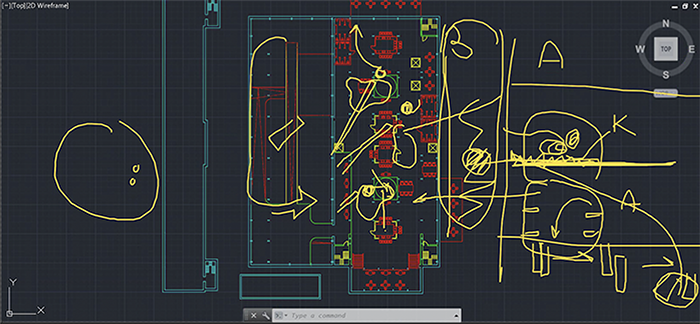
When Zoom arrived, it offered real time peer feedback for the entire class since they were all able to look at the screen, which was now ‘their desktop’. Events such as the one described above could now be experienced by all students in real time, and while I understand that often students are not fully attentive when not being directly critiqued, there is the aha moment that can be orchestrated. To expand on this thought, in these moments I often pause for a second and call out all to zoom participants to understand what they heard. This allows me to regroup some dreamers (typically those who have turned off their video), and have volunteers describe what they had just experienced as a listener. Here, an impromptu group discussion can be initiated, where the promotion of peer learning is brought to the center of the virtual design critique.
Now that we are back in a physical studio, I continue to use this strategy as I have found that students—over time—become more engaged, and learn to develop and sketch out concepts in concert with a dialogue between peers and faculty. A structured rapid back-and-forth between students and faculty encourages participation and keeps students actively involved. Students learn to publicly express their convictions and doubts, and gain facility in arguing their position, and refine or question the basis of their intuition and a project rationale vis a vis their design concept. This is particularly true when their project is not being directly discussed. Restated, I see students taking notes that I suspect relate to their own project as we discuss that of one of their peers.
Student critiques in architecture

If all works out, a dynamic learning environment is established. Of course, the faculty should leave the discussion open ended and, at times, at least at the beginning before students understand the format of the group discussions, I like to provoke the class by asking quick questions to bring them into the fold, which then leads to more robust discussions by all. Overall, there seems to be an appreciation of this pedagogical strategy by my students, as it requires each of them to think beyond their own design questions.
Ironically, discussions within the public realm set in place a healthier competitive relationship between students. No longer are they working in isolation, but their progress is made constantly public and discussed as encouragement for all. Critique of other student work takes time and courage but I have seen over the years how students find their place and contribute to the overall discussions, and, often as the semester advances, express pointed critiques that became part of an Aristotelian idea of sharing. An ideal world where learning with others is mutually fostered.
Challenges
Seeing the projects of others does not imply mimicry as a method of achieving excellence. On the contrary, I would argue that recognizing parallel struggles in other projects opens up discussion surrounding solutions; for example, topics that might have been avoided, or simply not recognized at a particular moment in a student’s design process. This might be a way of thinking about a particular problem, or the recognition that a peer is struggling with something (for example, structure) that another student hadn’t even realized they should consider.
Of course, the downfall of any public critique is that students can be shy and choose to remain silent, thus the need to engage them and develop a balance between individual crits and weekly public feedback. While I continue to offer periodic individual desk crits, I have learned that to engage students in a public realm has considerably improved their learning experience as it relates to their own design project. This may seem counter intuitive, but I believe that isolation (individual desk crits) is no longer a positive and essential quality for what was once considered a critical seed for artistic creation.
Conclusion
In conclusion, I would like to mention that in 2019 I also started writing blogs on the nature of architectural education. Their content often summarized particular design questions that the studio context brought forth and allowed me to extend teaching beyond location (studio context), and time (scheduled sessions). Students engage in learning at their own pace and through various didactic styles. Whether students learn orally, visually, or by practicing their art form, blogs seem to be a contemporary extension of the studio context which summarizes knowledge in a way that allows students to learn asynchronously. Thus, I was happy to leverage alternative and more comprehensive approaches to learning that fit today’s student reliance on digital media.

I am reminded of how many times as a student I did not catch the depth of a critique or missed an opportunity to rethink a professor’s comment, which at the moment might have seemed insignificant (e.g., the meaning of drawing in an integrative manner). My blogs have enabled my students to revisit fundamental design questions by reading the content as many times as necessary. Knowledge is often gained by repetition, and I am happy that this new medium has opened up new venues for students to learn. In fact, I had an epiphany when a student expanded on the topic of one of my blogs titled sketch modeling. By interpreting one of my blogs, they expanded in a way that I had not anticipated. I wrote another blog in response (blog 1 and blog 2).
Finally, while I applaud genius, the weekly pedagogical modality of group critiques allows me to circumvent the artistic self-centered ideal of the artist as sole creator. For me, this promotes a ‘return’ to an anonymous architect(ure) that is discreet and self-effacing. The obsessive discourse in academia that favors having the artist (student) look inward to elevate their craft when they abandon themselves to the direction of their genius, is for me passé in a world where cross-disciplinary endeavors and a team approach has given new meaning to the word design thinking.