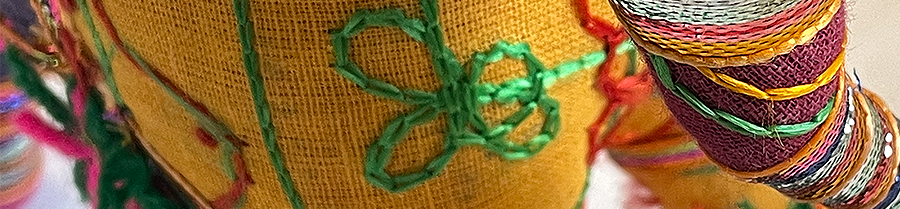
Rajasthani handmade stuffed animals. Now that the holiday season is rapidly approaching—and as I skipped Halloween this year like many of my friends—I have already brought down from the attic some of my favorite holiday decorative items. Over the years, I have collected Rajasthani handmade stuffed animals and made a point to add to my collection every time I return to India.
While I cannot remember the exact provenance of each, I do remember that some were purchased at the bustling Bapu Bazaar in Jaipur as well as from children on the donkey path leading up the hill to Amer Fort (former residence of the Rajput Maharajas prior to moving to Jaipur, the first planned grid-like city in India). I keenly remember acquiring my most prized animal, a magnificent horse, next to the towering 120 foot tall sandstone walls of the Mehangarh Fort in Jodhpur. Its story is described later in this blog.
My collection of Indian handicrafts (totaling eighteen pieces) has always made me smile and offers a glimpse of my childhood where stuffed animals meant comfort, provided a sense of security, and served as imaginary companions with whom I could play and share my thoughts. The animals in my collection now are elephants, camels, and horses of different sizes. In fact, in my experience those are the only animals featured by Indian artisans as they hold deep symbolic meaning in Indian culture, representing a range of qualities from divinity and wisdom to endurance and power. In particular, the elephant is seen as culturally more prominent, as it carries religious meaning on the subcontinent, namely as the Hindu deity called Ganesh.
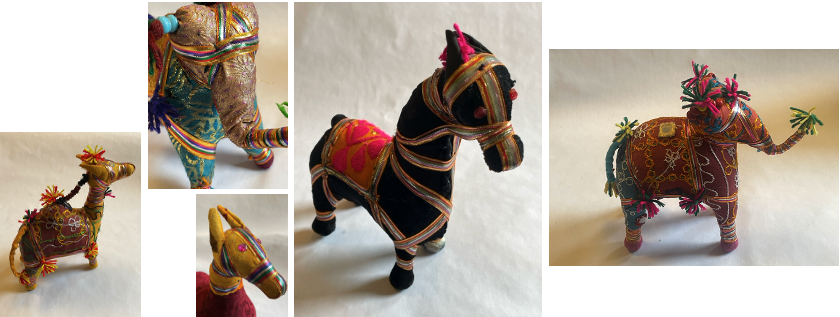
These handmade stuffed animals are produced by local women from the state of Rajasthan who often belong to women’s cooperatives representing India’s famous rural cottage industries. A cornerstone industry advocated and revitalized by Mahatma Gandhi. The examples that I have form a wonderful visual collection that I set on a large cabinet that has its own history.
The large display cabinet originated at the Kaufmann department store in Pittsburgh. The name Edgar J. Kaufmann, Sr.—is, of course, for an architect—synonymous with the great patron who commissioned the American juggernaut Frank Lloyd Wright to design the iconic home Fallingwater (1932-1937). Perhaps I will cover in another blog the modularity of each cabinet that allows the creation of flexible display cases and wall storage that are vintage, yet so contemporary.
Stuffed animals
When seeing these stuffed animals being sold, what drew my attention to them were their vibrant colors and textures. Made from luminous fabrics, beads, small mirror work, and colorful threads, hand stitched to cover the entire body of each animal.
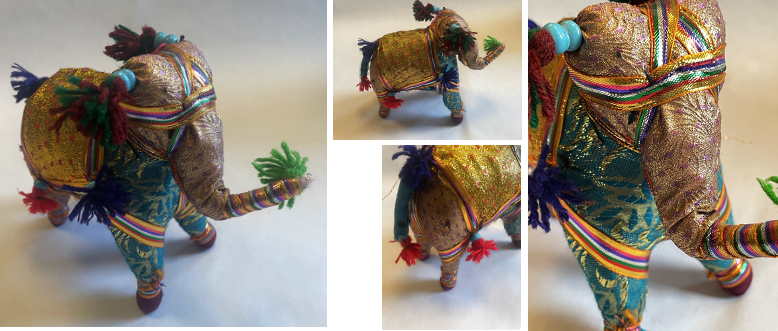
Scraps from saris (a cloth that is draped around a women’s body as a traditional Indian garment), or other brightly colored and patterned fabrics formed by a variety of materials such as cotton, silk, or velvet envelope the form. When the animal has taken its final shape, it is first covered with a velvet suede undercoating. Then, fabric scraps are sewn over in a patchwork design, emphasizing key features of each animal: trunk, head, large ears, tail, and powerful legs for the elephant; hump and long legs, stretched out and curved neck for the camel; and elongated and proud forehead, strong shoulders, and long skirt for the horse.
Elephants
The sewing is done with either thin threads or cotton yarn using contrasting colors to emphasize the seams between fabric. Another more prevalent technique is to use strips of zari ribbon trim predominantly featuring gold and silver (often with orange, white and green colors of the Indian flag) to conceal the seams (Image 1).
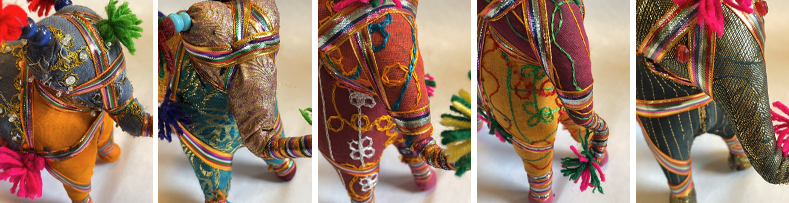
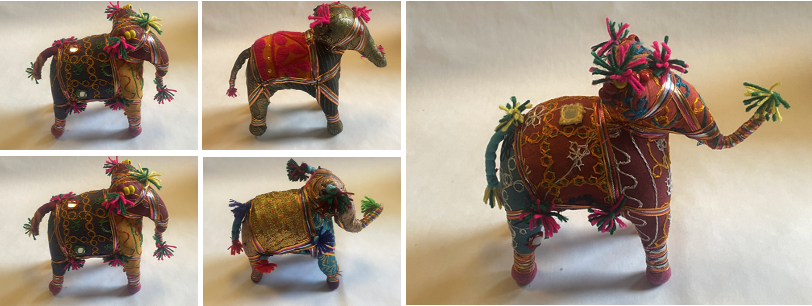
For example, all seven elephants that I have, incorporate ribbons to emphasize the powerful feet, while artfully extending around the legs and other body parts to give formality and dignity to the animal. Often pom-poms of various colors, along with shiny flecks and beads are placed at key joints—ears, trunks, and tails—lending variety and beauty. Each elephant has a decorative saddlecloth associated with the royal elephants of Rajasthan. My favorite one is gilded smooth with small square pink details like a rug that shimmers under the light with a Maharajan demeanor (Image 2).
Camels
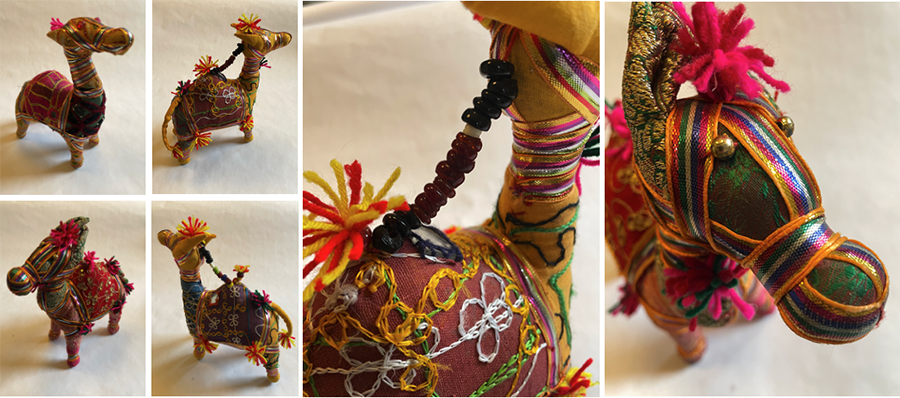
The camels are treated similarly to the elephants although they emphasize their hump and curved neck. Those in my collection have intricate patterns on the saddlecloth made from braided string which creates playful arabesques. Similarly, but with more formality, one finds this technique applied to the neck. Beads often join the head and the hump (Image 5).
Horses
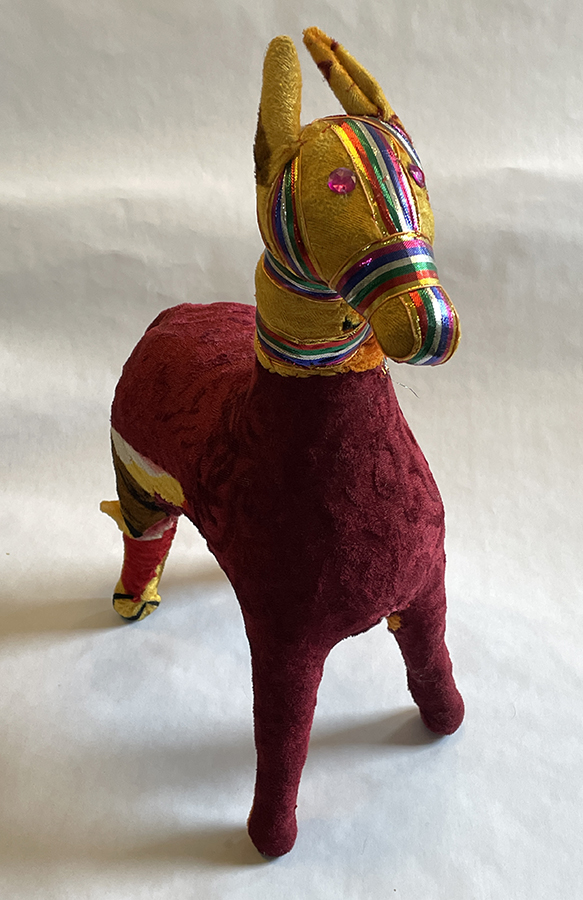
For some reason, I only have two horses (Image 1 middle, and Image 6), but one is especially prized. You might think that the horse’s decorative features outperform those of the elephants and camels. You guessed wrong! This horse, whose scale is double the others (19.6″), is unfinished. Yes, incomplete in its regal beauty, which is the reason I fell in love with it, and asked the artisan to let it go as an incomplete stuffed animal.
As we wandered on the ramparts after a tour of the interiors of the Mehrangarh Fort in Jodhpur, I saw a woman working on this horse. She had set many completed animals on the stone path, all waiting to find new homes. And yet, it was precisely the one that she was holding in her hand that drew my attention. I felt that it had to join my collection, and with the help of a native-speaking bystander, my admiration for its in-process state was conveyed to her.
Needless to say, the women was confused and almost concerned that she would part with an art piece that did not fully represent her skills, techniques, and sense of design. After some discussion, the rest is history, and I continue to love this particular horse. Not only because of its predominantly red velvet suede undercoating, but because it shows where and how the artisan started the decorative coating.
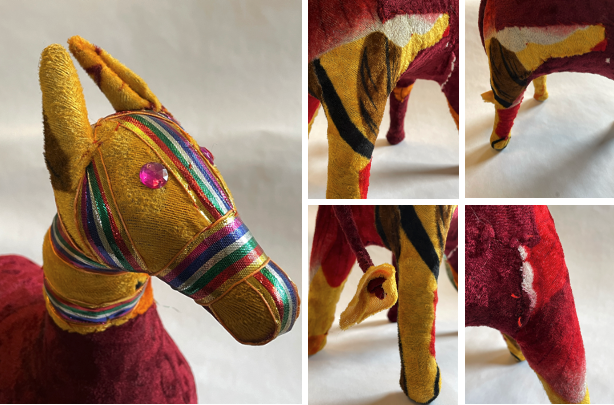
You can appreciate key moments of each stitch, the length of the zari trim, and in this case the beautiful deep maroon velvet undercover that give the horse its overall rich plush texture. The feet, and in particular the back feet, feature different colored fabrics (golden yellow, orange, red, black, and brown). A little like the motifs found on crazy quilts created by the Shakers. On this Indian horse, you can see all of the stitches, which gives it a sense of in-the-making (Image 7).
As a final note, already a beautiful touch appears at the end of the tail (a yellow flower with a saffron red bud, Image 7 middle bottom), that suggests the future planned completed magnificence. And yet, I love it for what it is: its design, its incompleteness, and its softness. I would have loved to have this horse as a kid!
Conclusion
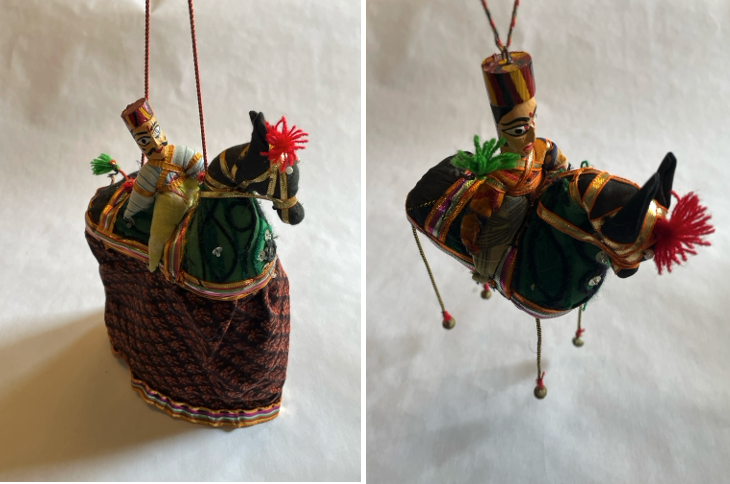
In my pursuit—and obsession—of collecting, I found these two small mobile-like horses each carrying a rider with a traditional Rajasthani turban. As they hang, the left image above covers the feet of the horse with a skirt, while the right hand one, when moved back and forth, lets the legs gallop in the air as it was competing with Pegasus.
Additional blogs on the author’s various collections
- Antique carpet stretchers
- Swiss white wine glasses
- About watches and their typefaces
- A compass set
- Harrods mid-century cocktail cabinet
- Mortician embalming cooling table
- Urban Posters in Paris, France
- Secretaire a abattant
- Tri-fold mirror
- Vintage New York Postcards: Part 1
- Vintage New York Postcards: Part 2
- About miniature metal buildings
- New York vintage traffic signals