
Antique carpet stretchers. A colleague of mine once said that I am a collector of collections. A flattering statement that I take with great pride, as in a certain way, his comment validates my interest in collecting distinct objects that I have an emotional connection with. Some of my collections may be called material culture, a term that refers “to the physical objects that people create, use, and value within a specific society.”
Other collections are of more mundane objects, yet when seen as a group, they generate a sense of curiosity (e.g., miniature metal buildings, snow globes, die cast toy airplanes, Forcole, to mention few). Unquestionably, one collection has always immediately intrigued viewers and almost always ends up with their utter fascination. It began this way. Years ago, I was given three antique carpet stretchers. Seeing them at a glance for the first time, and with no context, I thought that they looked intimidating, a little like torture instruments of a by gone era.
With some encouragement by the giver, I came to understand that these contraptions were designed for the installation of carpets, and associated maintenance tasks. The pieces that I own now—twelve to be precise after falling in love with the first three ones—include “power stretchers” and a “knee kicker” and all are vernacular in their form and were made in the United States in the late 19th and early 20th centuries. Several are readily identifiable as they feature names and patents embossed on the metal parts. All those in my collection are manual carpet stretchers (also called carpet strainers prior to 1938) and are made out of wood and cast iron.
Early carpet stretchers used the sheer force of the knees (knee kickers) and were considered the workhorses for smaller spaces such as closets and staircases, while new and improved tools came later with a variety of ratchet mechanisms with which to pull the carpet taut (power stretchers). Looking at my collection, each object is unique and beautiful as well as functional. Without question, each object expresses the craftsmen’s artistry and ingenuity that went beyond the call of duty. They exhort pride and knowhow as examples of the creation of practical tools for ease by the user, yet always with an aesthetic touch. Like in architecture, designing instruments (spaces) was a matter of pride where functional well-made (designed) attributes are a must.
Carpet stretchers
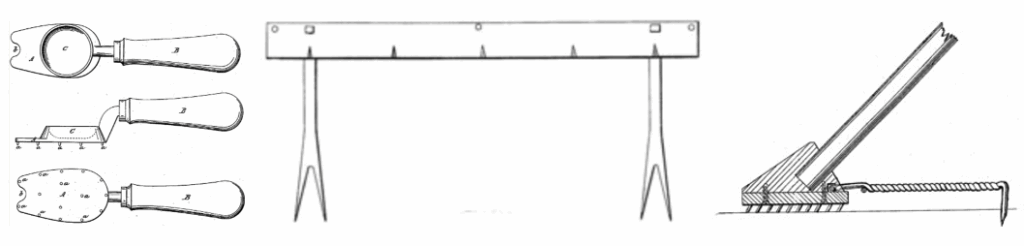
When initially developed (the first carpet stretcher was patented in 1860 according to the Directory of American Tool and Machinery Patents), carpets were secured by individual tacks and nails, then stretched by the installer’s strength as they pulled the carpet with a rudimentary tool to achieve a taut smooth horizontal layout. Other early stretchers were designed to push the carpet towards the edge of the room, with more or less success (Image 1).
As carpets became fashionable, the carpet industry expanded, in particular in the domestic realm. New tools were developed, such as knee and power stretchers—with ingenious contraptions including gripper strips—and they became readily available and made the installation of carpets more efficient with greater precision. Early tools consisted of two parts: a head that was made of metal, cast iron, or wrought iron with a set of teeth to grip the carpet, and either a handle made out of wood (typically beech wood) or a kicking pad to exert pressure.
Some of my stretchers have patent numbers, manufacturer markings such as logos or company names, all to enhance the perception of the value of their product. Not so dissimilar to today’s clothing that features brand names front and center to signal the owner’s good taste and status!
How are carpet stretchers used?
The technique of laying carpet was straightforward but demanded precision and leverage strength. Professional carpet layers would secure the carpet on one side of the room, often at a wall’s edge, and with a carpet stretcher, pull the carpet towards the perimeters of the room where it could be secured to the opposite side wall with tack strips. This method alleviated the chance of wrinkles, especially as carpets might expand due to foot traffic and usage, and result in unpleasant lumps. Thus, professional carpet stretchers assured a continued smooth carpet surface.
One can imagine how much force was involved given the weight of carpet, especially with the more rudimentary knee bump stretchers that did not provide appropriate ergonomics. No wonder the saying “carpet fitter’s knee,” to indicate the common injuries due to repeated impact.
The growth of carpets
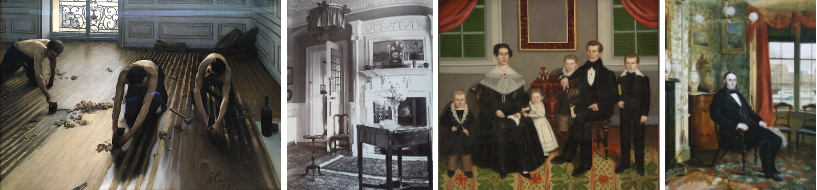
At the beginning of the 19th century, the interiors of bourgeois homes typically had hard wood floors. Initially made from various sized planks of basic pine wood, upscale houses began to feature newly fashionable parquet flooring composed of different colored woods (typically oak, cherry, maple, and walnut). Floors were often oiled or varnished, and could be painted, or stenciled with border motifs mimicking rug patterns, all in an effort to offset the desire for expensive carpets (Image 2).
The use of various woods emphasized lines and patterns and created ornate borders in a room, defining the space as a method of marking the excellence and wealth of the owners. Master craftsmen were responsible for such artistry in laying, waxing, or refurbishing the wood, as in the famous painting by Gustave Caillebotte titled Les raboteurs de parquet (Image 2 left).
As the century progressed, early wall-to-wall carpeting replaced wood flooring or expensive area pile carpets. If carpets were present, they were made by hand-sewing narrow strips of wool or cotton/flax to form larger carpets which were fitted to specific dimensions and shapes of a room. These fitted carpets were referred to as druggist or Venetian carpets, with patterns often matching floral wallpaper motifs and upholstery themes. Very quickly owners would call rooms the green room, the red room, etc.
The social role of carpets
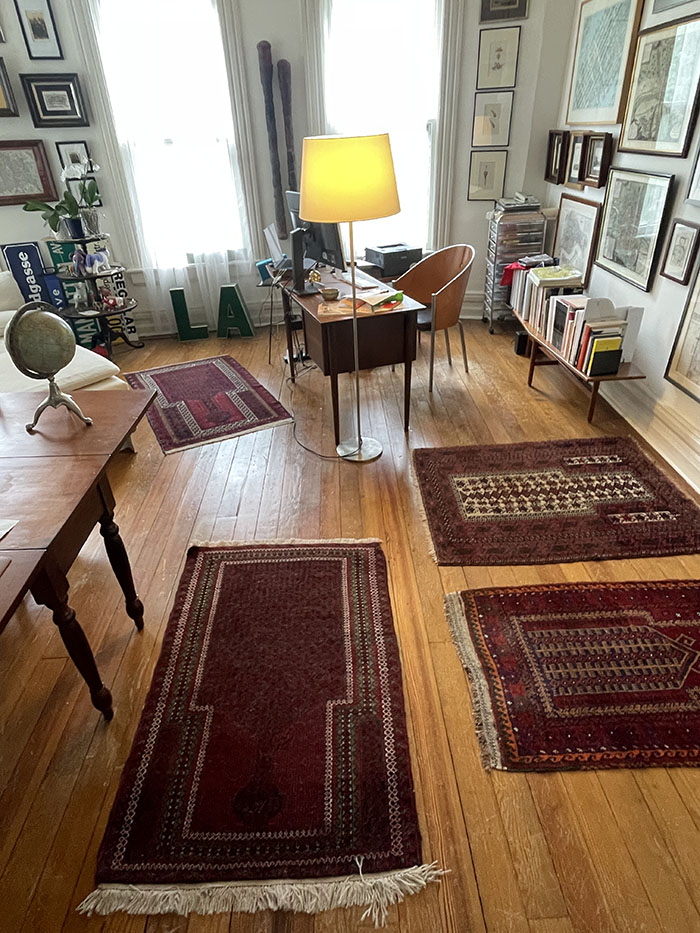
Early carpets were used in rooms that typically carried public functions such as parlors, drawing rooms, and living rooms, leaving other areas (e.g., service areas, hallways, and bedrooms) with more traditional flooring materials such as tile, marble, and painted or stenciled motifs on wood.
Choosing a carpet of this nature over pile carpets or wood floors became fashionable and was also a result of new and improved manufacturing techniques such as broadlooms that now wove large carpets by machine. Carpets became less expensive, fashionable and modern, offering a warm and a cozy feel. There was also a pragmatic choice in their popularity. As insulation was practically nonexistent in houses, plank floors contracted during the winter months, allowing drafts to enter through cracks in the flooring. Carpets resolves this issue and also provided some noise reduction that resulted from expansion, humidity and poor installation.
The expansion and demise of carpets
In this context, household goods catalogues were quick to hail carpet with “a view to appearance.” Thus, the carpet industry expanded rapidly, responding with a shift from woven to tufted carpets (the latter being a more economical manufacturing method), which subsequently increased demand for professional carpet layers and thus led to multiple innovations in the design of carpet stretchers.
However, with time, wall-to-wall carpets were vilified as dirty and difficult to maintain, especially beginning in the 1920s when society was abandoning at live-in servants. This was particularly true because of changes in social norms and the increasing participation of women in the workforce. Hard wood floors—in various European styles—became the norm again with hand-made oriental rugs as accents. The fashion of carpets rebounded after WWII with the advent of domestic vacuum cleaners. Then contemporary modernism of the 1950s ushered in new man-made machine materials such as vinyl tiles and linoleum. This new fad of modernity, led to the 1990s with natural fiber sisal rugs (a product that does not trap dust, thus only needs vacuuming).
My collection of carpet stretchers
The carpet stretchers in my collection are a small sample of the various types. Each is hand operated, from the primitive America kneecap style to the more advanced standing tools. Each is unique in its own way, and I have organized them below according to a chronology that I perceive to reflect their evolution of technical and ergonomic improvements. While carpet stretchers were central to the correct laying of wall-to-wall carpet, other tools used by carpet layers may have included tucking tools (for those difficult to access places), creasers, tack extractors (patent 1884), utility knifes, and trimmers to name a few. The assortment of tools seems to indicate that none were suited for performing multiple tasks.
My research also shows that some stretchers only had single primary teeth (for gripping the carpet), while others featured secondary smaller teeth interspersed among the primary ones to increase the tool’s effectiveness. The models in my collection only have primary teeth.
Important for any carpet stretchers are the varied methods for applying tension when installing the carpet. Some antique models feature a long handle that the installer would lean onto to apply pressure, essentially pushing the carpet across the room. A related tool, the knee kicker, is shorter and relies on the installer striking a padded end with their knee to generate tension. More modern power stretchers use adjustable poles and lever mechanisms to apply tension.
Two very early carpet stretcher
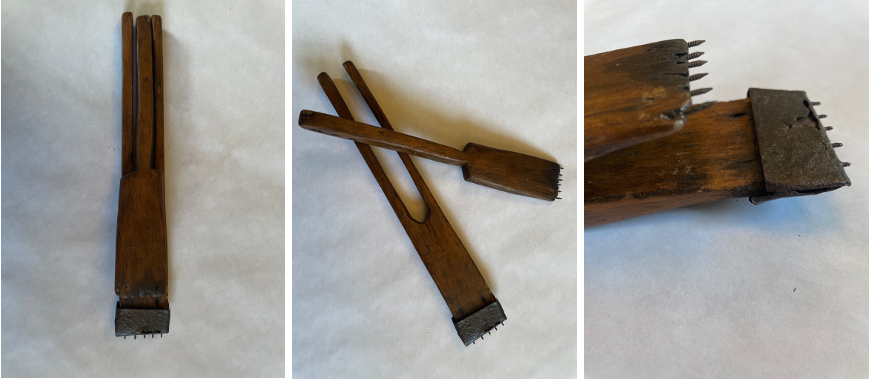
Image 5: Carpet stretcher (author’s collection)
This carpet stretcher seems to be the most vernacular and rudimentary one in my collection. I base this on the roughness in how the handles have been fashioned. Formed by two combs with nail-like spikes at both ends to grip the carpet, they are secured together by a dowel. One one handle is like tongs (perhaps to be used as leverage) while the other is a simple paddle stem. I am missing the connecting dowel but given that the tong handle features five holes, I assume that the paddle stem—which has only one hole—can be fitted in different positions, thus suggesting different lengths, which offer varied degrees of stretch.
Dimensions:
Wood handles measure each 13″ x 2″, and 11 1/4″ x 2″
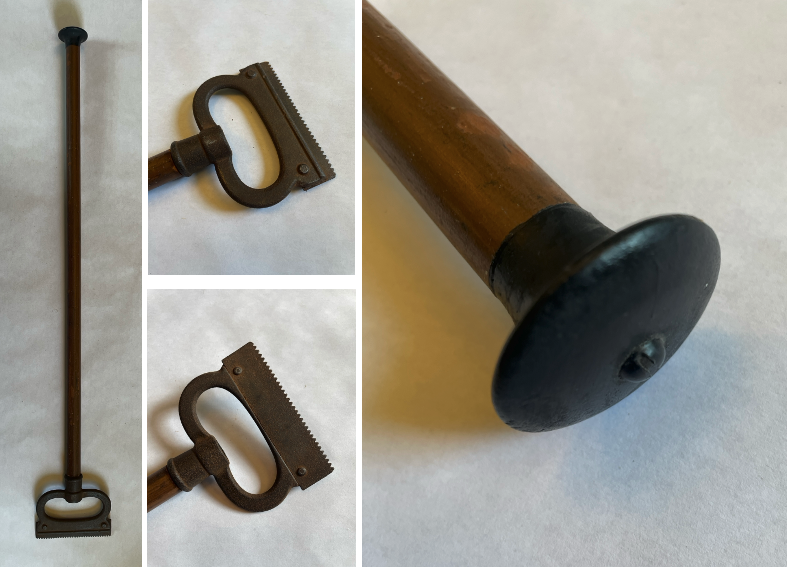
This carpet stretcher seems to be the second oldest in my collection, it is primitive yet handsome in its proportions, simplicity of design, and functional detailing. The wooden handled stretcher dates to the early 1920s and is made from wood and metal. One extremity has comb-like teeth that firmly anchor in the carpet while the top of the handheld pole pushed the stretcher in the desired direction. The top of the handle features a small elegant mushroom bead. The actual head (NOS model) features a decorative blade holder made of forged steel, in which a removable blade could be set.
Dimensions:
Metal measures 4″ wide and 27″ long, and ball end 3 1 ½ “
Kneecap Stretcher
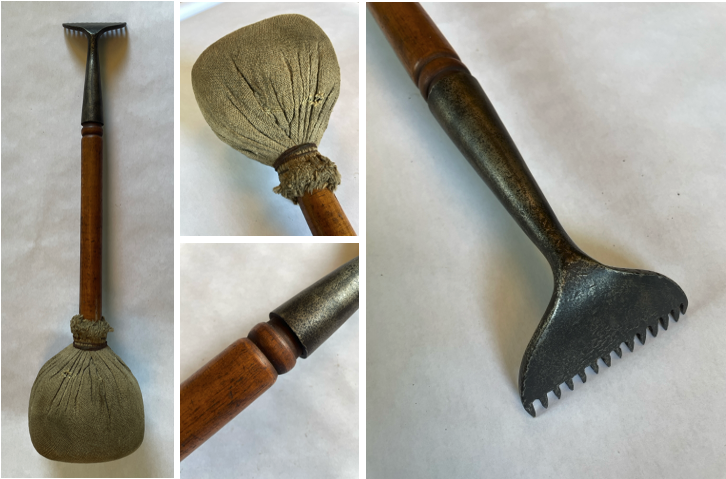
This very simple object speaks for itself. The kneecap stretcher has a comb shaped gripper with 14 spikes and is elegantly designed to receive a turned lacquered wooden handle. The handle was finished with varnish or resin-based paint, typically made from beech wood that is often referred to as Japanning, a decorative style that provided a more durable finish. This method of finishing was also applied to the serrated comb, which made from forged metal, needed to be treated to prevent rust, thus giving it the characteristic Japanese glossy hard black finish.
Note the detail at the juncture between cast iron and wood materials which belongs to this style. The stump used for pushing with the knee was made from a thick cloth fabric that I suspect that it is not original, yet the metal rod tying it is rusted and shows a certain age.
Dimensions:
Overall length: 22”, stretcher tool: 3 ½”, stump: 5” square base with a 4’ height
Wood Carpet Stretcher The Victor C M Mallory Albion NY (Patented May 7, 1889)
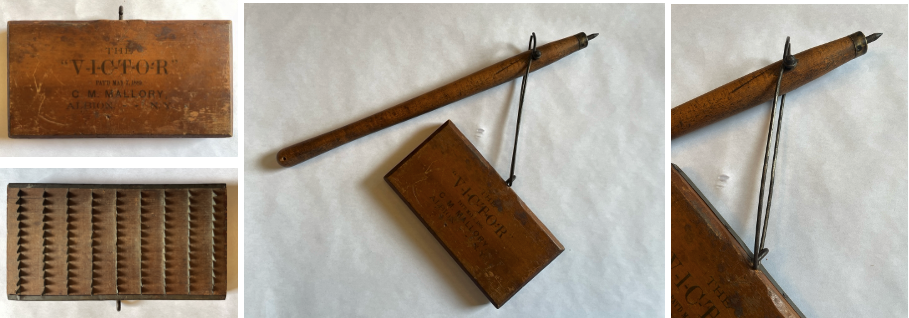
Reminiscent of early Americana, this primitive stretcher is a two piece tool. The flat rectangular section is made out of wood and features the patent information. On the back side nine rows of triangular sharp spikes are inserted and provide grip to the rug as it is pulled to make the carpet snug and flat. The stretching movement is done with a wooden handle tied to the rectangle with a hook.
Dimensions:Rectangle: 9 1/8″ x 5 1/2″ x 1″ and handle: 18 ½”
Four carpet stretcher cross-shaped models
Each of the following four models are called power stretchers or extendible stretchers and were used primarily in larger rooms compared to those where one used a kneecap stretcher. Each of these cross-shaped versions uses a lever to pull the carpet snug across the floor, benefiting from greater tension accompanied by more ease and efficiency.
The star cast iron carpet stretcher
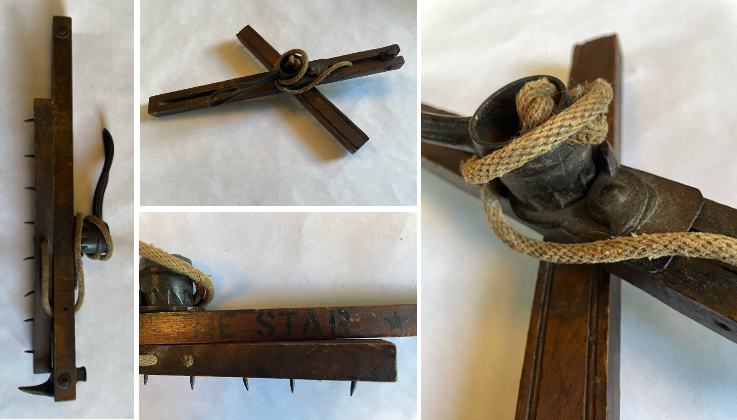
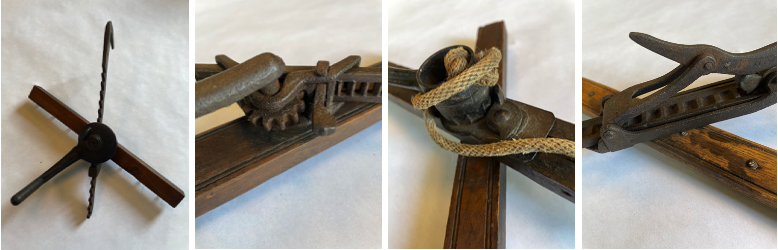
“The Star” carpet stretcher featured a cross-shaped design with pins to grip the carpet and a ratchet mechanism for tightening it. One arm has a heavy pin which is driven into the rug by a hammer. The other arm features eight angled pins that grab the rug and swivel to 90 degrees to form a cross. The center pully is then cranked by tightening a rope running through a small iron pulley, moving the cross bar, allowing the carpet to be stretched (Image 9).
Carpet stretcher
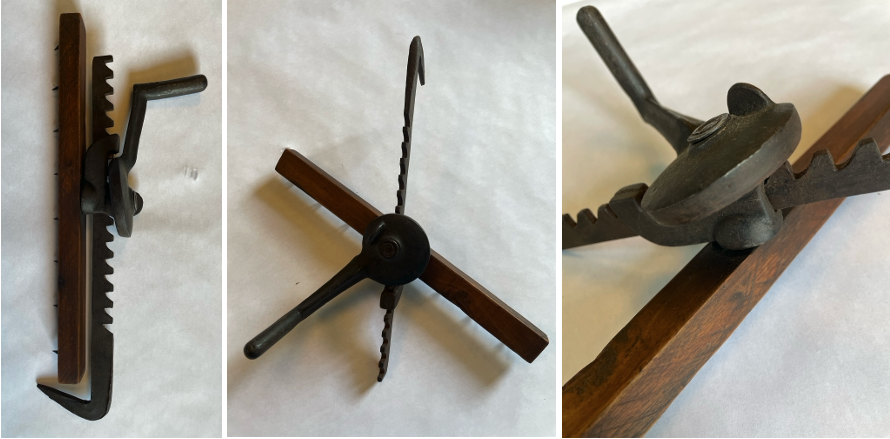
This stretcher, along with the next two (Images 11, and 12) present a new invention: a longitudinally extendible stock. The innovation provided a rack formed by a strip of cast-iron from which a set of teeth (convolutions) emerge on one side. As the hand grip rotates around its axis, the teeth are engaged with the eight pins under the wooden part stretching the carpet. A very simple, yet elegant solution.
Dimensions:
1’-0” by 1’0”
The Cady Wood Cast Iron Carpet Stretcher, Patent 1892
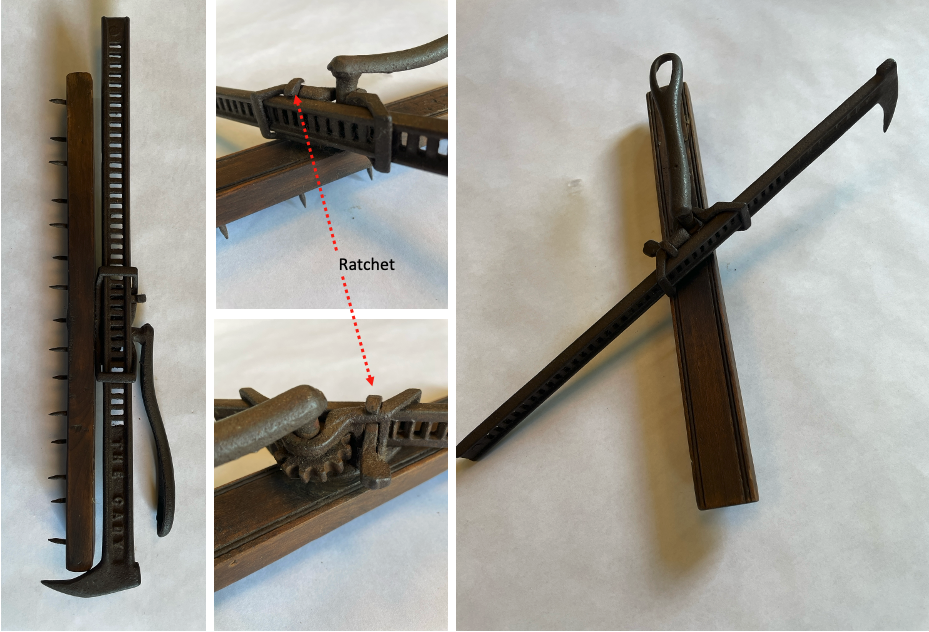
This carpet stretcher and the next one (Image 12), seem to be an improvement on Image 7. The earlier comb teeth like extension has been replaced by a ladder extension which includes the name The Cady. A more pointed hook is found on this tool, along with a lever mechanism that keeps the ladder straight. Noteworthy are two ratchets that when pulled down, fit snug into a groove, thus securing the rug’s position while nailing it firmly to the floor.
Dimensions:
1-0’ wood element by 14” cast iron comb
Stretcher (patent May 20, 1884)
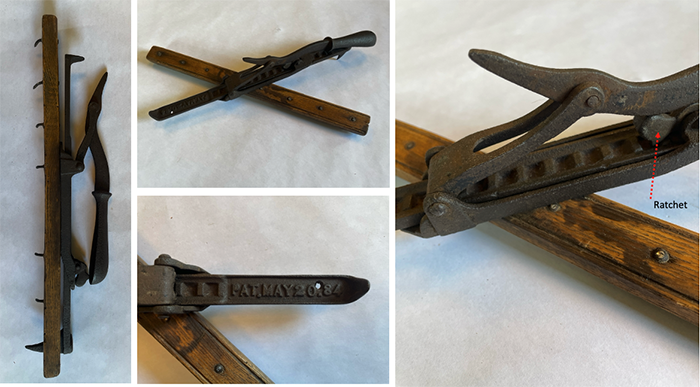
This stretcher uses a hand lever to move the extension bar in order to pull the carpet. A handle with a pointed extremity catches the groves and when pulled down advances the extension bar. Similar to the previous one, this tool features a ratchet.
Dimensions:
14” wood element (interesting that the comb is the largest of all four) by 1’0” cast iron comb
MFG J.N. HINKLE COLUMBUS, OHIO
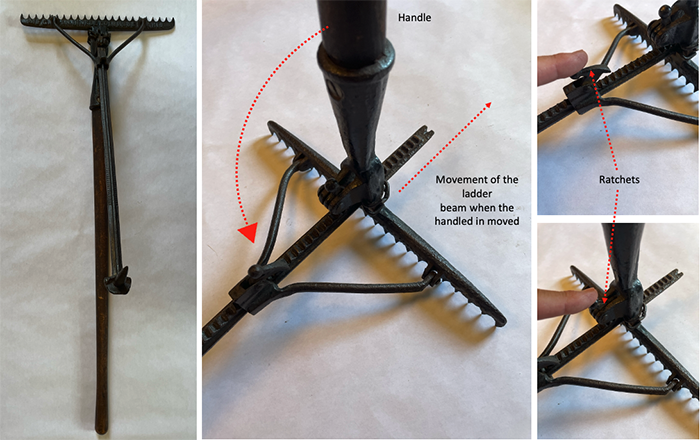
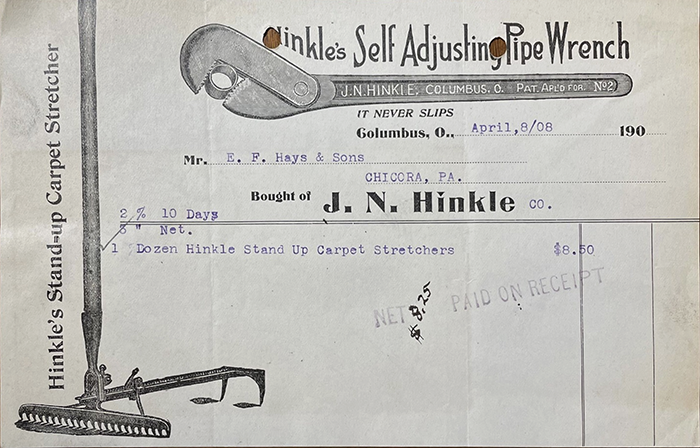
This carpet stretcher is a stand-up tool with two ratcheting toothed mechanisms that allow movement only in one direction while preventing movement in the opposite direction. A rather sophisticated tool that builds on the previous cross-shaped stretchers. The company, J. (Jessie) N. Hinkle, manufactured self-adjusting pipe wrenches (which were a novelty at the turn of the 20th century), as well as this improved carpet stretcher. The J. N. Hinkle factory was mentioned as located at Buttles and Michigan Avenue in Columbus, OH.Dimensions:
32” long by 11”
1890s Belvedere carpet stretcher and tacker
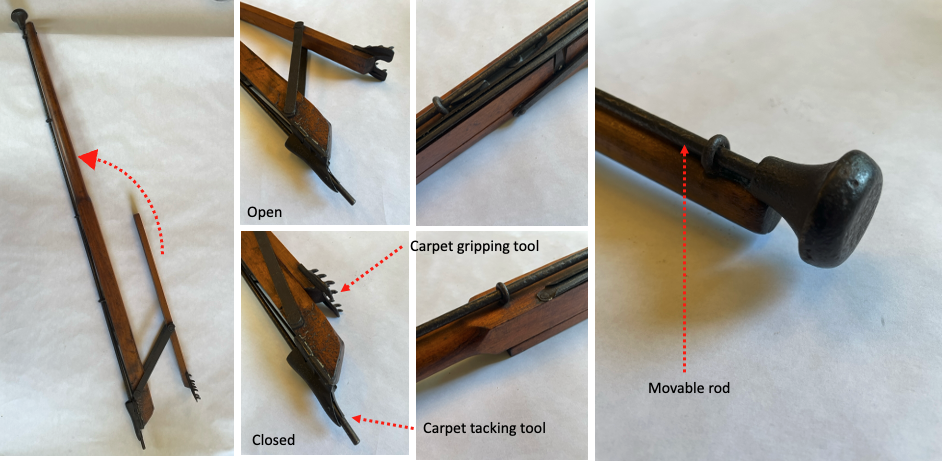
The last stretcher in my collection is a J.W. Quilling “Faultless Carpet Stretcher & Tacker”, patented in 1903. It is perhaps the most sophisticated one I own as it serves as both a carpet stretcher and a tacker. Made from Mahogony, this little marvel uses “minimal leverage to stretch the carpet, inserts a tack, and with the movable rod, set the tack in place. It folds open and close with a metal hardware.” It took some time to figure out as its multiple moving pieces of hardware are well crafted for its dual usage. I wonderful concluding object in my collection.
Dimensions:
Length: 44”
Additional blogs on design issues
- Antique primitive sideboards
- Miniature diecast airplanes
- About watches and their typefaces
- Swiss white wine glasses
- A compass set
- Harrods mid-century cocktail cabinet
- Lower deck lavatory: A340-600
- Mortician embalming cooling table
- Urban Posters in Paris, France
- Overnight sleeper train
- Post office Box Cabinet
- Secretaire a abattant
- Tri-fold mirror
- Vintage New York Postcards: Part 1
- Vintage New York Postcards: Part 2
- About miniature metal buildings
- New York vintage traffic signals
Nice collection I have some interesting pieces myself. Family started a carpet installation business in 1894.
Dear Wyatt, Thanks for reaching out. I would love to see some of your collectibles. Still trying to find some unique pieces for my own collection. Henri
I have a crank carpet stretcher, looks like it was made in the 1880s, was wondering if it was worth something or should I just donate it it to the union school?
Thanks for your comment. Any carpet strecher has value and let me know how it looks. I might be interested or you can sell in on Ebay or Etsy.
Dear Robert,
I missed your message and if you still have the carpet stretcher, I would love to see it and perhaps if I do not have it, purchase it if you care to. Thanks, Henri