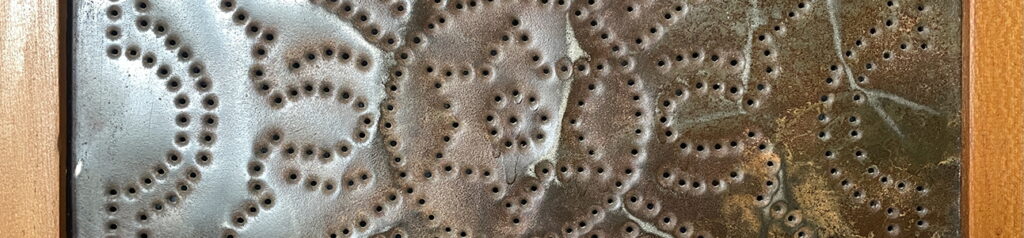
Antique primitive pie safe. Following up on a previous blog on two pieces of furniture, I wanted to present an additional primitive cupboard that I purchased decades ago in Kentucky. It is also emblematic of a kitchen space but has a very distinct function.
Pie safe
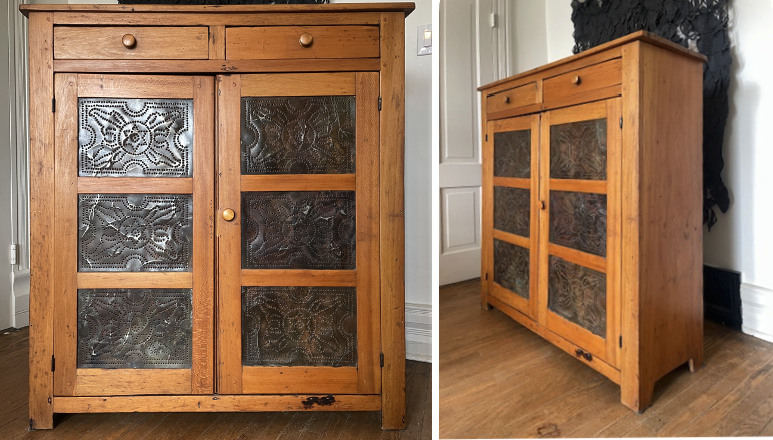
This rectangular cupboard is called a pie safe (Image 1). Introduced by German immigrants to Pennsylvania—whose communities are often referred to as Pennsylvania Dutch—pie safes were typically freestanding, and a must-have as a household item prior to the invention of iceboxes and later modern refrigeration. Although some pie safes might be found hanging from the wall (to achieve more height from the floor, offering maximum protection from rodents) the word freestanding is key to my pie safe. This piece of furniture was essential because in the early Republic, owners of such primitive household pieces were moving west in the quest to settle in new territories. Thus, the need to be nomadic.
Old Continent
Tracing its origins back to the Old Continent, the French had their rustic garde-manger (‘food keep’ for cheese and other perishable goods), and in German speaking countries, one found a number of types called Küchenschrank (kitchen cabinet), Brotkasten (bread box/cupboard), or Fleischschrank (meat cupboard); the latter two being specific to those food items.
The pie safe as we know it in America is a utilitarian piece that became a must for any kitchen in rural America as early as the 18th century. Their particularity was that, contrary to most cabinets, the central front door panels were not made from wood. Originally finished in Europe with screen mesh, American pie safe doors were constructed of hand-punched perforated tin panels (Image 2).
Tin Panels
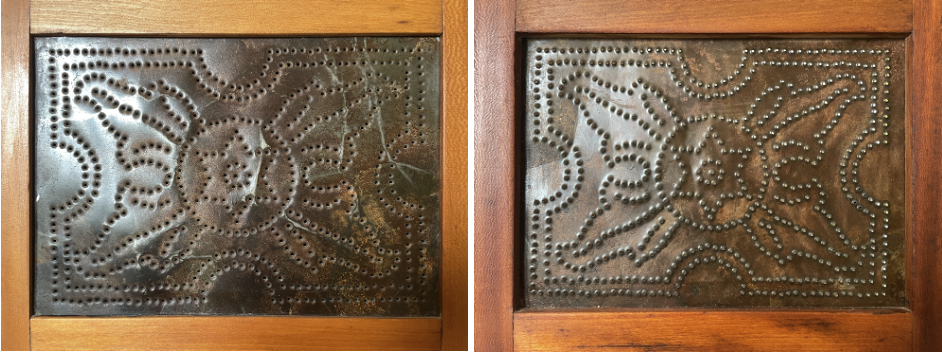
The holes are similar to a screen and serve as ventilation without letting flies or rodents penetrate to the interior, all the while preventing baked goods from molding (e.g. carrot cake, chocolate cream pie, pecan pie, or chess pie, which are part of the southern culinary history and remain quintessential as dessert offerings). Thus, the name pie safe or pie cabinet.
The six identical tin motifs featured on my pie safe have a simple decorative design with floral motifs radiating from a central hex-star framed by a geometrical border. This is a signature element found on 18th and 19th-century Dutch Pennsylvania cabinets and symbolized protection. Tin panels could be painted or left without any further decorative additions. Tin panels could also be found on either side of the cabinet. Pie safes also featured one or two shallow top drawers.
Construction
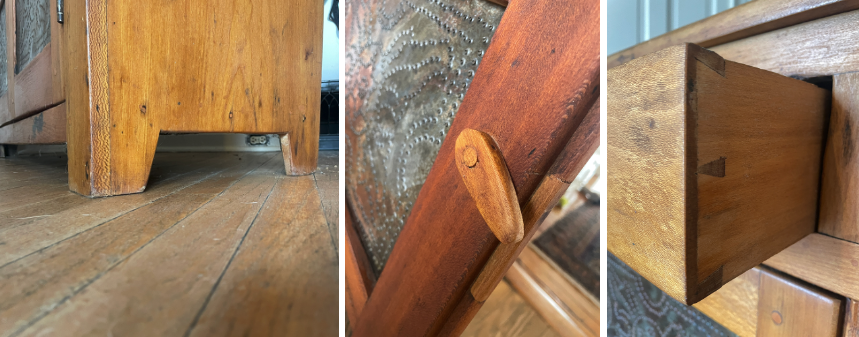
Like most pie safes, mine is free standing with short legs integrated in the front and back panels. They are identical in shape contrary to some more refined pie safes where the front legs were turned, taller. and not part of the frame. The two drawers on this pie safe are located below the top shelf. While I have seen some were drawers located at the lower bottom, the latter position seems more difficult to access; thus, I favor the style that I have.
One important note that gives more authenticity to my cupboard, is that the tin and interior wood are not painted. This gives the pie safe a more vernacular aspect. I guess that the decorative tin design served to protect the inside goods! Doorknobs are wooden pulls and the drawers have no keyholes.
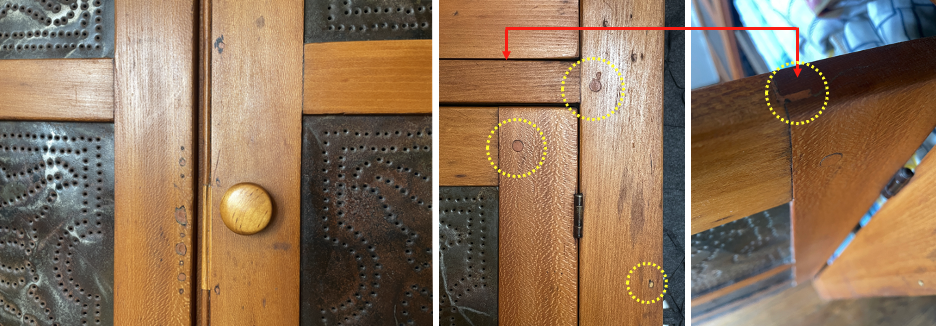
The fascias of the pie safe are made from cherry wood with the exceptions of two cabinet door frames. The vertical case side, which has a characteristic cherry wood crotch grain, or feather pattern, contrary to the other fine, straight, and closed-grain cherry pattern found elsewhere on the furniture. Note the wooden dowel pins securing the frame which complement the very thin half-blind dovetail, and the flat rectangular nails that hold the front and side frames (Image 4, yellow circles). I suspect that given the age of this pie safe, the nails were machine-cut.
As with most primitive pieces, the pie safe was designed for durability, often using cherry or walnut. Mine is made from cherry with walnut for the shelves and backing. The drawers have dovetail bottoms with beveled panels: all very similar to the sideboards featured in my previous blog.
Overall dimension: width: 46”, depth: 14½”, and height: 50”
Additional blogs on design issues
- Antique primitive sideboards
- Harrods mid-century cocktail cabinet
- Miniature diecast airplanes
- Antique carpet stretchers
- About watches and their typefaces
- A compass set
- Lower deck lavatory: A340-600
- Mortician embalming cooling table
- Urban Posters in Paris, France
- Overnight sleeper train
- Post office Box Cabinet
- Secretaire a abattant
- Tri-fold mirror
- Vintage New York Postcards: Part 1
- Vintage New York Postcards: Part 2
- New York vintage traffic signals