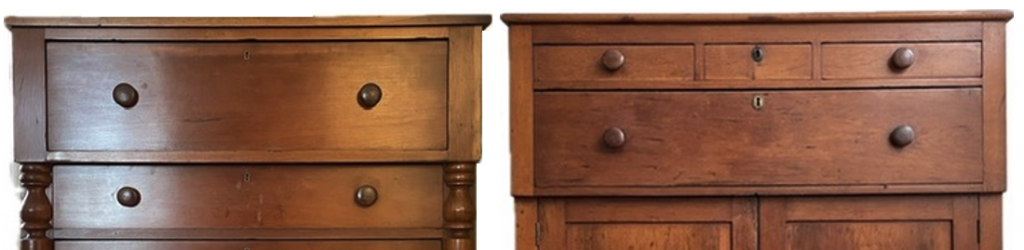
Antique primitive sideboards. There is something ironic about collecting furniture when, as an architect—in particular when a loft renovation is in order—I design built-in cabinetwork as much as possible.
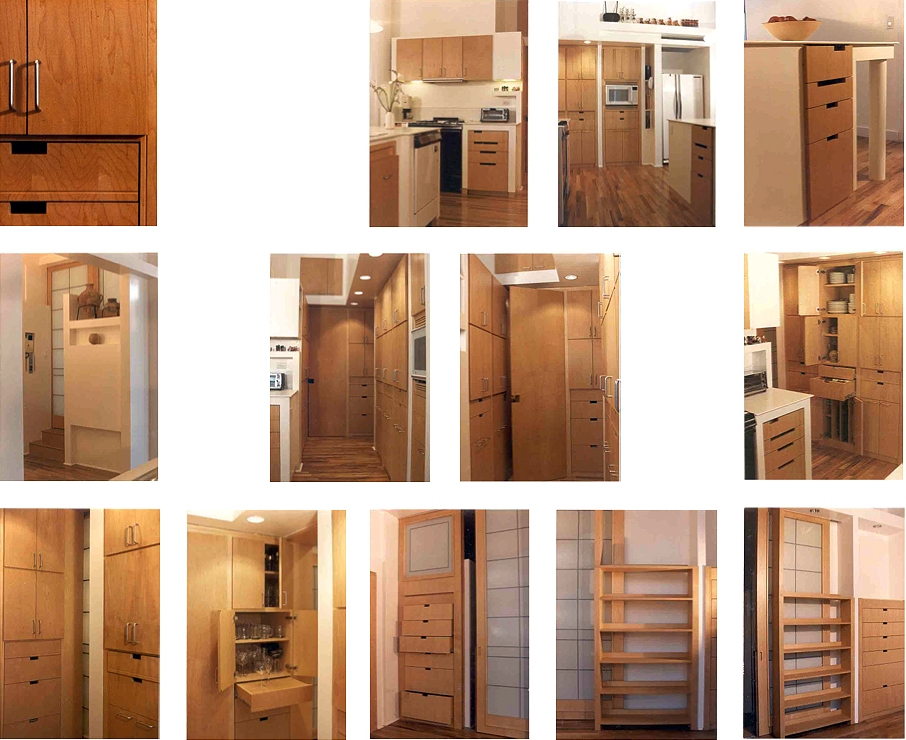
I guess this interest in designing cabinets is because most of my built work has unfolded in cities where there is almost always a lack of space within apartments to include furniture beyond the must haves such as wardrobes, beds, sofas, tables, and chairs. In this context, designing built-in furniture becomes for me a pretext to create modular casework that is spatial, particularly at juncture moments when they are positioned between rooms defining, for example, an entrance sequence. This is done by integrating a variety of flexible storage units such as cabinets, cupboards, bookcases, and doors—the latter if necessary!
The beginning of a collection
As I am fortunate to have lived most of my adult life in large homes where space is not at a premium, and I have enjoyed collecting antique furniture for almost three decades. Perhaps not the pieces immediately referenced when mentioning antiques. Those that I delight in are mostly vernacular with rural frontier characteristics that tend to lack the delicate, refined, or fashionable details of urban furniture. Those that I own are commonly called primitive or early American country made by American artisans; a time before other styles were in fashion, and certainly prior to an era of mass production.
I started my collection after joining the University of Kentucky and quickly recognized that Kentucky was a border state that has a cornucopia of marvelous regional furniture often used in early homes and farms. Nothing fancy like an aristocratic Louis XIV or Empire piece with their respective grandeur that talks about high-style fashion movements.
Shaker furniture
“Work was to be perfect, and a certain relative perfection was by all means within reach: the thing made had to be precisely what it was supposed to be [bold by me]. It had, so to speak, to fulfill its own vocation. The Shaker cabinetmaker enabled wood to respond to the “call” to become a chest, a table, a chair, a desk. “All things ought to be made accordingly to their order and use,” said Joseph Meacham [famous Shaker cabinetmaker]. The work of the craftsman’s hands had to be and embodiment of “form.” The form had to be an expression of spiritual force.”
Not to diminish the excellence of those pieces, but what has always attracted me to more humble furniture (e.g. Shaker furniture) is that there are like architecture. There is a harmony in the relationships of the parts. Shakers in particular saw the mastery of their craft, to be “a partnership with tools, materials, and process… It was not the mere utility nor beauty that shaped their pieces, but their proportions that were so remarkable” and made them, as the primitives that I seek out, distinctively their own.
Primitive furniture was locally handcrafted, and built for utility and not prestige using locally sourced hardwoods such as cherry, walnut, maple, and oak, with occasional yellow pine and poplar as secondary woods for drawer linings or rough-sawn backings, staying clear of the tradition of veneering that high-end furniture exhibited in a such wonderful and complex manner.
My delight in more humble furniture
Most importantly for me, in my quest to make a home rather than a showcase house, is that I find the furniture and objects that I collect have an overall aesthetic appeal that exhort a style of simplicity and unpretentious. This humility reminds me of Swiss design that fulfills a function, has an economy of means, and includes a choice of materials that make common sense—such as durability—beyond the obvious aesthetic appeal that is part of my agenda for collecting.
Rarely do the objects that I own call attention to themselves beyond, in today’s world of design conscious critics, a style often favored by architects termed minimalism. Call it less is more in the architectural jargon, I am fond of furniture that focused on utility, clean lines, and simplicity of form. Each piece is intentionally unobtrusive, aiming for a calm, quiet, and timeless charm.
Living in America, I have spent time in Kentucky, California, and Virginia, beyond studying in New York City as a student. Thus, the collection of furniture that I own are mostly regional testimonies from Kentucky and Virginia. Those that I admire are case pieces (e.g., chest, cupboard, and sideboard) that were built for storage in kitchens (e.g., jelly cabinet, pie safe, or pot cupboard for mixed storage). They are typically in the shape of rectangular boxes and are domestic in use.
But do not get fooled, my ‘boxes’ have an overall elegant silhouette that is complemented by beautifully proportioned drawers, doors, and shelves carefully built into them. Also, if they have survived to this day, durability was an important feature that is in direct contrast to many of today’s mass-produced products of desire.
New inventions are needed, but typically they end up as throw-away products with built-in obsolescence, creating a culture that contradicts the core aspect of antiques; one which means that works endure over time. I often think that architecture—and sadly today’s education of an architect—too often represents short-term assets among some junior faculty who promote a stylistic/pedagogical warrant slapped on to their research and teaching. If this is true, what a terrifying trend for the future of design, and, in particular, for those interested in pedagogy and education!
Other furniture collections
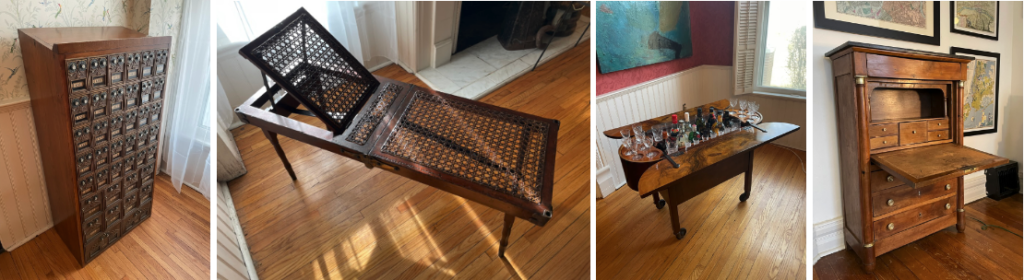
I am also proud to have my fair share of tables (drop-leaf, dining, and side tables), as well as conversation pieces such as a French style secretaire a abattant, a mortuary cooling board table, an art deco bar from Harrods, a quintessential American post-office box cabinet, a dough box table (to knead, store, and proof bread), as well as a cobbler’s bench; the latter being more rustic in appearance.
Also, I can count among my furniture a variety of 1920s display cases from the Kaufmann department store in Pittsburgh; Kaufmann was the patron of Frank Lloyd Wright’s famous Fallingwater house. I also have two mid-century night tables by Paul McCobb (Model 8714 for Calvin Irwin Group) in the bedroom, and a desk and two nesting tables from the 1960s in my home office.
This without counting the far too many primitive chairs, two original 1936 Alvar Aalto armchairs, and a Swedish Biedermeier sofa with a set of five chairs and a table inherited from my mother. All this assemblage of various furniture styles and functions has let a colleague of mine call our home a museum, or better said, a collection of collections!
Two sideboard examples
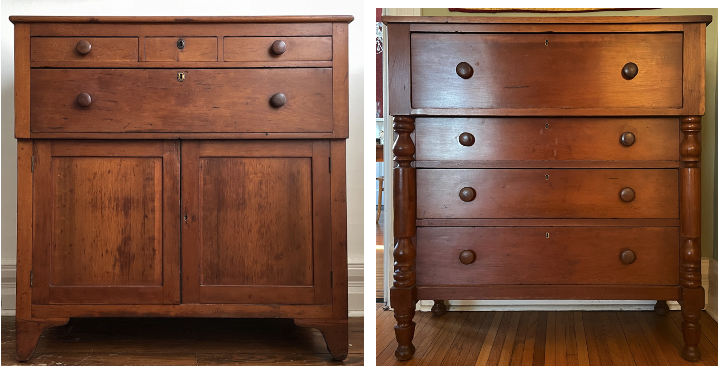
To explore furniture attributes, I am presenting two free standing sideboards of different styles but similar periods dating back to the mid to late 19th century. They are part of a family of furniture-types that talk about the lack, or integration, of outside cultural appropriation which give them each a distinctive appeal. As antiques, the two pieces have the obvious look of wear and tear without serious imperfections marring their overall beauty and detailing.
Sideboard 1
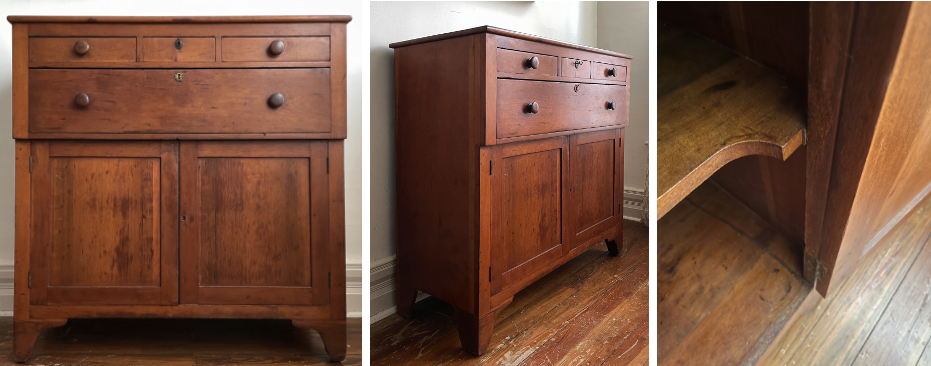
The first piece is more austere (Image 1 left) and, if I can attribute a gender to this object, it looks masculine in its proportions with a sturdy character, angular shapes, clean lines, and size that gives it its particular characteristic. In other words, a symmetrical composition where the placement of drawers and doors offer an elegant visual order. Talking about proportions, they seem to have been chosen with care, as everything seems juste in function, frame, assigned position of drawers, and doors no thicker than needed for strength.
The top three shallow drawers suggest the housing of cutlery, linens, account books, or possibly valuables. The latter because the top middle drawer features a central lock—often desired to keep money, silver, or documents secure. The large middle drawer was frequently used for table linens or serving pieces while the bottom portion with doors served for storage of crockery, bottles, or kitchenware. It has one shelf enabling bulkier items to be housed.
This piece is made from solid cherry which is used on all visible exterior fascias; a trademark used to exhibit the naturally ornate wood, thus no need for the artisan to use veneer, which is a method that converts a plain wood to a decorative surface. Because of its proportions, this cabinet might have been in either a dining room, pantry, or large kitchen; mostly functioning as a working piece (e.g., domestic) rather than a purely formal one.
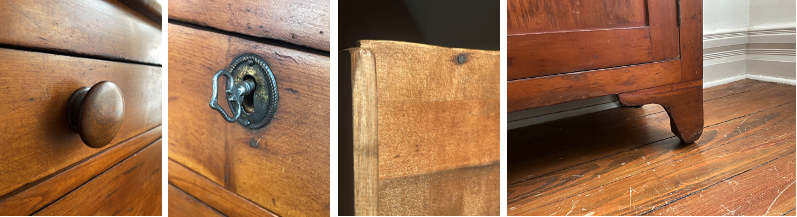
Its construction is typical for the period featuring hand-cut dovetails for drawer construction, frame-and-panel doors, turned wooden knobs, and keyholes. The craftsman would chisel a shallow mortise within the cherry fascia, this would then be covered by an oval brass escutcheon (metal ornamental protection around a keyhole).
Note that the escutcheon is missing on the bottom door (Image 3 left). I have found an almost exact replica that I intend to add to the keyhole. However, upon closer examination, I discovered a small hole to the right of the keyhole suggesting a knob, either original or added. More research will be needed to inform future decisions…
In conclusion, research reveals that based on proportion (restrained form), wood choice (cherry), and detailing (drawer dovetail joint style and spacing, mortise and tenon joints for the frames, frame-and-panel construction for the doors, and no applied columns or bold ogee feet), that this piece comes from Upstate New York or New England with a date between 1835–1865.
Overall dimension: width: 43”, depth: 20½”, and height: 45½”
Sideboard 2
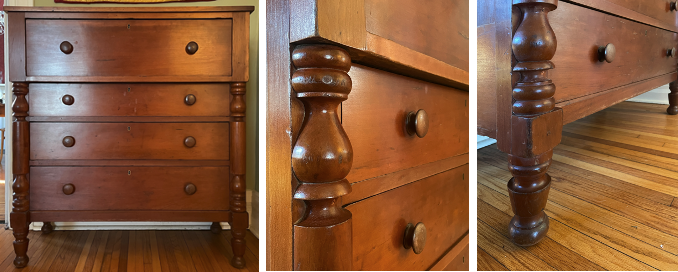
While maintaining similar technical attributes in its overall construction, this second piece is quite different in temperament from the previous sideboard—more formal, more architectural, and stylistically clearer. Research reveals that this chest or cupboard also dates back to the 19th century, and is called an Empire chest, or column-front chest.
This name comes from particular attributes on either side of the front face. Elaborate lathe-turned front columns are set under the large top drawer at each front corner, emphasizing the size, horizontality, and prominence of the top drawer. The chest’s decorative profile—perhaps referencing an architectural feature such as a pilaster translated to furniture—visually frames the lower three drawers, while extending to the floor and unifying post and foot through a rectangular piece similar to the one framing the top drawer.
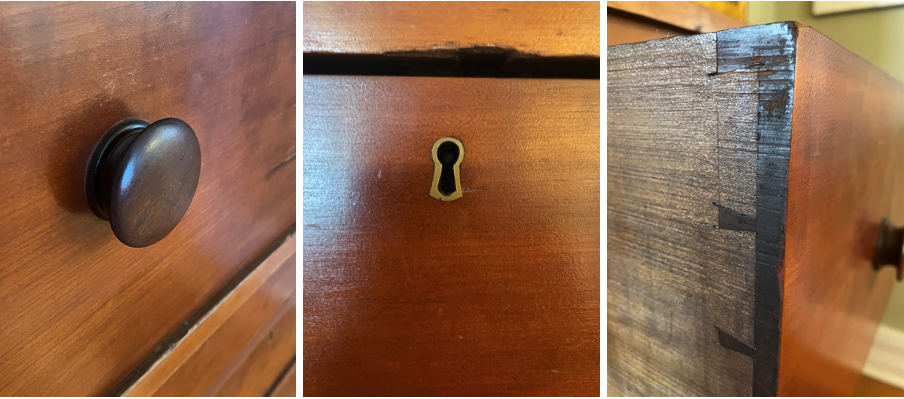
I can only assume that such treatment is a result of a more skilled craftsman, elevating this piece to a more prominent room such as a parlor or bedroom (there to store clothing or bedding). The previous sideboard had a more domestic function connected with a kitchen. Beyond the decorative aspects of the posts in the second piece, it maintains a degree of restraint, while emphasizing beautiful proportions as well.
Of note, the centered keyhole on each drawer—indicating that valuable items were to be stored within—are fitted with thin brass escutcheons with a mortise lock box affixed to the inside of the drawer. Dissimilar in construction to the previous cabinet where an escutcheon emphasized the keyhole, here the opening shape is set flush to the fascia. This “warded lock” was invented to prevent wrong keys from rotating within, thus the need to visually match the key’s correct profile. A very elegant detail with a rounded head and slightly flared narrow throat (Image 8). Unfortunately, the key(s) are missing for this sideboard. Again, an unfolding in-process search!
Drawer construction
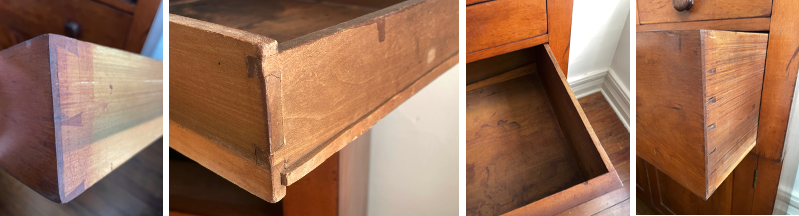
Two comments regarding the drawers of both sideboards. First, that the drawers have a thicker face than the sides. This indicates that the fascia requires a more durable wood, which in both cases is cherry, while the drawer box is made out of a lighter secondary wood, pine. This extra thickness on the fascia provides more durability and handles heavier content more easily, all the while allowing deeper dovetails to give more strength when pulling the drawer (Image 8, far right). Also, because the face does not overlap the case frame, this type of drawer is called “piston-fit” because the inset drawer is perfectly sized for the case opening. This sizing requires additional skill and finesse.
Second, both pieces are crafted to keep cleanliness at a premium. There are few surfaces which collect dust since each drawer and door is flush with the case frame’s fascia, with the exception of the architectural pilaster.
Overall dimension: width: 46¾”, depth: 20”, and height: 48”
Conclusion
Far from being a furniture expert, it remains a challenge to date primitive pieces in my collection. The question is finding a balance between understanding technological systems versus stylistic attributes. I try to learn everything I can about construction techniques, aesthetics, and cultural ramifications, and, most difficult, the name or locale of the makers of these objects. The furniture that I praise are primitives without readily available signatures.
Beyond the above described furniture attributes, other clues can be found through careful observation. Saw marks from milling the wood, size of wood panels, evaluating the handmade or machine made screws and nails, hinges, latches, turned knobs, or treatment of the feet, remains for me evidence that is in its infancy in my quest to date the furniture in my collection. Or, more intentionally, to make an informed decision with new acquisitions.
I am getting better at observing and understanding a piece’s age and the nature of its craftsmanship. But through all of my learning, I continue to rely on my instinct and slowly trained eye. Through all of this, I continue to be a custodian and not the owner of furniture. And if one day a dream comes true, maybe my passion will turn into owning an eclectic antique store.
Postscript
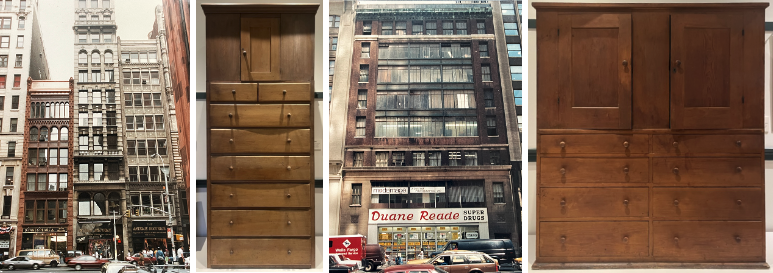
When designing and detailing cabinetwork for my first project in New York City (Image 1), I was inspired by the city’s cast iron skyscrapers on Broadway between Houston and Canal street (Image 9). Perhaps more importantly, the interpretation of Shaker design was part of my process in drawing up the built-in cabinets. This direct aesthetic influence could have not been perfectly executed without the talent of Kentucky craftsmen Prajna Design & Construction, and cabinet maker David Gregory. Many thanks to all of them.
Additional blogs on design issues
- Harrods mid-century cocktail cabinet
- Miniature diecast airplanes
- Antique carpet stretchers
- About watches and their typefaces
- A compass set
- Lower deck lavatory: A340-600
- Mortician embalming cooling table
- Urban Posters in Paris, France
- Overnight sleeper train
- Post office Box Cabinet
- Secretaire a abattant
- Tri-fold mirror
- Vintage New York Postcards: Part 1
- Vintage New York Postcards: Part 2
- New York vintage traffic signals