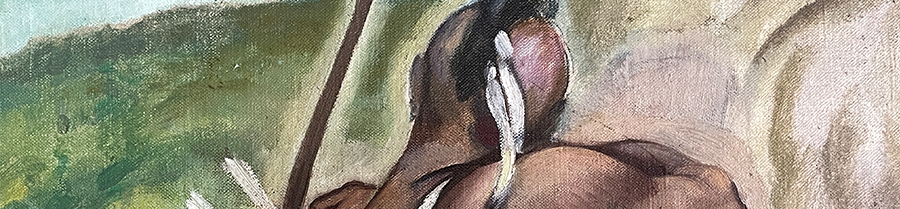
PWAP Post Office mural. Ever since visiting the famous Coit Tower in San Francisco for the first time almost thirty years ago, I fell in love with modern murals.
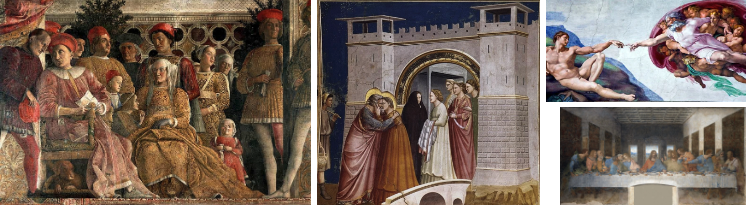
Prior to my visit, I had done a pilgrimage to see frescoes in Italy and still have fond memories of those painted by Giotto in the Arena Chapel in Padua (c. 1305), and Andrea Mantegna in the Camera degli Sposi (Room of the Brides) in the Ducal Palace of Mantua (c. 1474). Not to mention the Sistine Chapel’s frescoes by Michelangelo in Vatican City, and the Last Supper by Leonardo da Vinci in Milan, which are true masterpieces, but did not outdo my admiration of the others (Image 1).
Entering the ground floor of Coit Tower—with its striking visual resemblance to a fire hose nozzle according to urban myth—the circular space contains the works of over two dozen artists hired in 1934 under the American Public Works of Art Project (PWAP). During the Great Depression, the PWAP was the very first federal program to employ professional artists to create sculptures, paintings, crafts, and designs for public buildings and parks.
The murals in Coit Tower were painted by local Bay Area artists whose social realism style and fresco techniques represented themes of city life, as well as California agriculture and industry. Many of the artists were inspired by Mexican muralists such as José Clemente Orozco, David Siqueiros, and Diego Rivera. The latter’s Detroit Industry Murals (1932-1933) are considered his most important work in the United States. When seeing these in person, the artistic dimension of both the Coit Tower and the Detroit murals left me awestruck for hours and have given me a lasting admiration for murals done during that time period.
Great Road
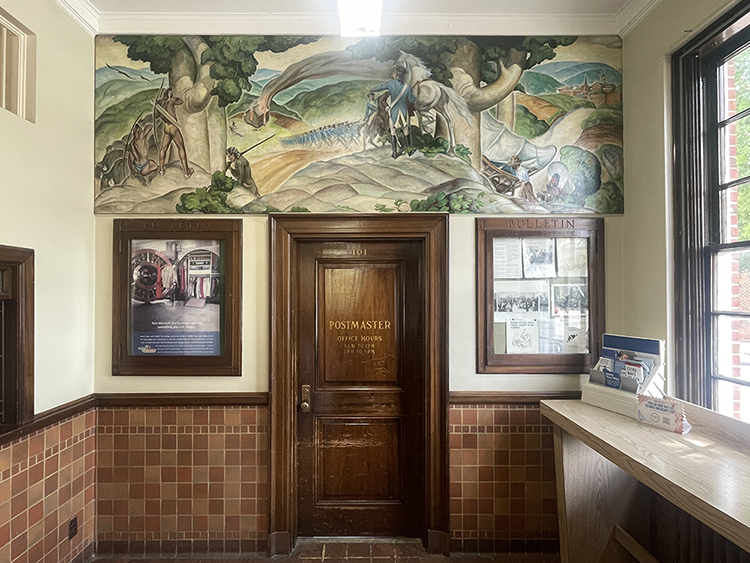
Closer to where I live, and painted during the same period of the Great Depression, I discovered at our local post office (completed in 1936) a mural painted in 1938 by prominent Richmond and Washington painter John W. de Groot (1908-1989 and signed John De Groot). From my research, de Groot was a writer and illustrator with only two postal murals credited to him. One completed in 1941 is featured at the post office in Red Springs, North Carolina and consists of three panels titled Battle of Little Raft Swamp; Coming of the Scots; and Peace-Work and Knowledge. As of the writing of this blog, I have not seen these murals but intend to visit them later this fall.
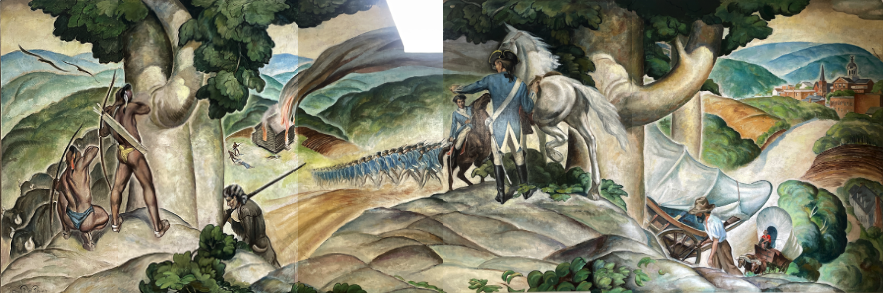
The mural I wish to investigate today was created as a single panel. As with most US post offices built during the 1930s, the art was commissioned by the Works Progress Administration (WPA, part of the New Deal agency during the Great Depression), when the federal government sponsored art, in this case murals. This governmental plan served two purposes. One, to provide work for jobseekers (in this case artists), and second, and perhaps more importantly as one looked forward to the next quarter of the 20th century, to give ordinary public buildings a sense of civic identity in which the composition of the murals and various art pieces told a visual story of the conquest of America from East to West.
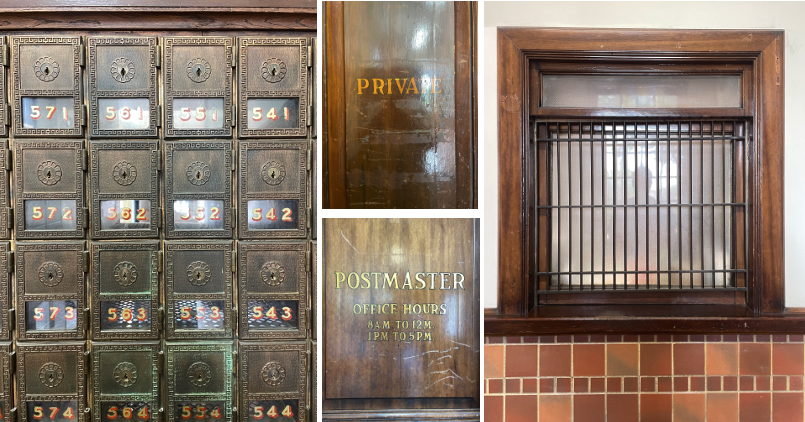
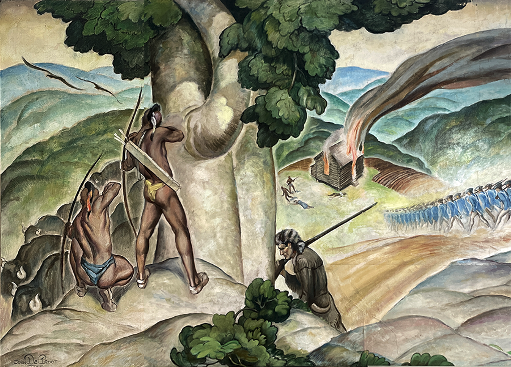
The mural in Christiansburg is titled The Great Road after the Wilderness Road that passed through Christiansburg conveying settlers migrating westwards into the Appalachian frontier. The city was named after Colonel William Christian and was an important point on the Great Wilderness Road with taverns and other rest stops. The art hangs in the lobby of the post office above the post master’s entrance (Image 2) and remains for me one of the outstanding features of the original building, beyond the brass mailboxes tucked in the corner.
The mural represents an idealized history of the settlement of the Appalachian frontier by European settlers around the town of Christiansburg, which was the county seat of Montgomery County from 1792. The mural acts similar to a panorama, conveying several episodes and periods specific to local history. To describe the panel, I have created three segments that do not carry any particular meaning beyond the visual story in each as they move from left to right, and as we will see, from right to left.
Segment 1
In this first segment, to the far left two Native Americans, probably of the Tutelo or Monacan tribes (possibly belonging to other tribes that inhabited the area) aim their bows and arrows towards a nearby herd of bison; the iconic North American animal of the vast plains, with their distinctive shoulder hump, short curved horns, and thick coat. The Native Americans’ heads are shaved with a patch of hair decorated with feathers and they are wearing loin cloths of various colors with moccasins on their feet.
Shielded by the majestic canopy of a mature oak tree, they overlook the drove of animals from a promontory with one carrying arrows in a quiver over his shoulder. There are no other Native Americans depicted in the mural and they are the sole protagonists who remind us that hunting buffalo and other animals was typically done cooperatively in groups rather than alone, taking inspiration from wolves who work together as a team.
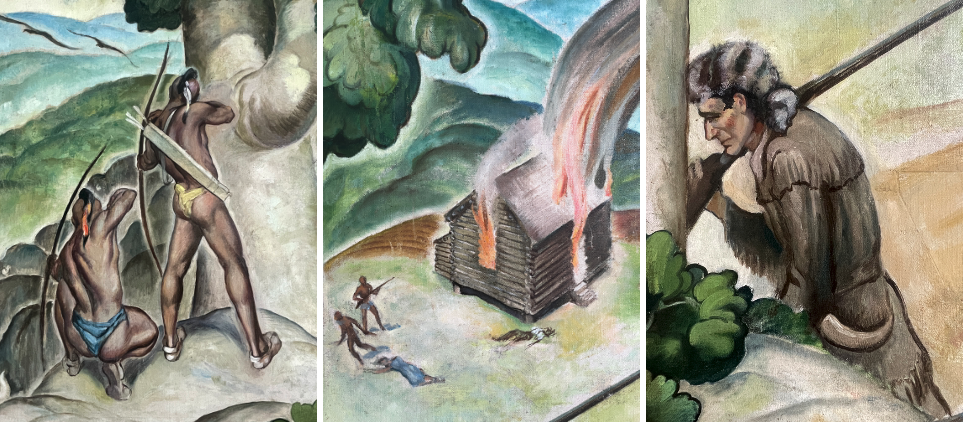
The rolling landscape is similar to what I have experienced countless times when driving around Christiansburg in the New River Valley (NRV, named in 1671 after the western hemisphere’s oldest river). Rolling hills, dense forested ridgelines, and wide valleys nestled within the Blue Ridge Mountains. This is a mountain range named for its soft, bluish haze when seen from afar. De Groot captures beautifully this landscape and the progression of colors of the landscape—from green to blue—depicted through the succession of three gentle rolling ridges. There are no roads as shown to the right side of the panel, only two birds flying along the herd of buffalos, underscoring that the countryside was mostly natural wilderness, which we know from literature was in reality a landscape domesticated by long-term Indigenous stewardship.
Behind the tree, almost acting as a curtain to the next narrative, one sees in the distance an encampment in the form of an isolated log cabin with inhabitants on the ground after what might have been an attack by the Natives Americans. The inhabitants of this log cabin must have lived there for some time as visual traces of plowed fields surround the house. Fire raging inside and bursting through the roof is accompanied by dark smoke that mimics the continuous background landscape that unifies itself with the left part of the mural, and in fact, the entire panorama, thus giving the mural a deeply anchored regional context for the various stories unfolding in the middle and foreground.
In the foreground, is a recognizable character with a traditional coonskin cap. Research reveals that both David Crockett and Daniel Boone resided a short time in Christiansburg during their lifetime, thus one must assume that the artist is depicting either one of these larger than life figures. With a flintlock longrifle over his right shoulder, a powder horn containing black gunpowder, and a fringed buckskin tunic, the man is depicted in profile, is bent over and moving ‘west’ not giving much notice to the background scene or to the marching soldiers to his right.
Early pioneers explored the New River Valley as early as 1671, but it was only in the 1740s and 1750s that European settlers (German, French, Scotch-Irish and English descent) actively established themselves in what would become Christiansburg, Virginia. The town was vital on the migration route connecting Northern Virginia and Tennessee through the Appalachian Mountains.
Segment 2
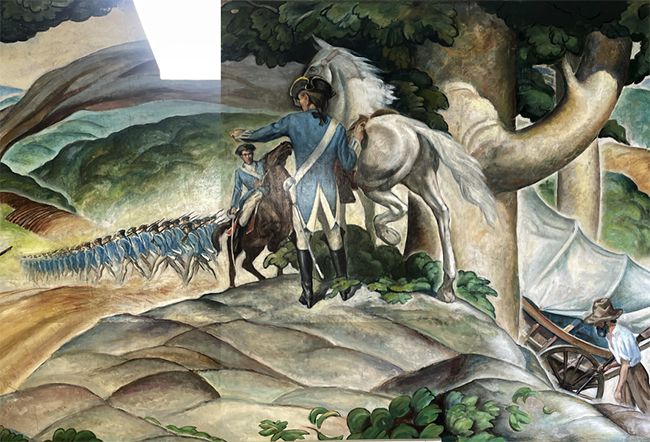
From another promontory in the mural, one sees soldiers marching down towards the burning log cabin. It is unknown to me if they were part of an army or a militia force. However, research indicates that they belong to the Virginia colonial militia that was made up of armed settlers accompanying and protecting other settlers moving through the frontiers. From the previous scene to this one, de Groot depicts the move from Native Americans to conquerors imposing their laws and rituals.
Although inspired by the uniforms in vogue at that time, the color, shape, and formality of the militia’s uniforms seem to be an artistic interpretation by de Groot. Next to a tree, similar to the one we saw to the left, is a soldier who holds a more prominent role, indicating to another soldier the path to take towards the log cabin.
Both wear a tricolor hat, which through its gold trim for the standing man perhaps indicates an officer’s rank, especially that he wears a sword, symbols thus separating him from the regular enlisted soldiers. His frock coat falls at knee-length and features the era’s typical wide turned-back cuffs and flaps. His boots remain polished. This main figure is standing next to a white horse—often in the military representing absolute authority, while also being a potentially fatal tactical liability. The horse is ready to charge, yet there is no battle in this scene, just the visual suggestion that land—symbolically pointed to by the officer—is now taken and being colonized. Additional research points to the key figure as Colonel William Christian, founder of Christiansburg.
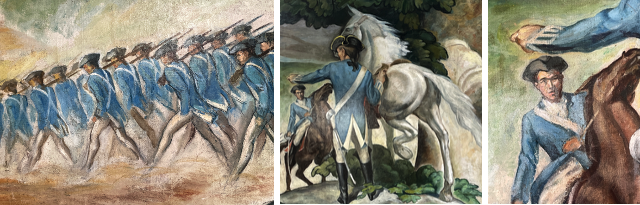
To the left behind the tree a wagon ascends a steep slope. Of note, and as an interpretative comment, the two trees shielding the Native Americans are closely paired together with a singular strong muscular branch pointing back to the left. In this segment, the two are again visible as a pair, but this time separated as if they form a metaphorical gateway to the west, letting the new settlers pass between them.
Segment 3
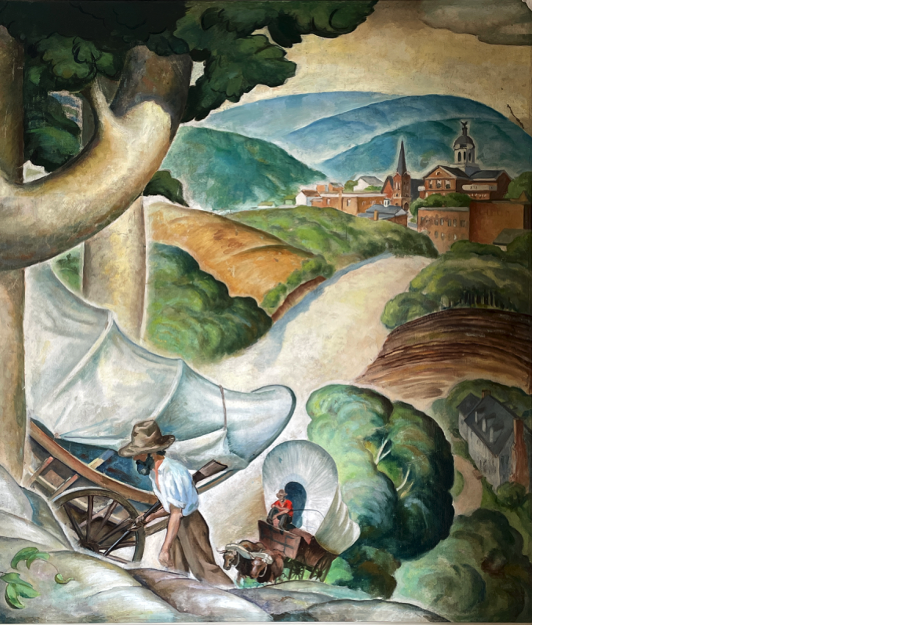
The subject matter of this last segment of the mural depicts the movement of the settlers who, upon leaving the city of Christiansburg (in the background) now pursue their journey west. Two covered wagons are prominently featured in the foreground. One accompanied by what may be a farmer and is depicted in profile similarly to the man wearing a coonskin cap. The second covered wagon, shown in perspective, is pulled by two oxen. Both are negotiating the steep hill towards the unknown wilderness.
While the perspective depicting the soldiers marching down the ridge (segment 2) gives depth to the scene, here de Groot compresses the movement of both wagons by juxtaposing depth with a diagonal motion. Not only is the left wagon more prominent to the viewer, but by placing a smaller second wagon down the hill, the landscape feels three-dimensional. This is artistically achieved by having both wagons almost touch each other, and yet they are so far apart. The curvature of the road accentuates the overall movement of the scene and brings us to the city the settlers have just departed.
The last prospect is the city, which is assumed to be Christiansburg. Generic buildings form a cluster around recognizable civic and religious buildings that are highlighted by the Blue Ridge mountains. Directly outside the city, the artist has deliberately set a white house—perhaps one of the famous taverns or stagecoach stations, all within a lush and cultivated rural land. Not depicted in this scene but nevertheless suggested is the historical importance of the city as key to transportation routes towards the West. We also know that in the 19th century the railroad reached the nearby town of Cambria, a train station that is about to be reactivated as a connection to the northwest corridor of the US.
Christiansburg
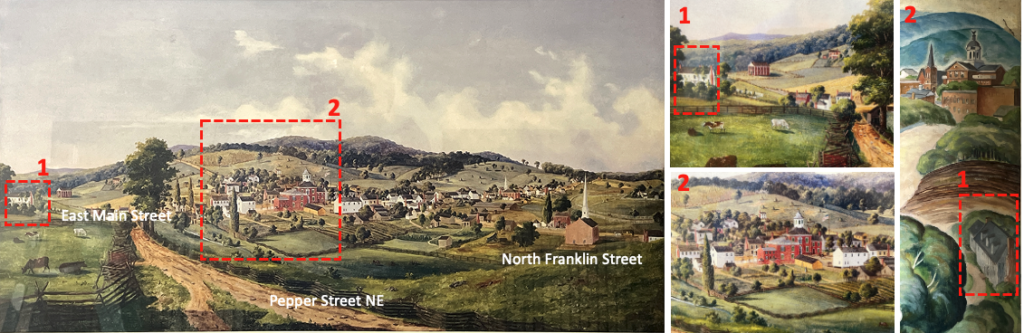
Of note, chatting with the post office officer about the mural, she shared with me a panorama depicting Chistiansburg in 1855 (Image 11). There is so much resemblance between the mural and this painting. From the civic building, the stippled church, and perhaps most important, the inclusion of the isolated white house to the far right (Image 11, right).
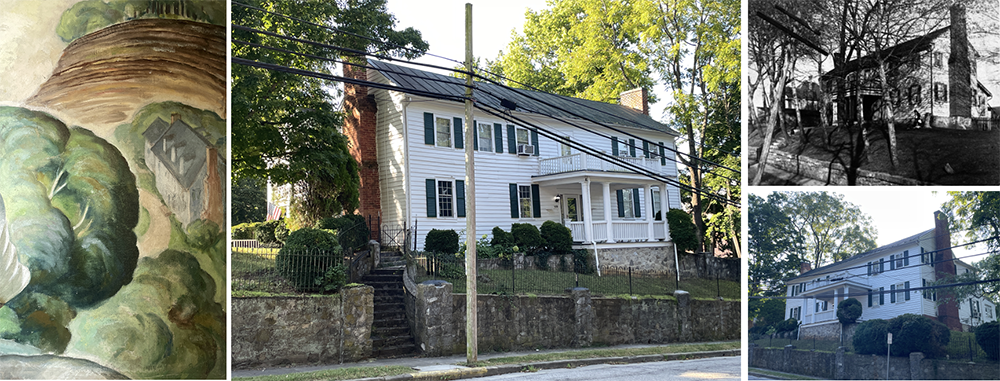
Located at the intersection between East Main Street and Montague Street, the house built c. 1790 was used as “headquarters by US general George B. Stoneman when his cavalry raiders passed through Christiansburg in April 1865.” The Montague family was in possession of this house since its beginning before a new owner, Judge Charles W. Crush purchased the house in 1938, the same year the mural was painted.
Without certitude as to the direct link between the white house in the mural and the one at 109 E Main, one may at least argue that its presence in the painting is an artistic representation of one of Christiansburg’s oldest houses, one which was historically significant in several ways.
Conclusion
There is so much to be admired in this mural. First, that it is part of the PWAP era, which makes it significant as a contribution to America’s tradition of modern murals. Second, that it presents and represents attributes that identify with the place and city of Christiansburg. Lastly, there is a fine line between fiction and reality, thus offering the panorama of the mural an interpretative story of the settler’s movement towards the West, while including different time periods which makes its visual story diachronic and not simply a snapshot of a given time.
From the Native Americans within an ‘untouched’ wilderness, to the depiction of an army somewhere in the middle of the 19th century, to a city on a promontory which shows firm establishment within the region, the narrative moves seamlessly in time from left to right. However, one may also read from right to left leveraging the covered wagons moving West to continue their journey into unknown land.
Other blogs of interest on art
Architectural Education: valuing your mentors -Robert Slutzky. Part 2
Still lives by Ben Nicholson
Simone Martini: three principles of settlement
Le Baron Tavernier: a cafe terrace in the middle of the Lavaux vineyards, Switzerland
Edward Hopper
Art by Mike Goodlett
Robert Slutzky
Netton Bosson, Gruyeres, Switzerland