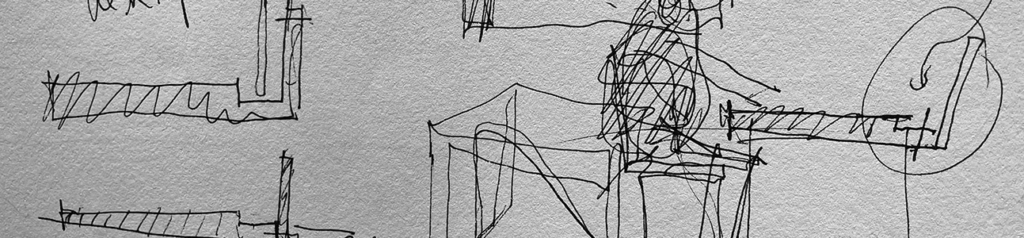
About sketching-an iterative process, Part 3. I often ask myself how many more blogs can I write about iterative sketching (Blog 1 and Blog 2) without exhausting the essence. Sketching in this manner is based on a conversational dialogue between oneself and the drawing, with the latter always being an expression of the person.
While my recuring question often ends up being rhetorical, I always find something new to highlight, especially with today’s increased reliance on digital platforms and on-demand machine-generated options. In particular, I point towards many AI generated projects where imagery is based on well written prompts, providing picture-perfect renderings.
While such AI representations may seem rewarding for many students —with proposals seen to be flawless, ideal, and exact in appearance and execution—the issue for faculty is how such processes of iteration were generated to achieve such tempting results. Between polished and messy, new AI challenges have created numerous tension points at the center of many faculty’s design pedagogies.
What I see here as an important debate is that the fundamental challenge— and often the uphill battle—is how do faculty continue to encourage a traditional lineage of thinking while most students arrive at college with an ingrained attitude that betrays the shift from evolution (slow process of iteration) to one of selection (instantaneous decision making).
For faculty, student AI renderings, which are at this point only visual interpretations, look effortless in their output and show a simplistic yet well-executed image of an unvetted idea. Needless to say that such solutions hide the lack of critical thinking, evolution, and human decision-making that is sine qua non for traditional iterative processes. For students, the “pretty picture” may seem ready and finalized, but for faculty the design is not.
We all know that the shift between deep design thinking—which is rigorous and needs maturation and was so well emphasized by Le Corbusier in his 1960 La recherche patiente (The Patient Search)—and a generation who is raised on algorithmic curated output is important to acknowledge. The projects of the latter generation are often accompanied by a quasi-obsessive self-identification through content filtering and ‘liking’ taps. But let us be honest, while AI is here to stay, where has originality gone, which, at least for me, is deeply rooted in lived experiences and personal emotions.
For many faculty, what is seen as instant gratification and the illusion of immediate choices for students, needs to be addressed if architecture is to remain a human art form relying on iteration and not solely a result of AI prompts. However, playing the devils advocate, students may argue that any refinement of their AI prompts equals to a traditional iterative process. Granted this incorporates changes, but there is a world apart between the written word and the anchor of authenticity developed through a process of evolutionary steps—between human self-discovery as a result of iterations and machine generated images that are derivative through AI.
As a welcome and necessary act of resistance or call to order, faculty need to find a balance, thus we shall continue to ask the question of how did a student arrive at their solution (idea, form, plan…), while refocusing the discussion with additional fundamental questions in how students choose a specific image from the myriad of (already derivative) solutions that AI has generated in a nanosecond.
While there is no immediate and correct answer to this new challenge, I would like to offer here an example of an old fashioned iterative process where one of the key features for a successful outcome is to embrace productive mistakes, or as I like to quote American trumpeter and bandleader Miles Davis: “Play your mistakes,” followed by “It’s not the note you play that’s the wrong note—it’s the note you play afterwards that makes it right or wrong.”
Designing a writing desk
A couple of years ago while leading a travel program in Europe, a colleague of mine and I devised a series of short intermezzo charettes where various prompts invited students to think rapidly about a simple design issue. These were conceived as intermezzos between visits to seminal buildings. After visiting Mies van der Rohe’s Tugendhat Villa in Brno, Czech Republic, we asked students to design a desk to hand write letters; a piece of furniture traditionally called a secretary desk, or écritoire.
Yes, the specificity of writing letters may have seemed old fashioned, but the prompt was devised to offer students an opportunity to redefine the function of a desk, especially for a generation that perhaps no longer writes letters by hand. Beyond the numerous antique components that one might find in vintage desks, the design of their desk was to be basic and their sketches to showcase a process of iteration followed by a public conversation.
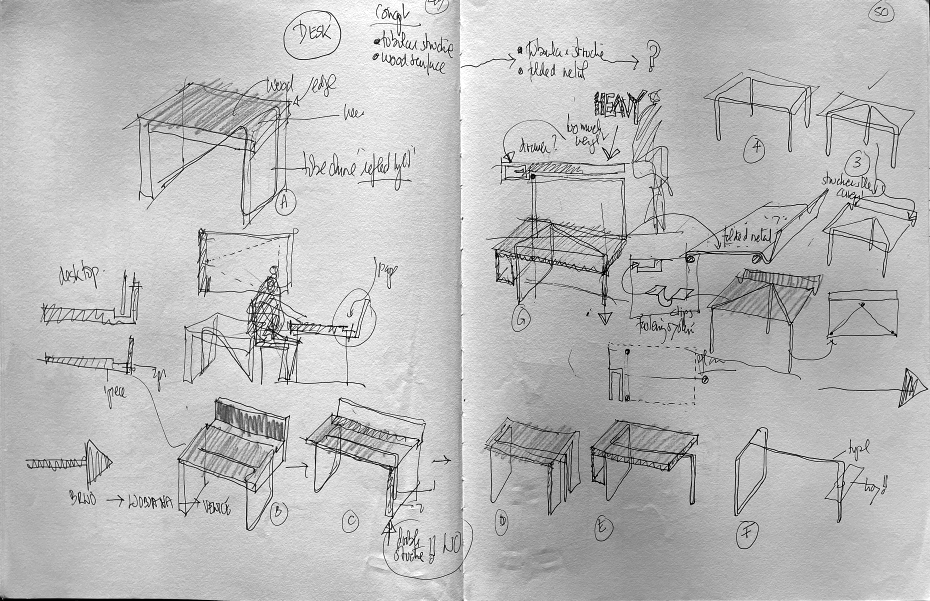
As a side note, I remember that years ago during a similar exercise, a student asked me to present my own solution, which I regret I was unable at that time to produce as the design remained sadly in my head. Learning from my embarrassment, I have from there on always sketched my ideas when an impromptu exercise is proposed. Thus, all drawings included in this blog are mine and showcase the iterative process about the design of my desk.
Also, I have over decades favored carrying a large sketchbook, and this despite being heavy and often cumbersome to pack in a satchel. And yet, the size has always been a great asset as the real estate of the white page is no longer dauting for me (often called the blank page syndrome), but a companion eager to get scribbled on, and this particularly when I use a double page such as in this charette (Image 1). It allows me to navigate within the page and see in a synthetic way progress as ideas unfold.
The inspiration for my desk
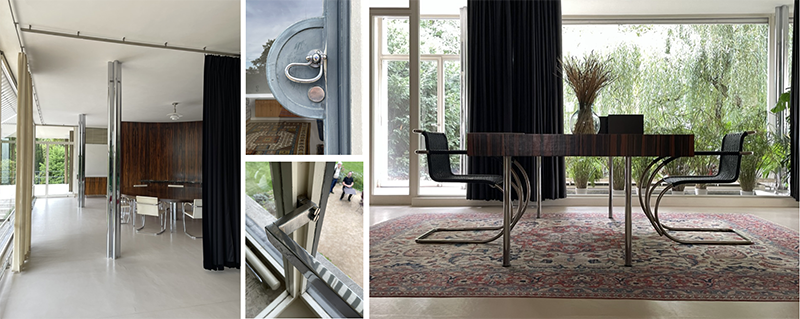
I previously mentioned the visit to the Tugendhat Villa (1929-1930) for the simple reason that my design for the desk charette integrated and interpreted what I had seen that morning. I am a firm believer in re-inventing, thus know that many of my ideas come from the trove of my memory, or in this case, an epiphanic morning trip to this iconic building.
The Miesian (Mies van der Rohe 1886-1969) language of the Tugendhat includes cruciform chrome columns for the structure of the building, lightweight spatial tubular assemblies for the villa’s furniture; themes of transparency versus opaqueness in its spatial definition; and light-absorbing warmth through natural materials (Image 2). These precepts became the ingredients for my desk proposal.
While using many of the modernist precedence experiences discovered throughout the villa, the struggle was to give a personal twist to my design by showcasing the evolution of the syntax of a desk. In other words, I needed to trace how I dealt with the prompt history rather than the image history, thus moving from a visual inspiration to a conceptual framework.
Iterative sketches
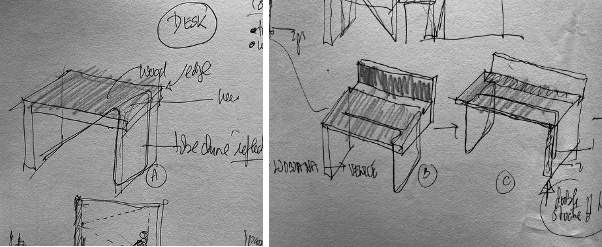
In lieu of describing each sketch in detail—I hope that all of them are self-explanatory—perhaps it is more appropriate to showcase the process of iteration through two themes; the tubular structure of the desk, and the shape, function, and material of the desk’s surface.
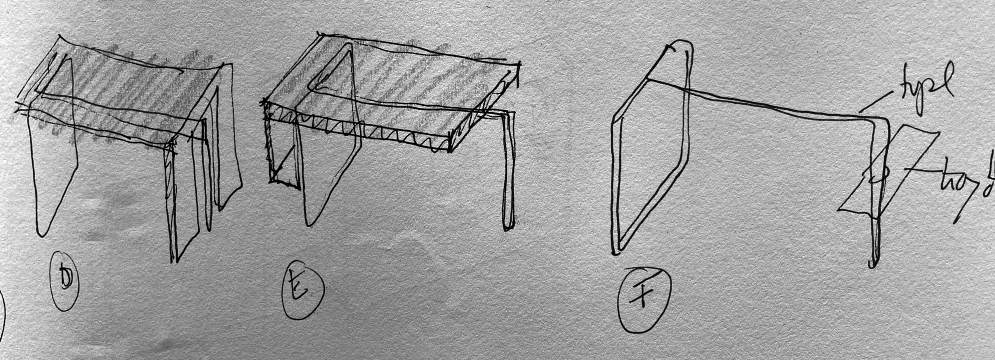
Starting with a hybrid structure, the proposed tubular chrome and the thick wooden desktop were integrated. An interesting proposal that eventually illustrated (in a clumsy manner) the lack of hierarchy in terms of primary and secondary structure. In my first sketches, the overall structure relied on both tubular chrome and the desk’s surface, which folded down to become a continuous leg (Image 3). It took three iterations to realize that the syntax of the structure and the desktop were in competition, thus they had to be clarified. Note, that in each of these first three iterative sketches, the tubular chrome structure attempts to find its supportive structural logic (Image 3- A, B, and C).
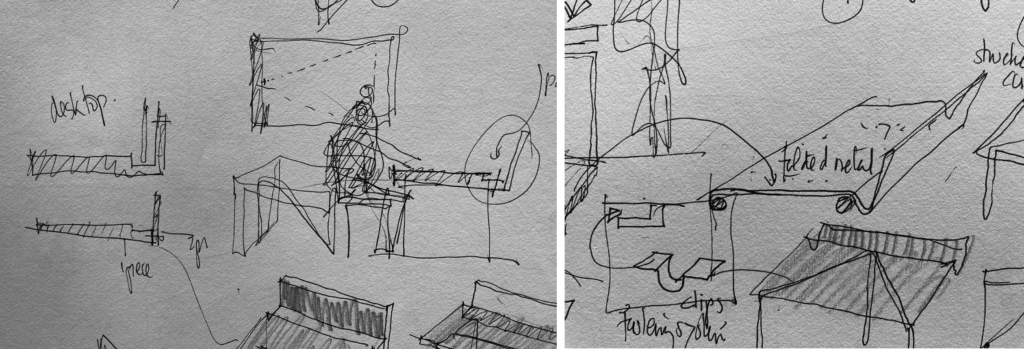
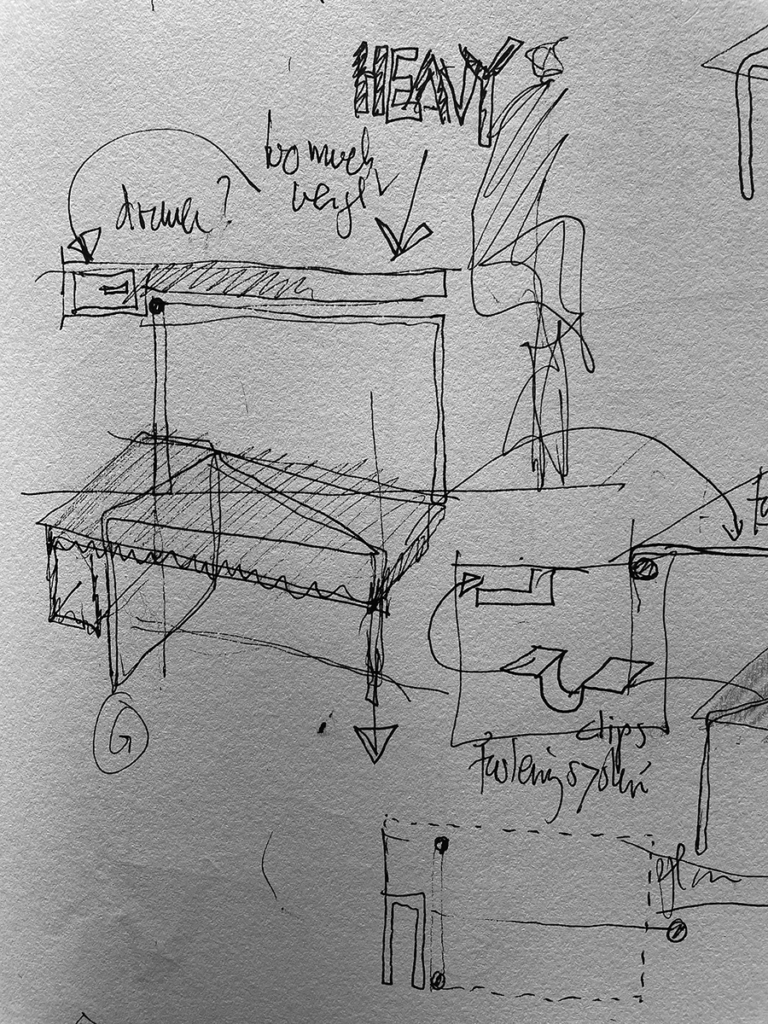
Added to this search for a clear structural expression, came the desire to give the writing desk a particular identity. Therefore, I devised a channel at the front of the desk so that stationary and envelopes could be incorporated as they were waiting to be scribbled on (Image 4 left). That little design touch expanded to become, after several iterations, a drawer on the side of the table, but was quickly discarded as being too heavy and cumbersome for the simple and elegant expression that I was seeking (Image 5, E).
As shown on the right side of image 4, I then questioned my initial assumption of using wood (Baltic birch) for the actual material of the desktop, and introduced a glass top, thus revealing through transparency the precise joinery as an aesthetic component. As my thoughts advanced, after leaving both glass, frosted glass, and my initial inclination for wood, I ended up with a more revolutionary approach by suggesting a floating stainless steel top. Wow, was I contemporary!
However, I quickly found that this proposal was in direct competition with the chrome, thus making the desk sterile and cold visually; especially since I was denying the sense of coziness and warmth that I associated with letter writing. Had I continued with my research on the desktop’s materiality, perhaps I would have ventured into a 3D-milled desktop, lending a contemporary approach to the modernist chrome structural system that seemed to have never been questioned throughout each iterative sketch.
As I translated ideas onto paper there were happy mistakes, and each sketch provoked me to draw another that either capitalized on the previous one, corrected perceived mistakes or misinterpretations, or even better, led me to take advantage of the discrepancies between my mind and my hand, thus bringing me into unknown terrain of investigation.
This design tension was and remains for me so rewarding when I sketch in an iterative manner. This process allows me to not only let the drawing dictate the next moves, but perhaps most importantly, as a designer, allows constant reassessing as I challenge myself through sketching; incorporating thinking, learning, reasoning, remembering, and projecting. Something that an AI generated images cannot do!
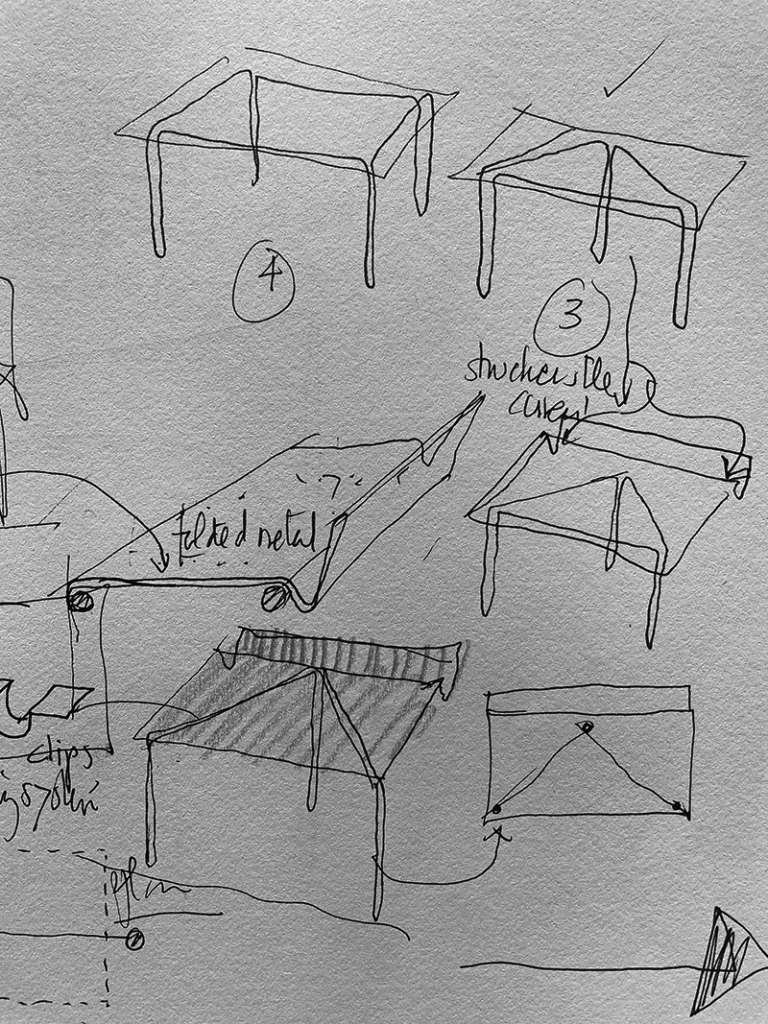
As the iterative process advances, constant re-assessment of the structural chrome frame never lost its momentum. In particular, the desire to find the correct number of legs —between three or four —both as an aesthetic pursuit and an economy of means in term of structure. Finally, I recognized that in this dual pursuit (aesthetic and structural) in the last sketched I was revisiting an interest in giving an orientation to the desk from the user’s perspective, thus several more iterations were to come.
Because I am always interested in translating my thoughts to how student’s learn and wondering how they imagine taking sketch to model and vice versa, I am in the process of creating rough study models of some of the iterative sketches. So now I am, of course, sketching in an iterative way in model! More to come.