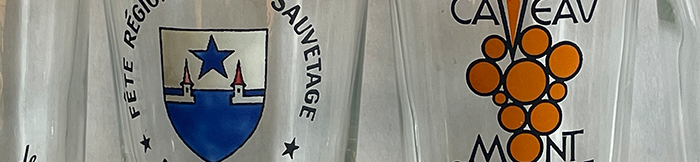
Swiss white wine glasses. There are myriad vessels from which we are accustomed to taste the elixirs of the gods or savor sophisticated cocktails. If one enjoys even the slightest sophistication in life you know that glasses can be categorized by shape, size, and intended use.
There is a world apart between wine glasses (even Swiss white wine glasses), beer glasses, and cocktail glasses as each vessel emphasizes the vessel’s role in enhancing the drinking experience.
For Master Sommeliers, their expertise in understanding the distinctions between the various glasses is critical, as not only does their rigorous training give them knowledge in oenology to pair wine with food, but they also have the responsibility towards patrons to serve wine in the appropriate glass in order to enhance a nuanced tasting experience. Enjoying wine is often accompanied by an exquisite meal, impeccable service, and a hefty price tag if you choose to visit a Michelin Starred restaurant.
One a more mundane level in the world of glasses, I would like to introduce a particular wine glass that is dear to me from my early adulthood in Switzerland. Integral to the French speaking regions (cantons Romand)—and well known within the canton of Vaud—one finds an iconic small white wine glass that has for decades been part of the tradition of their white wine culture.
Wine glasses

This wine glass is stemless and small enough to easily be held between two fingers. Measuring 3 1/2 inches tall by 2 inches wide, the glass holds 7cl white wine (0.7dl, equivalent to 2.37 fluid ounces). Of note, regarding the size of the glass, I understand that its origins can be traced back to the 19th century, where vintners in the Canton of Vaud initially used these small glasses to sample their wine.
Beyond the particularity of the size and unique shape, the quantity of wine held in the glass is not substantial. You might think it was designed to avoid rapid inebriation, but the benefit is that the wine stays cold and fresh longer. In the United States, typical stem glasses (for white and red wine) are designed for a 6 to 9 ounce pour and often, to my disappointment, the last sip is no longer cool. Of course. the waiter has already asked if you care for another, promptly removing the one in front of you containing the warm last sip.
Having such small glass sizes in Switzerland does not suggest that you will be left high and dry during your meal. A carafe is in order; thus, patrons can serve themselves small portions at leisure, always keeping the wine cool and pleasurable.
Colloquialism in ordering wine
In Switzerland, there are a number of colloquial names used when ordering wine. In the German speaking part (Bern in particular), funny descriptions of wine quantities are found. Order a “Tschumpeli” which means a “simple-minded female person” to get 1 dl; a “Zweierli” or a “Römer” to get 2 dl; or a “Halbeli” meaning 5dl (half a liter). In the Romandie region a “ballon de rouge” is 1 dl which is always directly served in a glass. Larger quantities such as 2, 3, or 5 dl (a “pot de rouge”) are always served in a jug or carafe. Within the complex vernacular world of various nomenclatures, the actual “official” white wine glass in the canton of Vaud is the topic of this blog.
The typical small white wine glasses are usually found in a carnotzet setting; a homey setting that is cozy, intimate, and rustic (the furniture), often small in size. It is also a place where homeowners might have their own wine cellars. Traditionally used as a gathering place for friends the 19th century, the term carnotzet is mostly used in French speaking parts of Switzerland. For many locals, the carnotzet conjures fond memories of friendship, vigorus political and cultural discussions, and, of course, local wine tastings around a Jass or Belote card game.
Enjoying wine is often accompanied by cheese (perhaps Gruyeres or Vacherin), a variety of meats (salami, cured meats including prosciutto which reflect the other regional culinary delicacies of Switzerland), fresh bread, mustard, gherkins, and cocktail onions. Of note, Swiss white wine does not age well and should be enjoyed shortly after being bottled.
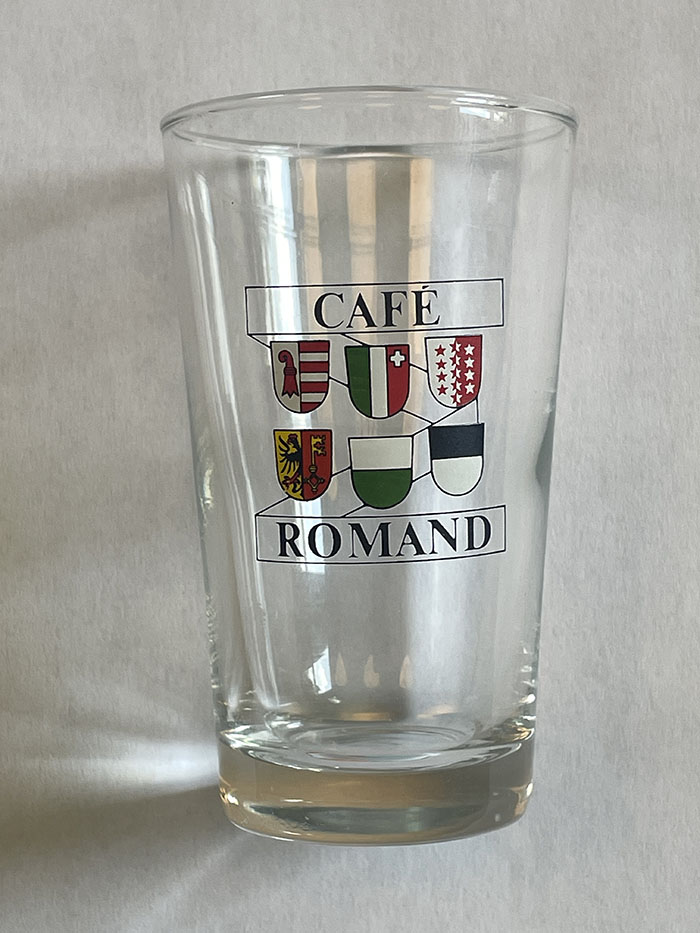
As I hold in my hand a glass celebrating the 30th anniversary of the famous Café Romand, a local brasserie in Lausanne, the cool touch conjures for me, as for many locals, fond memories of friendship, old fashioned ambiance, and, of course, drinking local wines alongside staple dishes such as braised pork, sautéed calf’s kidneys, tripe, choucroute, or more to my liking, a simple cheese fondue or Viennese Schnitzel. (Image 3)
Festival de la Cité
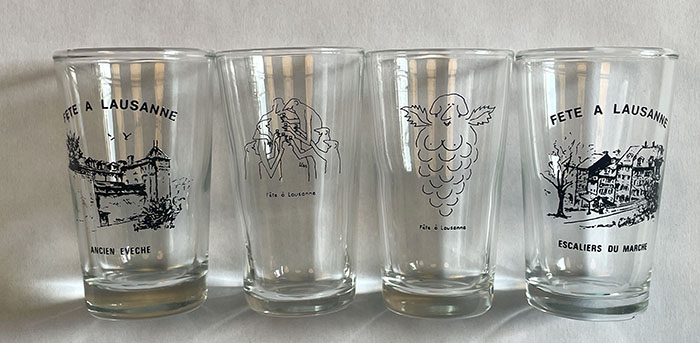
My collection of Swiss wine glasses started during my architectural studies in Lausanne. I remember purchasing my first set of glasses at the Festival de la Cité. This annual open-air event offered theatrical and musical performances, street entertainers, dance, circus acts, art installations, and food vendors staged throughout streets, gardens, and plazas. It stretched onto the esplanade in front of the well-known Gothic cathedral with its famous chestnut trees. The esplanade is a culminating place and a rite of passage for any visitor to the historic city (Cité quarter), particularly during festivities as it serves as a bookend to the castle plaza higher up the hill at the end of the main street where major performances also take place.

Although small in scale, the esplanade offers a 180 degree panoramic view overlooking the 19th century city, and at night, presents myriads little shining lights which give comfort: the city is well and alive. Further away, one admires Lac Léman (not to be confused with Lake Geneva which is the small bay of the city of Geneva) with its breathtaking background of the French Alps. Thinking of this view towards France, I am reminded of the paintings by Swiss artist Ferdinand Hodler that magically depict the lake and alps in their ever changing moods. (Image 5).
Activities at the Festival de la Cité
The Festival de la Cité is cultural moment in the life of the city and takes place every July. When night falls, the neighborhood is transformed into a medieval atmosphere. No cars, only pedestrians walking back and forth on cobblestones streets between events. The Festival de la Cité remains to this day one of the most popular events among the Lausannois. It was particularly cherished by me during my studies, as not only were programs free, but the open-air events offered a well-deserved treat away from grueling finals. Most evenings of the week-long festivities, I would meet friends and roam around enjoying performances that often surpassed each other. While we meandered through the narrow streets, we would find wine tasting stalls offering regional winegrowers a way to impress upon visitors the quality of their recent vintages.
Lausanne’s countryside extends to the east (Lavaux) and west (La Côte) and is famous for its wine and its century old architecturally terraced vineyards that were recognized in 2007 as a UNESCO World Heritage Site. This terroir produces some of the most delicate and flavorful wines in Switzerland. My favorites are hands down the crisp floral white wines with their iconic estate names: Dezaley, Epesses, Féchy, Fendant (Chasselas grapes), Lavaux, Mont-sur-Rolle, and Saint-Saphorin. Yes, all wines are exquisite with their own identity, and to keep their freshness, these white wine are served in small glasses that were sold with the purchase of wine.
Logos on the wine glasses
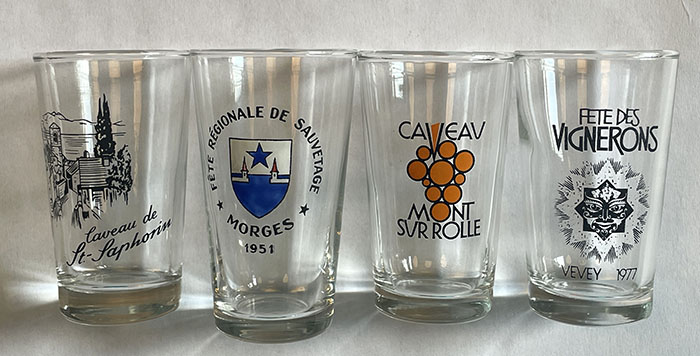
Although all winemakers are friends, they need to differentiate among each other. Thus, wine glasses are often decorated with commemorative logos showcasing the emblem of the winery. I have many of them and they are nice reminders of my time as a student. As these glasses are part of a cherished tradition of enjoying local wine, many of the glasses in my collection feature logos of small towns, football clubs, restaurants, and events such as the yearly general meeting of the Lac Leman rescue company, the National Swiss exhibition in Lausanne (1964); and of course, annual Festival de la Cité.
Conclusion
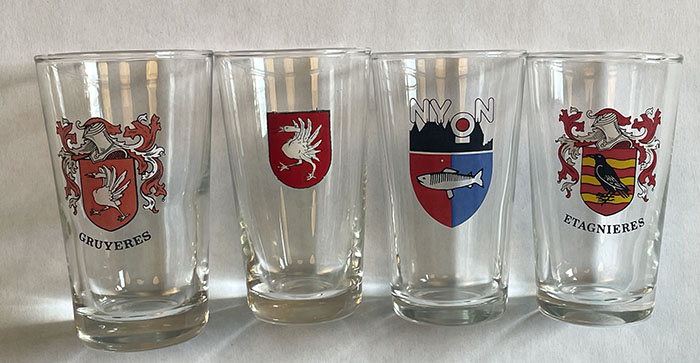
I find it interesting how a simple Swiss white wine glass can hold such cultural and personal significance. Between the typical verrée among friends, either at home or at a carnotzet, or a gathering at your neighborhood bistro, or during moments of festival, enjoying white wine has always been for me tied to those glasses. Call it regional heritage, but now that I no longer live there, I miss them dearly.
Also to my dismay, stem glasses have become more popular in the canton Vaud, leading to the declining use of the typical small wine glasses. Some would argue that a new type of ‘bowl’ wine glass allows better expression of its properties and provides a more satisfying tasting experience. I will dig in my heels and stay old fashioned to a tradition that is mine, one that remains a convivial ritual among those of my generation.
Additional blogs on design issues
- MIniature diecast airplanes
- Antique carpet stretchers
- About watches and their typefaces
- A compass set
- Harrods mid-century cocktail cabinet
- Lower deck lavatory: A340-600
- Mortician embalming cooling table
- Urban Posters in Paris, France
- Overnight sleeper train
- Post office Box Cabinet
- Secretaire a abattant
- Tri-fold mirror
- Vintage New York Postcards: Part 1
- Vintage New York Postcards: Part 2
- New York vintage traffic signals