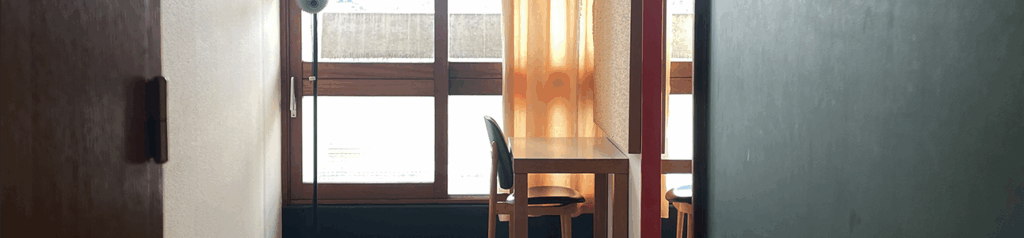
Cinematographic traveling in architecture. With the importance of translating ideas into space, thinking spatially in architecture remains a significant stumbling block for students studying architecture; especially for university juniors who are for the first time learning about fundamentals of space making.
To create architecture is to understand that people move through space, record knowingly or subconsciously what was called by Le Corbusier, a promenade architecturale. Architecture is not static and many students when designing their project—typically through analog or digital plans and sections—fail to design spaces as if they mere moving through them; at least in their first design projects. In other words, to create a dynamic and immersive visual experience when a student projects space is an attitude that needs to be learned, rehearsed, and mastered. Needless to say, today’s technologic aides—walkthroughs, flyovers, virtual reality (VR) and augmented reality (AR)—which are in their own right indispensable tools—are often used inadequately in the students’ design process. Often, they are not applied at the beginning of the research and merely serve as tools to create a wow factor.
Walls, floors, ceilings, and various openings—not to mention light, materials, details, textures, colors, and furniture to name a few aspects of design beyond the emotional and cultural components that give architecture its letters of credential—are typically seen from a bird’s eye view and are rarely designed in perspective as a sequencing of spaces from one to the other; from level to level; from inside to out and vice versa. My comments result from years of teaching students whose design thinking is still in its infancy about matters of space making, especially as they need to break out of the rut of thinking about architecture as a set of combined objects.
Purpose of this blog
This blog will explore a cinematographic technique called traveling (tracking shot or dolly shot), as a way to design a sequence within or of spaces. To illustrate my point, I will be using an example taken from a photographic survey I did at Le Corbusier’s Unité d’Habitation in Firminy, France; in particular, the left hand child’s room on the second floor of the historic show apartment.
But let me be honest. I am unsure how Le Corbusier choreographed the experience of this specific space (child’s room)—although I believe that this is how he thought of architecture given the cornucopia of interior perspective spaces he drew for each project. The series of photographs that I took might well serve as a narrative to either analyze, in this case an existing space, or assist to design one’s own built environment through cinematographic traveling. Of course, in lieu of photographs, plans and sections serve the same purpose, yet a three dimensional documentation seems more robust.
Cinematographic traveling
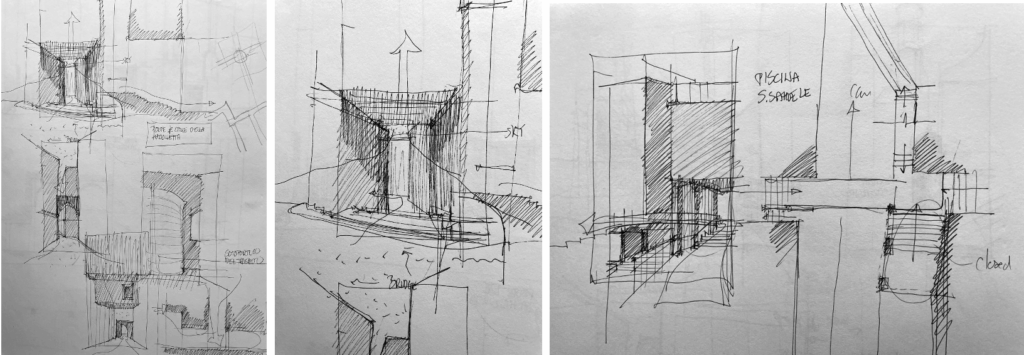
I touched upon the topic of cinematographic traveling in a previous blog titled Sketching on a field trip -Part 2 that described a personal way to sketch in an urban environment. While living in Venice, Italy, I realized that I had without thinking, became accustomed to walking through the streets of Venice in the manner that Kevin Lynch wrote about in his seminal book The Image of the City. The Serenissima had become second nature to my peregrinations—although its medieval and middle eastern morphology is complex in comparison to the typical American gridded city. I knew where and when to turn, where to follow a narrow alley, a passageway under a building which leads to a campo with a church and fountain, to finally cross a canal to enter another Parrochia.
Understanding this urban strategy of how Venice was built over and in-between thousand of islands, helped me navigate the city, but it was done with such intuition that I decided to record key moments during my journey through the streets to understand what sublime intuition made me make a turn.
Cinematographic technique in architecture
I like to draw a parallel between experiencing architecture and a cinematographic technique of traveling (or tracking shot), where the camera physically moves alongside a subject, object, or anything of interest to describe a scene. Often, when students recognize that peripheral excursions with other art discipline can benefit their design thinking, they come to slowly understand how designing architecture is more than creating static objects, or worse, a static representation of space that is based solely on functional attributes.
The above thoughts assume that architecture is to be experienced by moving through space in a haptic and visual manner—one that already exists (actual building) or envisioning a space (design). This immersive approach to design obliges students to be within their space (or scene) and understand, at least for me, that any space can be sliced into a series of sectional cuts. This not only reveals particular spatial conditions, which are often called sections (vertical cuts in opposition to plans which are horizontal cuts), but initiates and controls a sequence of events that unfolds for particular reasons.
Unité d’Habitation by Le Corbusier
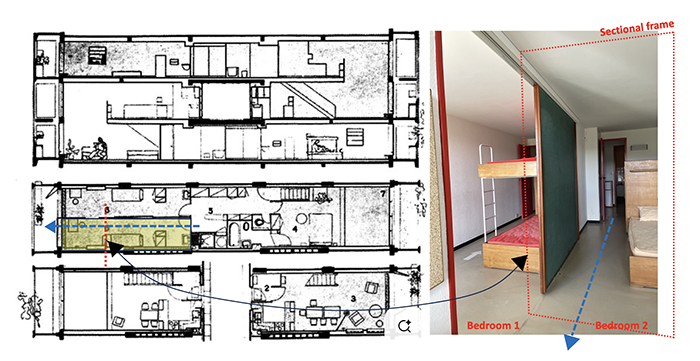
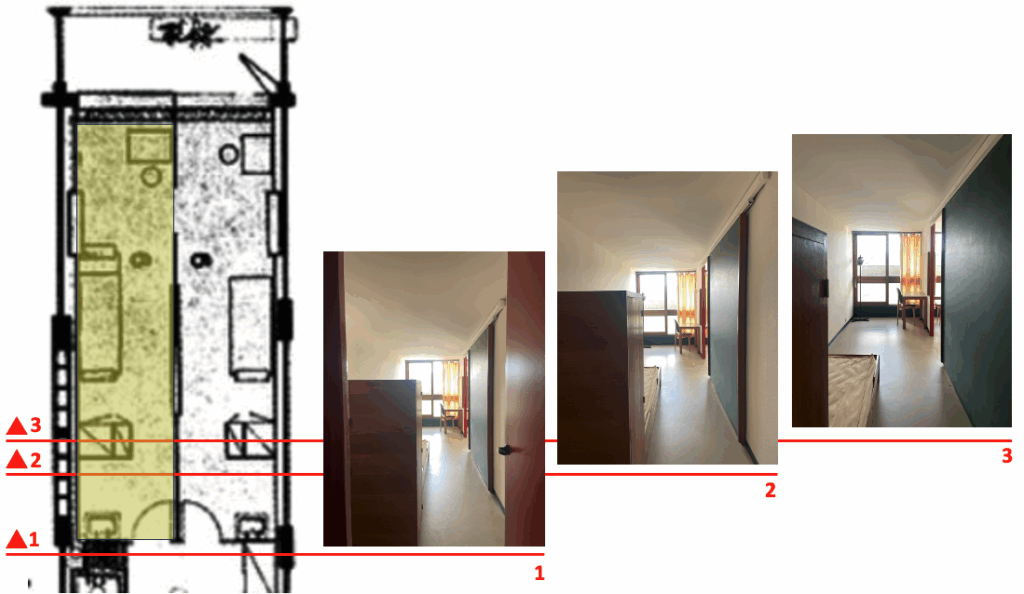
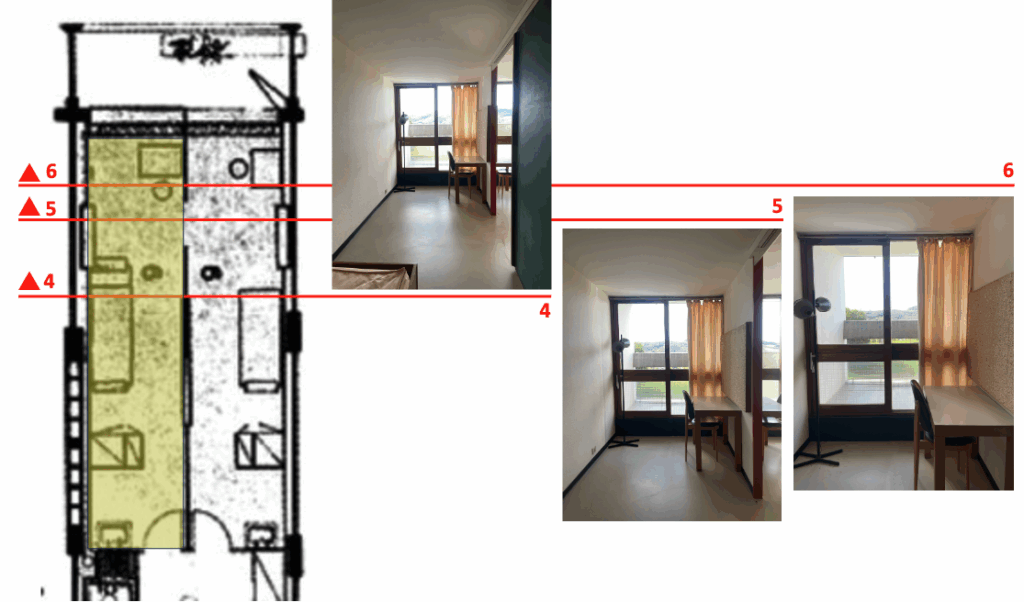
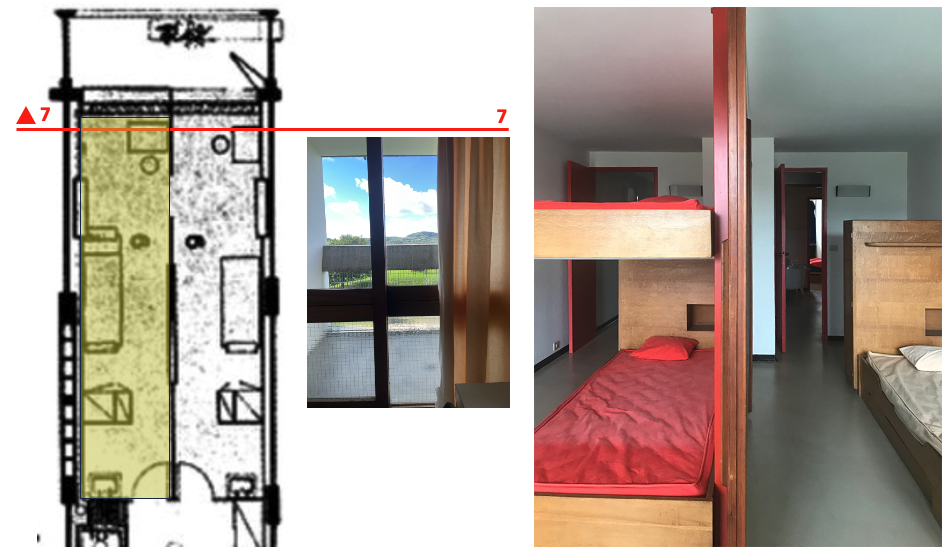
To explore how to design spatially in a cinematographic way, I documented a sequence during my last visit to Le Corbusier’s Unité d’Habitation. This photographic survey documents, in seven frames, a spatial procession through the left hand side children’s bedroom (Image 2). We all experience space through movement, and depending on one’s interest, the focus is on the interplay of specific elements: spatial layouts, circulation patterns, dimensioning, built-in furniture/storage, colors, light, textures, views, etc. The following cinematographic cuts showcase how I perceived important moments as I progressed through the room (Image 3-7).
Seven cinematographic cuts
I invite the reader to experience “my” spatial sequencing and to evaluate for themselves how their own gaze would have moved through the space (e.g., when and how did the opening to the other child’s bedroom influence your walk and give you a sense of spatial expansion-after a deliberate sense of compression). Of particular interest, I have always found that Le Corbusier plays by teasing us between horizontal spaces (here defined with the horizon of the built-in cabinet (right) and vertical elements such as the movable door (left). How one progresses through space affects the vertical experience, which always defies gravity. Note that in my photo reportage, my framing was linear, and my gaze remained constant along the ‘corridor’ leading from the door of the room to the balcony.
Conclusion
There are many ways to design, but to think spatially is a sine qua non condition to avoid static thinking in one’s own design. The above content emphasizes the experience of moving through space and the evolving perspectives it offers. It is a simple way to interact with design, projecting how the space will be perceived as one moves through it.
Postscript: story boards
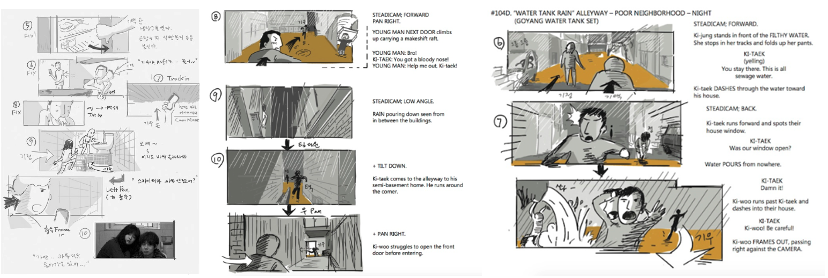
Another way, to think through the discipline of cinema is to story board, a method that can assist in creating ‘scenes’ at particular spatial moments. Be in within the narrative of any design thinking or the confrontation between spaces, the pacing and anticipation of one event leading to other event(s) through movement, designing story boards is similar to creating cinematographic sections. Story boards or sectional cuts ensure that a student ‘controls’ the sequencing of events and space(s), the changing perspectives, or the framing and composition.
In other words, it is important to choreograph a series of spaces through sketches on either paper or digital medium. This approach is not new for film directors. I have a copy of the story boards for the 2019 film Parasite by South Korean director Bong Joon Ho. I found the book and sketches informative. Not only in understanding the director’s process and how he relies on his sketches for daily shoots, but as a tool that can easily be used when designing an architectural project.
With both strategies—cinematographic traveling and story boards—I am suggesting that these design approaches resonate with the concept of narrative-driven thinking for any architectural design (story telling); where the experience of space is not solely abstract or functional but evokes emotions in a human-centered approach.
Other blogs of interest
Sketching as -reflection-in action
Architectural sketching and how do I sketch
The importance of sketching for architects, Part 1
Some thoughts on sketching by hand
Sketching on a field trip, Part 1
Sketching on a field trip, Part 2
Issues about sketching, Part 1
Sketching -an iterative process, Part 2
Sketching -an iterative process, Part 1
Architectural Education: What issues does one encounter when sketching?
Question of section, Part 2
Question of section, Part 1