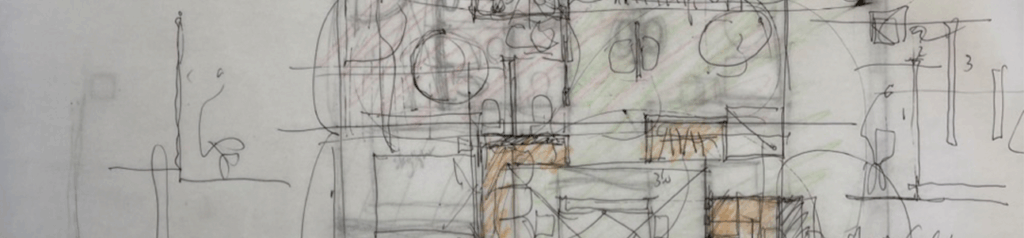
Sketching as reflection-in-action. I have had ample opportunities in previous blogs to write about teaching as a balance between theory and practice, which I do by merging various pedagogical strategies from my European and American experiences in order to trigger intellectual and professional curiosity among students.
There are multiple ways to tease students into outperforming themselves, but, for me, sketching remains one of the most powerful learning tools students can use to actively engage with their project. Sketching is an empirical drawing method that focuses on visual representation to capture ideas and explore design concepts. Sketching is often misconstrued, it is NOT about an academic drawing or the drafting of a plan, and this, for the following reasons:
Sketching as process, is fundamentally about encountering in a visual and loose way—in the moment—design questions that carry spatial uncertainties. The unique quality of sketching is how it helps resolve a design problem. And if there is a method to this particular creative endeavor, I learned that it is called “reflection-in-action.” A term developed by Donald Schön, I teach this technique to my students as a method of establishing their design process, as well as a method of discussion that works as an even exchange between faculty and student. In the best case scenario, an exchange of ideas takes the form of an equitable dialogue in order to avoid the asymmetrical faculty position where a student remains a bystander.
Strength
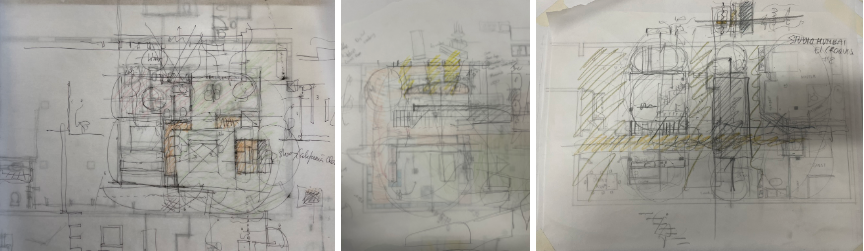
The richness of reflection-in-action is “where individuals think critically about their actions during the activity or event.” I would argue that at any stage of a project resolution, discussions between student(s) and faculty take place through desk crits or studio discussions. Here, strategic thinking needs to be done while sketching. In this manner, combining and adapting on-the-spot reflection with action, always adjusting as questions are answered and new problems appear. In this process, I persistently remind students that reflection-in-action must leverage their sketch into “talking back,” thus forming a dynamic back and forth between sketch intentions and sketch feedback. The latter allows the testing and refinement of ideas in real time.
The challenge of the process is that talking, listening, AND sketching must involve on-the-spot analysis and adjustments. This skill is not innate, but is acquired over time through multiple, and even hundreds of iterations through solving specific problems. To be successful when sketching, is to promote and abide to a context-of-doing (learn-by-doing or experiential learning which is fundamentally different than the art of making promoted by architecture schools) that relies on a spontaneous and tacit process of self-awareness of the problem at stake.
Let me be honest, this concept of design-sketching appears at first daunting for many students as it does not provide immediate “final” solutions—an attitude endemic with many students in their early design careers. Students often cannot pinpoint the essential problem or what to do when faced with a design conundrum, and thus, at an early stage typically look towards geometries and artifices to advance their project, usually without much success.
In summary
Every decision visible in a work of art bears witness to the rejection of something else.
- To look for alternatives that demand to be further explored
- To follow the implications of each gesture as they evolve over time, even if this takes one into unforeseen and perhaps unwanted directions
- To investigate multiple possibilities by testing the limits of particular directions, subjects, and compositions, all the while teasing adjacent side roads
- Probing implications is about testing alternatives that postulate the question: “What if?” This process of self-interrogation is critical in any working process, as it shows how new ideas are generated. The changes might be subtle or dramatic.
- To weigh possibilities, and examine untried solutions, pursuing and altering ideas as they emerge while sketching
- To remain curious about the suggestions that arise in the course of working. Often the difficulty is to spontaneously rethink, reprise, and reinvent on the spot. Changing, altering, exaggerating, simplifying, and conceptualizing are strategies that should engage the author in order to extract the unexhausted possibilities from a first idea. This process should end with the transformation of the sketch through what one has learned or left unexamined during the process.
- A first sketch is only the STARTING point
Conclusion
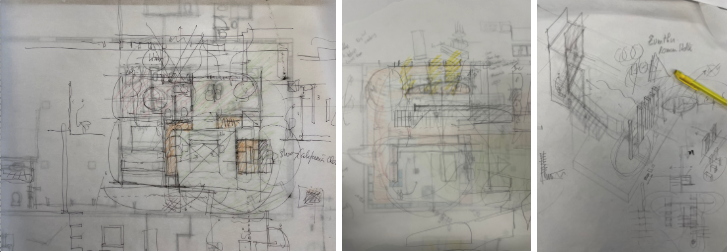
I will admit that I favor a certain dependency on this method of sketching as reflection-in-action, as it has always brought clarity, logic, and spatial iterations (sequential design thinking) to the building blocks of my own design process. In an academic setting, it has become a strong reference for student learning, as they can quickly progress by applying this technique, all the while bringing various ideations based on their own experiences (personal growth), design subjectivity, and value systems in how space needs to be brought about.
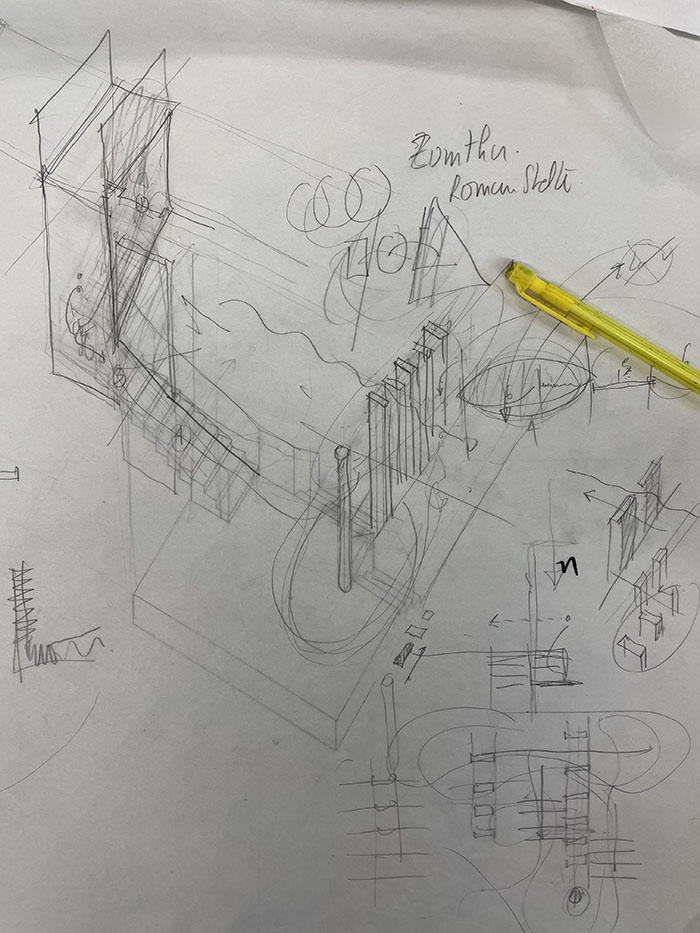
A note of caution. Reflection-in-action is ONLY acquired over time, and this, by trusting one’s instincts and as always, building on some newly gained expertise. Give it a try and you will see marvels unfold under your eyes . . . after practice.
Additional blogs of interest
Architectural sketching and how do I sketch
The importance of sketching for architects, Part 1
Some thoughts on sketching by hand
Sketching on a field trip, Part 1
Sketching on a field trip, Part 2
Issues about sketching, Part 1
Sketching -an iterative process, Part 2
Sketching -an iterative process, Part 1
Architectural Education: What issues does one encounter when sketching?
Why Model Sketching? Part 5
Why Model Sketching? Part 4
Why Model Sketching? Part 3
Why Model Sketching? Part 2
Why Model Sketching? Part 1